




Turkey-based Işılsan Plastic sees growing opportunities in Egypt’s spinning industry as new textile investments increase demand for reliable, application-specific components, according to Saylan Karinca, General Manager of the company.
In an interview with Kohan Textile Journal, during Egypt Stitch & Tex 2026 in Cairo Karinca discussed Işılsan Plastic’s yarn carriers for spinning mills, the importance of engineering polymers and material selection, the company’s in-house mould-making and customisation capabilities, and its plans to expand in Egypt and other international markets.
Saylan Karinca on Işılsan Plastic’s Yarn Carrier Portfolio
Could you briefly introduce Işılsan Plastic and explain your main product range for the textile industry?
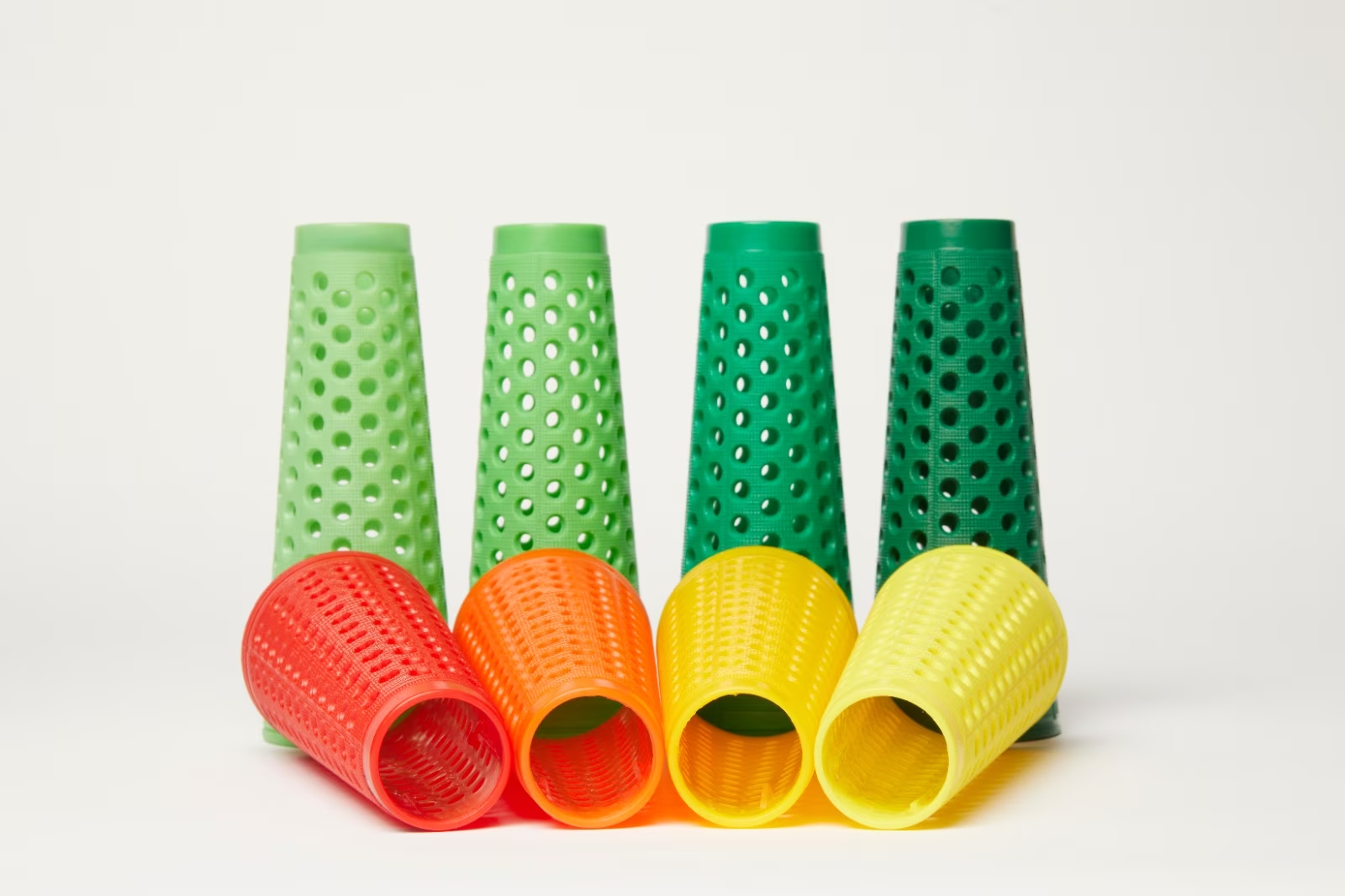
Saylan Karinca: Işılsan was founded in 1994 in Istanbul, Turkey. We are a plastic injection manufacturer specialised in yarn carriers for the textile industry. Our product range covers ring spinning tubes, roving bobbins, dye tubes and cones, compatible with the leading spinning machine brands. We design and produce everything in-house, from the mould to the finished product.
What distinguishes Işılsan Plastic’s yarn carriers and plastic textile components from competing products in terms of raw materials, precision, durability and performance?
Saylan Karinca: Our biggest strength is our deep knowledge of technical materials, combined with the manufacturing know-how needed to process them correctly. We do not simply offer standard tubes made from standard raw materials. Our first step is always to understand the customer’s real needs, and then to offer a product designed for those needs.
This matters because every market has different working conditions. Machines are run in different ways: some markets prefer very high spindle speeds, while in others the tubes must survive very tough handling and harsh conditions.
A material that performs perfectly in one market can be over-engineered, or simply not the right choice, for another. We select and test our materials for each application, so that the tube runs smoothly on the spindle, keeps its precision over time and helps the mill produce more yarn with less downtime.


Customisation and In-House Manufacturing for Spinning Mills
How do your manufacturing technology, production capacity and customisation capabilities help you meet the different requirements of yarn and textile manufacturers?
Saylan Karinca: This is exactly where our customisation capability gives us an advantage. Because we make our own moulds and master the processing of engineering polymers, we can adapt dimensions, wall thicknesses, colours and materials to each customer’s requirements, whether for cotton or synthetic yarns, high-speed spinning or demanding mill conditions.
We also work closely with machine manufacturers on new developments. Our capacity allows us to serve both large projects and smaller, customised orders with short lead times.
Read More: Why Egypt Stitch & Tex 2026 Matters for the Global Textile Industry
Egypt and North Africa Offer Growth Opportunities
How do you assess the Egyptian textile market, and what opportunities do you see for Işılsan Plastic in Egypt and the wider North African region?
Saylan Karinca: Egypt has a long cotton tradition and a strong textile base, and today the spinning industry is growing with new investments. We have been active in this market for more than a decade, and together with our local agent we offer fast communication, technical support and reliable service.


Sustainability and High-Speed Spinning Drive Future Development
Sustainability is becoming increasingly important in textile manufacturing. How is Işılsan Plastic addressing recyclability, material efficiency and waste reduction, and what are the company’s main development plans for the coming years?
Saylan Karinca: For us, sustainability starts with long product life: a tube that lasts longer means less plastic waste and fewer replacements for the mill. Choosing the right material for each market also avoids using more material than necessary.
We work to reduce material use through optimised designs and to minimise production waste in our factory.
In the coming years, our focus is on high-performance tubes for high-speed spinning, the further development of our SKS Series, and growing our presence in export markets such as Egypt, Asia, and America.


Editor’s Note
This interview was conducted by Kohan Textile Journal with Saylan Karinca of Işılsan Plastic. The discussion highlights the importance of application-specific material selection, in-house mould development and customisation in yarn carrier manufacturing, particularly as spinning mills seek higher speeds, longer component life and more reliable production.
Işılsan’s comments also reflect growing opportunities in Egypt as the country continues to invest in spinning capacity and textile manufacturing.











