




Iran, historically renowned for its rich textile heritage, is now at a pivotal moment in redefining its role in the modern global textile and apparel landscape. Despite economic hurdles and outdated machinery, Iran’s textile sector holds significant promise, particularly with concentrated efforts in industrial hubs like Isfahan.
The Strategic Role of Isfahan in Iran’s Textile Economy
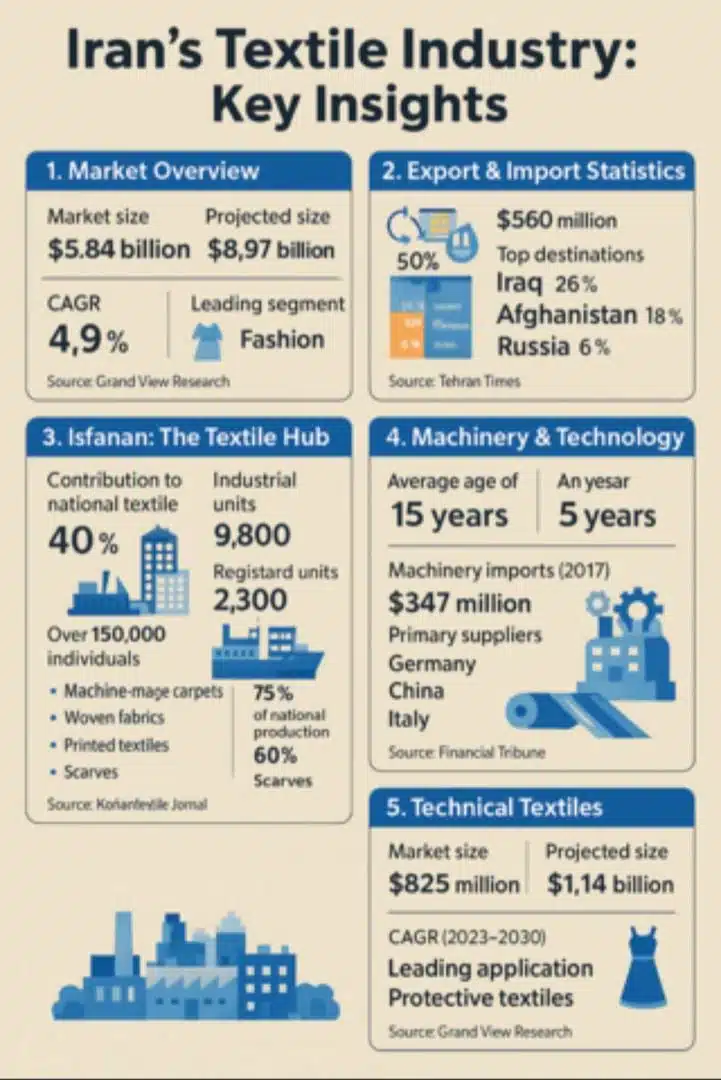
Isfahan stands as a major hub for Iran’s textile production, accounting for 40% of the country’s total industrial textile output. With over 9,800 industrial units, including 2,300 registered factories, the province is a powerhouse of both traditional and modern textile activity.
Key Contributions from Isfahan’s Textile Sector:
- 75% of machine-made carpets
- 60% of woven fabric production
- 60% of textile printing and finishing
- 90% of Iran’s domestic scarf production
- Strong exports to regional markets such as Afghanistan and Iraq
The sector also employs over 150,000 people, representing nearly one-fourth of Isfahan’s industrial workforce, highlighting its socio-economic importance.
Challenges Hindering Competitive Edge
Despite its massive output, Iran’s textile industry faces structural challenges:
Aging Machinery
The average age of textile machinery in Iran is around 15 years, compared to a global average of 5 years. This affects efficiency, productivity, and competitiveness, particularly in international markets.
Import Dependency
Iran relies heavily on imported machinery, with 60% of components sourced internationally. Bureaucratic import regulations and lack of updated technology inhibit modernization efforts.
Limited Global Market Share
According to Iran’s Scientific and Technological Deputy, the country only holds 4% of the global textile market, with $3 billion in local textile production and $500–600 million in domestic machinery manufacturing. This is significantly below potential due to sanctions and export limitations.
Unlocking Potential Through Innovation and Policy Support
To bridge the gap between potential and performance, Iran needs to invest in:
Advanced Textile Machinery and Digital Solutions
Upgrading existing equipment and fostering partnerships with international machinery makers can boost productivity and enable the industry to compete with Turkey, India, and China.
Knowledge-Based Economy and Skilled Labor
Efforts are underway to align academia with industry through dual education systems and mechatronics programs inspired by German models. These initiatives aim to produce highly skilled workers tailored for textile and machinery manufacturing.
Government Incentives for Domestic Manufacturing
Iran’s tax credit policies for R&D in machinery and textile development encourage local production and reduce dependency on foreign tech.
Opportunities for Export and Global Integration
With improved machinery, skilled labor, and strategic policies, Iran could increase its global textile machinery share from 2% to 7%, and further expand in fabric and garment exports. Removing export limitations and integrating with financial systems are crucial for achieving this growth.
Iran’s Textile Industry—A Sleeping Giant Ready to Rise
Despite significant obstacles, Iran’s textile sector remains a promising frontier. Isfahan’s dominance, coupled with national efforts to modernize machinery, train skilled labor, and boost domestic innovation, positions Iran as a potential regional leader. With strategic reforms and international collaboration, Iran could unlock billions in untapped value and reshape its textile future.











