






Trützschler and the Indian company Gimatex have a long relationship that began in 2006. Since then, they have successfully collaborated on many projects. Gimatex has used Trützschler’s IDF successfully in direct spinning. Now, they are using it to turn textile waste into valuable ring yarn.
Gimatex Industries Pvt. Ltd. has high standards for quality and sustainability. The company operates fully integrated facilities with ginning, spinning, recycling, weaving and processing units in Hinganghat, within India’s major cotton-growing region of Vidarbha. It also runs a state-of-the art fabric processing unit in Dholka, near Ahmedabad. As a family-owned company with over 125 years of history, it has a lot in common with Trützschler. Together, the two partners are working in close collaboration with the shared aim of extending that long history far into the future.
“Our clients demand consistent quality and competitive prices,” says Mr. Vineet Mohota, Director at Gimatex. “We meet those demands by always leveraging the latest technologies to boost quality, save energy and make progress for sustainability. Trützschler is a strong partner for that work.”
Lower costs and higher productivityTrützschler’s Integrated Draw Frame (IDF) technology is at the heart of this collaboration. Gimatex is using these innovative solutions to produce high-quality yarn. In particular, IDF enables Gimatex to produce top- quality yarns from a uniquely wide variety of raw materials – from 100 percent cotton through to polyester, recycled fibers and blends of various different inputs.
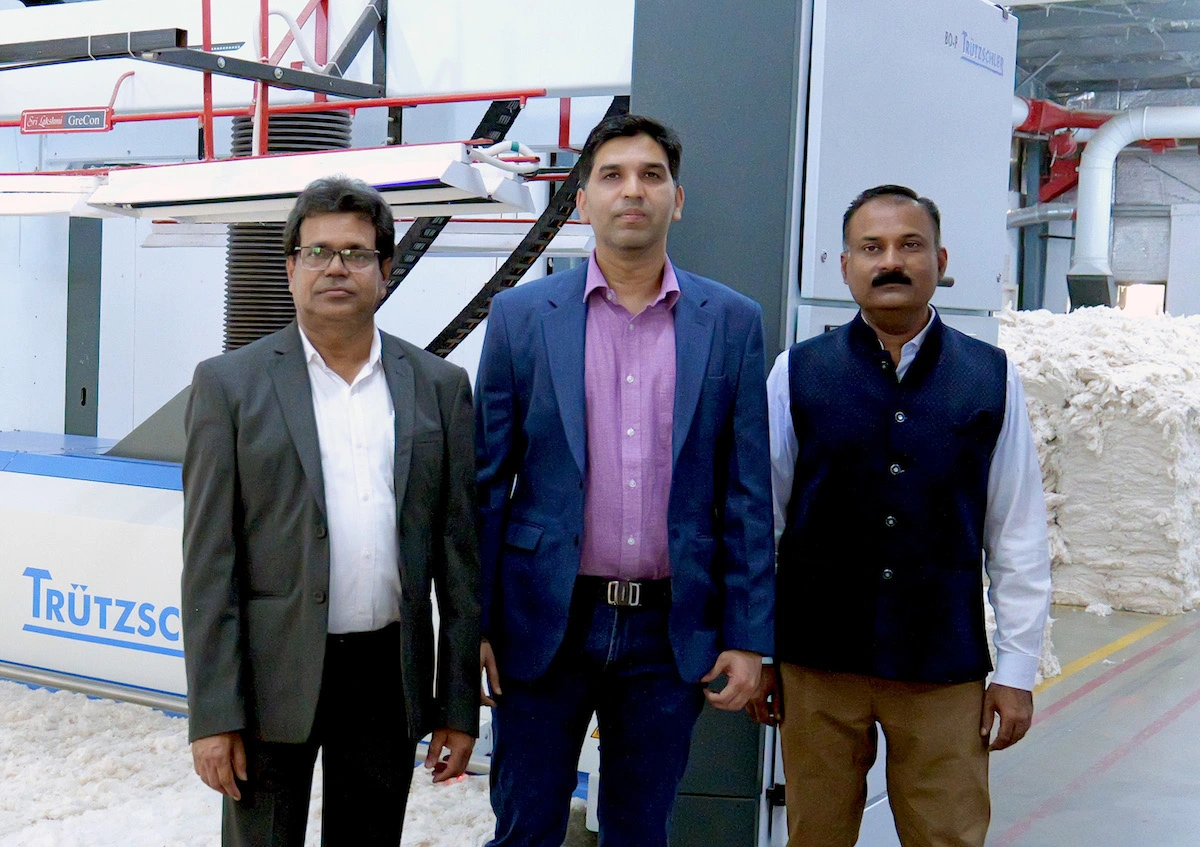
Vineet Mohota (Director Gimatex) and Manish Deolankar (General Manager Gimatex) in front of Trützschler’s Bale Opener.
Gimatex mainly uses Trützschler IDF to manufacture rotor yarns in a direct spinning process. Direct spinning means shortening the spinning process by eliminating draw frame passages. Fiber slivers are fed directly from the card into the integrated drafting passage.
This direct spinning concept uses less electricity and less space than conventional draw frame passages, which helps Gimatex to cut costs while increasing output volumes – with no compromise in quality. Most often, IDF technology is used for rotor and vortex spinning. However, the team at Gimatex is now also one of the first spinning mills in India to develop a special IDF process for producing traditional and recycled ring yarn. This allows the company to leverage the same setup it uses for open-end yarn.
The ring yarn produced in this unusual way is mostly coarser varieties and recycling blends for cotton / spandex (lycra) products, with Ne 10s and Ne 16s. The yarn goes through a blow room into a TC 15 card with IDF, before entering a Trützschler TD 10 draw frame, a speed frame and a ring frame.
Longstanding partnership
“The performance of Trützschler’s IDF machines is great,” says Mr. Mohota. “We also get support from Trützschler’s expert teams. They’re always available to give guidance and answer questions, and they’re able to access data from around the globe to share best practices for every application.” Gimatex and Trützschler have established a close relationship over a long period. IDF machines are a flexible, highly efficient and sustainable technology that is helping to extend that valuable partnership. As market conditions in India continue to evolve, we will keep working hand in hand to adapt to change successfully – while meeting high expectations from customers.











