Hasna Kourda is making fashion more sustainable – but not in the way you’re thinking
Hasna spent her whole life growing up in the North African country of Tunisia. She studied in France after high school and she has spent the last six years living in London, bridging fashion and tech, and all the while, making the industry more sustainable with her company, Save Your Wardrobe. She was just named as one of the top 100 women in fashion tech by Medium. “Our aim is to change the way we approach fashion, while also increasing sustainability,” says Hasna.
Save Your Wardrobe is a virtual version of a person’s wardrobe, with an ecosystem created around it that boast services like dry cleaning, customisation, and styling, taken from the users’ API. The company will refer the user to their local service partner, who then learns about the users’ consumption behavior.

Hasna Kourda
“My passion for fashion started when I was in primary school. I was always drawing and I tried designing clothes but it’s not my strength. I don’t do well designing clothes,” muses Hasna. “I decided to focus on the business side so when I studied in France, I went to Université Paris-Dauphine to study trade and finance, but I also learned about the importance of technology. My family and I moved from Paris to London and I thought that London would be the best place to launch a fashion career.”
“But when I arrived in London, I realised how different the lifestyle was from Tunisia. Tunisia is all about zero waste and in Europe, people were consuming in a mindless way, throwing away things that still had use. It was from this moment that a more sustainable way of living was birthed in me and I came up with this idea of using technology to optimise fashion. That’s how the company was born.”
Tech – specifically AI – has crept onto the fashion scene making us more intelligent fashion consumers. AI or artificial intelligence is an area of computer science that uses computer systems to perform tasks that humans normally perform, because human intelligence like vision, speech, and decision-making is needed. Your Uber app is AI, autopilot is AI, and spam filters are AI. We’re going to see more of it in fashion as designers are using this key piece of technology for sales and marketing purposes.
Also Read: Tunicotex Group: Where Italian Style Meets Sustainable Innovation in Knitwear
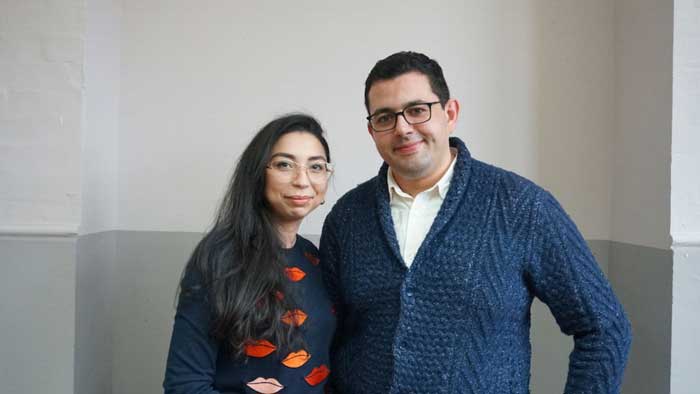
Hasna and her co-founder Mehdi
Hasna and co-founder Mehdi Doghri complement each other. “With his background and my vision, we were able to form the company,” she says. Together they are disrupting fashion and making us sustainable connoisseurs of it. “I saw a need in the market, having observed how people shopped in a previous job. I saw how shoppers were disconnected from what they already have in their wardrobes, buying the items they already had in their closets, or buying things they would never wear, only to leave the item in their closets with the tag still stuck on.”
But Hasna believes that her fellow Arab women are just the ones to lead in fashion sustainability. “Arab women are amazing with their styles and this is mainly coming from the religion [Islam] that teaches us to be clean, to take care of our looks, to be mindful of our hygiene, and to wear perfumes. It’s embedded in our culture and lifestyle, which is different from the Western way. Arab women are now learning to balance family and work, so Save Your Wardrobe can help Arab women balance their wardrobes, along with the personalised services we provide, as they lead hectic lives.”
“I just saw an article that fashion waste reached 800% compared to the 1960s, and this is not a sustainable way to do fashion. Through AI we are working to minimise that waste in fashion and the tools we are using are more advanced.”
Uploading your wardrobe to the app is instant. Once you connect with your email address, the company’s AI based technology can upload your wardrobe in less than a minute. You can also take a picture of an item instead of putting in all the details for each item, and their computer vision will automatically tag the features, like length of sleeves on a shirt.
“It’s for men and children too,” she adds. “How many of us are styling our husbands?” Hasna laughs.
“My dream is to have an impact on the environment, to reduce waste, especially in countries that are importing second hand textiles that are sold in Western flea markets, and there is a lot of waste there with clothes and fabrics that are not sold, they end up in landfills or are incinerated. The goal is to divert as much clothing away from landfills, and to encourage people to buy items that will last as long as possible.”