
Ankara fabric is recognised for its saturated colours, bold repeats and strong association with African fashion. Yet its significance extends beyond clothing. In contemporary art, the cloth has become a material for exploring identity, colonial trade, belonging and the movement of ideas between cultures.
Its history connects Indonesian batik, European industrial printing and African markets. Understanding those connections explains how a commercially manufactured textile became a powerful form of cultural expression.
What Is Ankara Fabric?
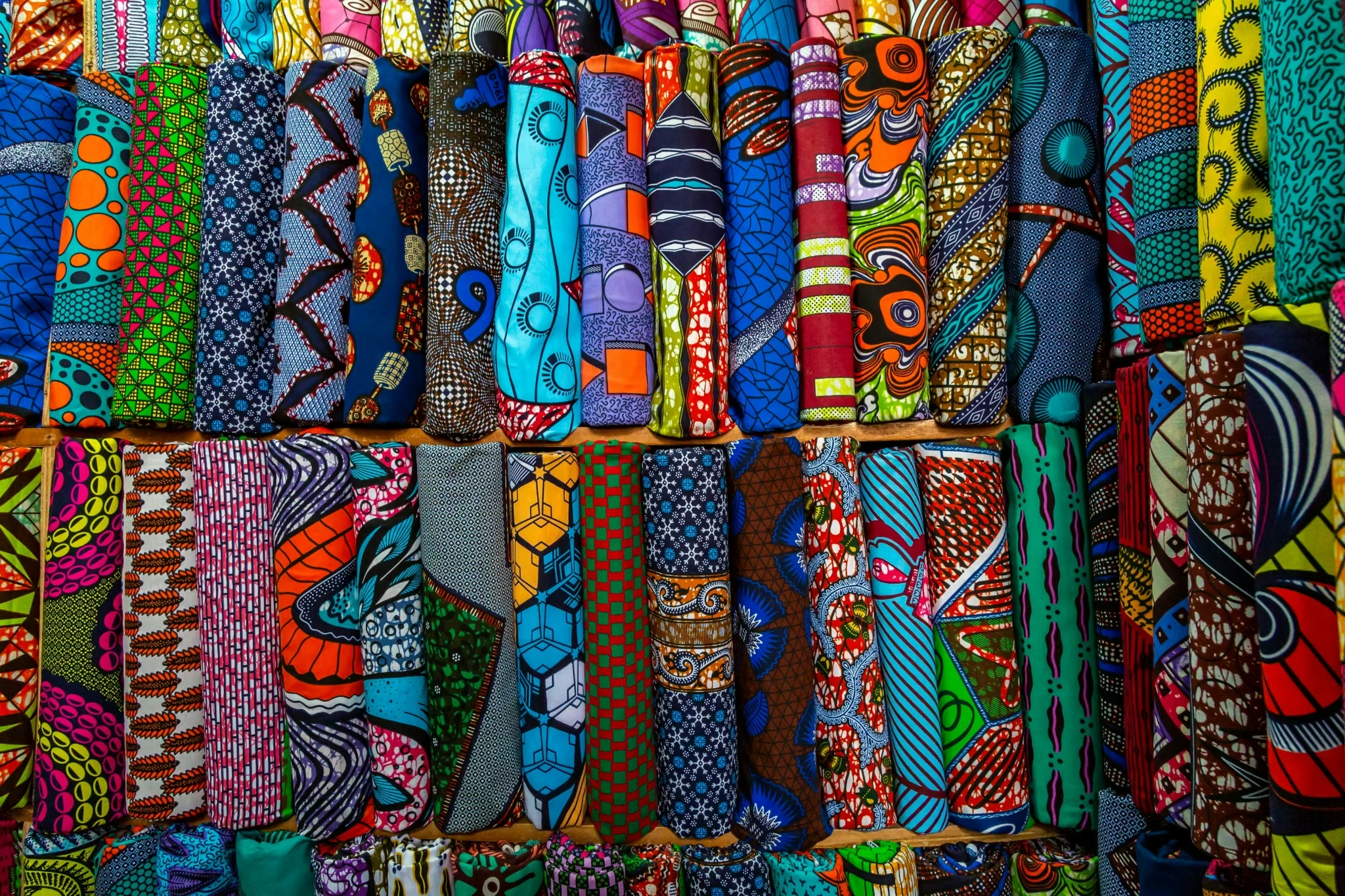
Ankara generally refers to patterned cotton cloth also known as African wax print or Dutch wax print. Its visual identity comes from the relationship between colour, repeated motifs and layered patterns, rather than a particular weaving structure.
The term should not be treated as a description of every African textile. Ankara belongs to a much broader textile landscape that includes distinct weaving, dyeing and printing traditions, each with its own history and cultural setting.
How Wax-Resist Printing Creates the Pattern
The production history of Ankara is closely connected to attempts to industrialise Indonesian batik. In batik, a resist protects selected areas of cloth from dye, allowing patterns to emerge through successive applications.
Early Dutch manufacturers mechanically applied a resin resist to both sides of fabric before dyeing. After removing the resist, further colours could be introduced through additional processing. Cracks and bubbles produced irregular effects that became associated with the cloth’s appearance.
However, the name “wax print” does not guarantee a single manufacturing method. Direct printing processes were also developed to reproduce the look, including its characteristic irregularities. Fabrics with similar designs can therefore differ in how they are produced.
A Global Manufacturing History Shaped by African Markets
European attempts to imitate batik did not achieve the intended success in Indonesia. A receptive market developed in West Africa in the late nineteenth century, encouraging manufacturers to adapt their products.
African customers and traders helped determine which colours and motifs succeeded. They were active participants in the textile’s development, influencing design choices and giving patterns local relevance. Production subsequently expanded within Africa as local businesses established competing operations.
This history makes a simple division between “European product” and “African tradition” inadequate. The fabric’s manufacturing origins are international, while its cultural significance has been shaped through African commerce, dress and everyday use.
Read More: WIFT Driving Change in African Fashion-Tech
Patterns That Communicate Social Meaning
Ankara patterns can carry messages about relationships, aspirations and community ties. Their meanings are not necessarily fixed by the manufacturer: traders and wearers have helped create names and stories around particular designs.
The same pattern may communicate different ideas in different places. A horse motif, for example, has been associated with communal identity among some Nigerian wearers and rivalry in Côte d’Ivoire. Such differences show why assigning one universal meaning to a print can be misleading.
Women textile traders have played an especially important role in connecting manufacturers with consumers. Their knowledge helped transform numbered commercial designs into recognisable fabrics with social narratives and market identities.
Ankara Fabric in Contemporary Art
British-Nigerian artist Yinka Shonibare offers a prominent example of how wax-print cloth can function as an artistic argument.
In How Does a Girl Like You Get to Be a Girl Like You? (1995), he uses Dutch wax-print cotton to create nineteenth-century Western-style costumes on mannequins. The combination brings different cultural associations into the same object, questioning how viewers identify clothing, people and history.
The material’s international journey is central to this approach. A cloth widely associated with African identity also carries the history of Indonesian techniques and European manufacturing. Its apparent familiarity becomes a way to challenge assumptions about cultural authenticity.
Shonibare also uses the material beyond costume. His work 100 Years (2000) combines emulsion and acrylic with Dutch wax-printed cotton and a painted wall. Here, a manufactured textile becomes part of the painting’s physical structure.
Across his practice, cloth connects visual appeal with questions about trade, class and identity. It demonstrates how textiles can carry an artwork’s meaning through their own production and circulation histories.
What Ankara Reveals About Textile Value
For the textile industry, Ankara illustrates how a fabric’s value develops through several connected elements: manufacturing technique, design, distribution and the meanings people attach to it.
Reading these artworks alongside the textile’s history suggests that pattern alone cannot explain its significance. The cloth matters because of who produced it, who traded it, how it was worn and how artists subsequently reinterpreted it.
Ankara’s place in contemporary art therefore offers a wider lesson: an industrially produced fabric can become both a cultural document and a medium for questioning the history that created it.