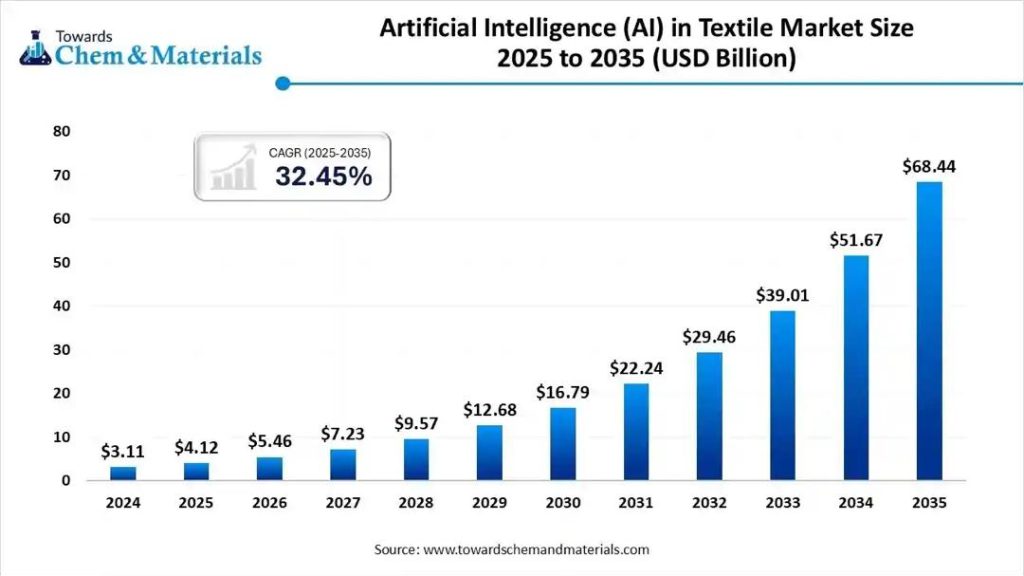
The global Artificial Intelligence (AI) in Textile Market is entering a new era of accelerated growth, with its value projected to rise from USD 4.12 billion in 2025 to USD 68.44 billion by 2035, according to new data released by Towards Chemical and Materials Consulting, a sister firm of Precedence Research. This reflects an impressive CAGR of 32.45%, making AI one of the fastest-growing innovation pillars in the textile and apparel industry.
The surge is fueled by the rapid digital transformation of textile manufacturing, rising adoption of automated quality inspection, and strong industry demand for predictive maintenance and smart production solutions.
AI Adoption Accelerates in Textile Production Worldwide
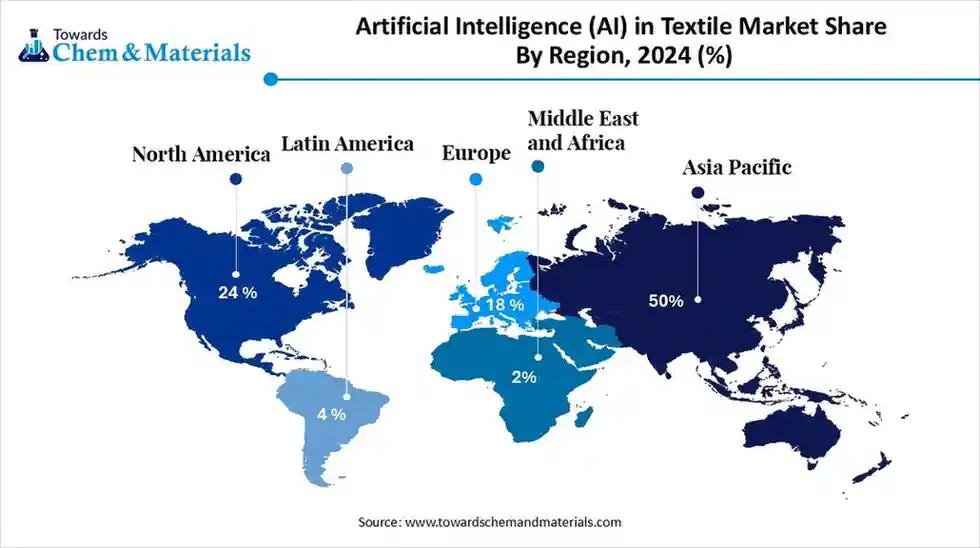
The Asia Pacific region dominated the global market in 2024 with an estimated 50% share, driven by China, India, and Bangladesh’s manufacturing strength and government-backed smart factory initiatives. North America is the fastest-growing region, expanding at a 28% CAGR, while Europe and South America are increasing their investments in smart textile technologies and sustainability-driven automation.
AI applications in textiles now extend from automated defect detection and real-time process monitoring to inventory optimization, predictive maintenance, and AI-assisted design. The technology is also enabling rapid growth in smart textiles, particularly for healthcare, sports, and military sectors.
Why AI Matters in Today’s Textile Industry
AI integration in textiles is reshaping the industry by delivering:
-
Automated Fabric Inspection
Computer vision systems can detect minute defects at high production speeds—improving accuracy and reducing waste.
-
Predictive Maintenance
AI helps mills prevent machine failures by analyzing vibration, temperature, and operational patterns, significantly reducing downtime.
-
Real-Time Optimization
AI-enabled monitoring ensures efficient energy usage, reduced chemical consumption, and optimized production workflows.
-
Better Forecasting & Customization
Brands rely on AI to predict trends, personalize designs, and improve supply-chain planning—key advantages in fast fashion and on-demand manufacturing.
Key Market Highlights
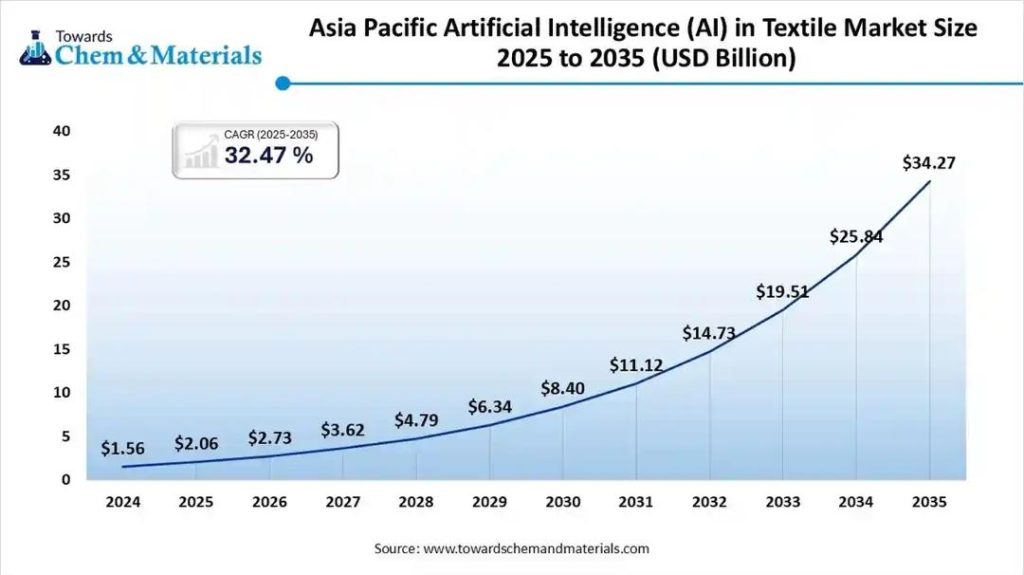
- Asia Pacific: 50% market share in 2024; projected to reach USD 34.27 billion by 2035.
- Machine Learning & Deep Learning: Largest technology segment with 38% share.
- Computer Vision: Fastest-growing technology (25% CAGR).
- Software Platforms: Leading solution category (45% share).
- Quality Inspection: Largest application segment (32% share).
- Predictive Maintenance: Fastest-growing application.
- Apparel & Fashion Manufacturing: Largest end-use sector (40% share).
- Nonwovens & Hygiene: Fastest-growing end-use (27% CAGR).
Major Companies Driving AI Integration
Leading global technology firms are reshaping the industry’s digital capabilities:
- Microsoft – Cloud-based digital transformation and production visibility tools
- IBM – Supply-chain optimization, trend forecasting, AI analytics
- Google – AI-powered material innovation and wearable tech development
- AWS – Cloud, AI, and IoT platforms for smart manufacturing
- Nvidia & Siemens – Industrial AI, robotics, and automation solutions
- SAP & Oracle – AI-driven enterprise resource and production management
- Huawei – AI hardware, edge systems, and industrial automation tools
Fashion giants adopting AI include H&M, Nike, Levi Strauss & Co., and Stitch Fix, each using predictive analytics, personalization, and AI-driven quality systems.
Private Investments Fueling AI Transformation in Textiles
- The global industry is witnessing strong private-sector investments:
- Levi Strauss & Co. uses AI-driven laser finishing to reduce water and chemical use.
- Adidas incorporates AI-powered robots for high-speed manufacturing in its “Speedfactory.”
- Smartex.ai installs AI-based fabric defect systems across Europe and Asia.
- Matoha Instrumentation develops AI-enabled infrared scanners for textile waste sorting.
- Sun Tekstil invests in Refabric, an AI-powered fashion design platform.
AI-Powered Smart Textiles: The Next Big Opportunity
One of the fastest-emerging segments is AI-integrated smart textiles, offering advanced capabilities such as:
- Health monitoring (heart rate, temperature, hydration)
- Athlete performance tracking
- Military-grade environmental and situational sensing
- Adaptive fabrics that respond to climate or movement
Growing global demand for connected wearables is pushing manufacturers to develop advanced materials embedded with AI-powered sensors and analytical systems.
Regional Market Insights
Asia Pacific
- Strongest global hub due to massive production scale and smart manufacturing adoption
- Rapid growth in China for AI-assisted design, automated inspection, and predictive maintenance
North America
- Fastest expansion, supported by high-tech innovation and investment in smart factories
- Strong demand for military-grade and healthcare smart textiles
Europe
- Driven by Industry 4.0, sustainability mandates, and advanced textile engineering
- Germany plays a leading role with USD 30.7B textile exports in 2024
South America
- Growth supported by sustainability-focused innovation and personalization demand
- Brazil remains a key market with USD 6.08B textile exports in 2024
Middle East & Africa
- Increasing investment in AI infrastructure, especially in UAE and Saudi Arabia
- Rising demand for customized textiles and predictive trend analysis
Recent Developments
- Taiwan introduced AI-driven textile technologies at ITMA ASIA + CITME 2025.
- DataBeyond (China) launched a hyperspectral AI optical sorter for textile recycling.
- Fu Hsun Fiber Industries unveiled the FabGoalie AI defect detection system at TITAS 2025.
Conclusion
The adoption of AI is rapidly transforming the global textile and apparel industry—streamlining operations, improving precision, and unlocking new opportunities in smart textiles and sustainable manufacturing. With major brands, machinery suppliers, and technology companies accelerating investment, the next decade will mark a fundamental shift from traditional production to AI-driven textile ecosystems.
Elevate your brand’s visibility across the global textile and fashion industry with Kohan Textile Journal. From Display Ads and Video Promotion to Press Releases, Event Coverage, PR & Marketing, and comprehensive Content Creation & Promotion, our media solutions help industry leaders reach the right audience with maximum impact. Discover how we can support your next campaign through Kohan Textile Journal Services or connect with key markets via Textile Industry Events.