The Hidden Reality Behind the World’s Most Demanded Luxury Fiber
An Editorial Analysis by Kohan Textile Journal
Introduction: The Fiber the Fashion Industry Cannot Stop Chasing
Few materials in the textile world carry the same emotional and commercial value as cashmere. The word itself immediately suggests softness, exclusivity, warmth, refinement, and luxury. For decades, luxury fashion houses, knitwear brands, and premium textile suppliers have used cashmere as one of the strongest symbols of high-end apparel.
Yet the real story behind cashmere is far more complicated than most consumers realize.
Its high price is not simply the result of branding or luxury positioning. The deeper reason lies in the nature of the fiber itself. Cashmere is expensive because it is extremely difficult to produce, impossible to scale efficiently, and increasingly vulnerable to environmental pressure.
In many ways, cashmere has become one of the clearest examples of the tension between luxury and industrialization in the modern textile industry.
Cashmere Is Not Produced Like Ordinary Wool
One of the biggest misconceptions among consumers is the assumption that cashmere is simply another type of wool. In reality, the production system behind cashmere is entirely different from conventional wool manufacturing.
Cashmere does not come from the outer fleece of sheep. Instead, it originates from the delicate undercoat of specific goat breeds raised in extremely cold climates such as Mongolia, Inner Mongolia in China, parts of Central Asia, Afghanistan, Iran, and Kashmir. During harsh winters, these goats naturally develop a fine insulating layer beneath their outer hair to survive freezing temperatures.
This fine undercoat is the true source of cashmere.
Unlike industrial fibers that can be produced continuously, cashmere is only available during a short natural molting season each year. Once temperatures rise in spring, goats begin shedding the soft underlayer that protected them during winter. Only then can the fiber be collected.
This biological limitation is critical. Cashmere production is controlled by nature, not by industrial demand.
| Advantages of Cashmere | Disadvantages of Cashmere |
|---|---|
| Exceptionally soft and comfortable against the skin | High price due to limited annual fiber yield |
| Lightweight while offering excellent warmth | Requires delicate care and proper washing |
| Natural, breathable and suitable for premium knitwear | Lower-quality cashmere can pill quickly |
| Strong luxury appeal and high market value | Supply chain can be difficult to trace and control |
| Excellent insulation in cold climates | Large-scale production may contribute to overgrazing and land degradation |
Why the Global Supply of Cashmere Is Naturally Limited
The economics of cashmere begin with one very simple reality: each animal produces an extremely small amount of usable fiber.
A single cashmere goat generally yields only a small quantity of fine undercoat annually. After cleaning and processing, the amount of premium-quality fiber becomes even smaller. In practical terms, multiple goats are often required to produce enough fiber for a single sweater.
This immediately creates one of the industry’s biggest structural problems. Unlike cotton or synthetic fibers, cashmere production cannot be rapidly expanded through industrial efficiency alone. The only way to significantly increase supply is to increase goat populations.
And this is precisely where many of the industry’s current problems began.
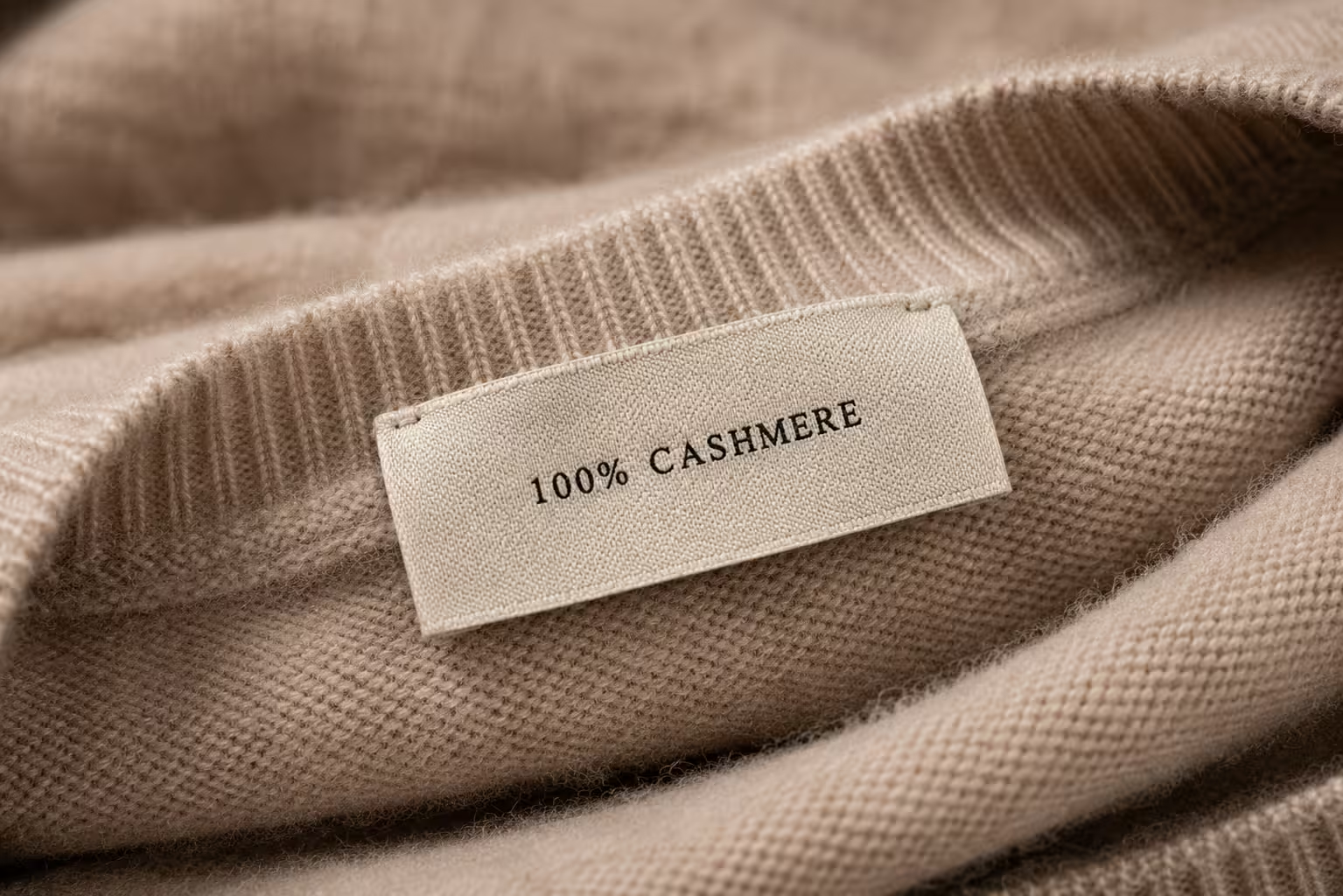
The Luxury Industry Tried to Turn Cashmere Into a Mass Product
For many years, cashmere remained relatively exclusive. It was associated primarily with luxury tailoring, premium knitwear, and limited production collections. However, as global fashion consumption accelerated and luxury branding became more mainstream, international demand for cashmere expanded dramatically.
Suddenly, cashmere was no longer limited to luxury boutiques. Major fashion retailers and global apparel chains started introducing affordable cashmere products into mass-market collections.
The industry responded by expanding goat herding across major production regions, especially Mongolia and China. At first glance, this appeared to be a successful commercial strategy. More goats meant more raw material, larger production volumes, and broader global availability.
But the long-term consequences gradually became impossible to ignore.
The Environmental Cost Behind Cheap Cashmere
The modern cashmere industry faces an environmental challenge that is becoming increasingly serious.
Cashmere goats are highly aggressive grazers. Unlike some other livestock species, they often pull vegetation directly from the roots while feeding. As herd populations increased to satisfy international demand, fragile grassland ecosystems in Mongolia and northern China began experiencing severe pressure.
Large-scale overgrazing contributed to land degradation, declining vegetation recovery, soil erosion, and desertification in several regions. Some experts now view parts of the cashmere supply chain as environmentally unsustainable under current production models.
This created one of the greatest ironies in modern textiles.
Cashmere became globally valuable because it was naturally rare. Yet the attempt to transform it into a mass-market product started damaging the very ecosystems that make its production possible.
In other words, the industry tried to industrialize a fiber that was never designed by nature for industrial-scale expansion.
The Hidden Problem of Quality Inconsistency
Another major issue within the global cashmere market is quality inconsistency.
Many consumers assume that all cashmere products offer similar softness and durability. In reality, there are enormous differences between high-grade and low-grade cashmere fibers.
The quality of cashmere depends on multiple factors, including climate conditions, animal health, grazing quality, fiber length, fineness, and processing standards. As production volumes increased, maintaining consistency became increasingly difficult.
Some fibers remain exceptionally soft, durable, and luxurious. Others are shorter, weaker, and more vulnerable to pilling after limited use. However, these differences are often difficult for ordinary consumers to identify visually inside retail environments.
As a result, two garments labeled as “cashmere” may perform completely differently over time even if they appear similar at first glance.
This inconsistency has become one of the biggest hidden issues in the modern luxury textile market.
Why Cashmere Processing Is So Difficult
The complexity of cashmere extends far beyond fiber collection.
Once the raw material is gathered, it must go through a highly delicate processing journey. Coarse outer hairs must be removed carefully. Fibers must be sorted according to fineness and length. Spinning requires precision because fine fibers can easily break during processing.
Every stage affects the final quality of the product.
Producing premium cashmere yarn is not simply about softness; it is about maintaining structural integrity while preserving the natural characteristics of the fiber. This requires technical expertise, specialized machinery, and extremely controlled processing conditions.
The softer and finer the cashmere, the more difficult it becomes to process successfully.
This is one of the reasons why truly premium cashmere products remain expensive despite growing market competition.
Fast Fashion Changed Consumer Perception of Cashmere
The rise of affordable luxury has also changed how consumers perceive cashmere.
Today, many retailers promote low-cost cashmere products as accessible luxury items. While this has expanded market reach, it has also created confusion around what genuine high-quality cashmere actually is.
In many lower-priced products, manufacturers reduce costs through lower fiber grades, shorter fibers, weaker yarn structures, or blended materials. Chemical finishing processes are sometimes used to artificially improve softness during the early stages of use.
The result is a market where the word “cashmere” no longer automatically guarantees premium quality.
This shift may eventually reshape the entire industry, particularly as consumers become more informed about textile sourcing and fiber quality.
Read more : The Good Cashmere Standard® (GCS) Launched Its Third Model Farm in Inner Mongolia, China
Can Cashmere Become Sustainable?
Sustainability is now one of the central discussions surrounding cashmere production.
Luxury brands and textile suppliers are increasingly investing in traceability programs, responsible grazing systems, fiber certification initiatives, and more transparent sourcing practices. Some companies are also attempting to rebuild smaller-scale supply systems that prioritize quality over volume.
However, the challenge remains extremely complex.
The core issue is that cashmere is biologically limited by nature itself. Any attempt to dramatically expand supply will almost inevitably create pressure on ecosystems and quality stability.
This means the future of cashmere may depend not on producing more, but on producing more carefully.
The Future of Cashmere in the Global Textile Industry
The next decade may become a turning point for the cashmere sector.
As sustainability concerns grow and consumers demand greater transparency, the industry may gradually move away from aggressive volume expansion and back toward controlled premium positioning. Brands that focus on traceability, quality preservation, and environmental responsibility are likely to gain stronger long-term credibility.
At the same time, the market will probably become increasingly divided between true premium cashmere and lower-cost commercial alternatives.
This distinction will become more important as educated consumers begin questioning not only softness and price, but also origin, durability, and environmental impact.

Conclusion: The Real Reason Cashmere Costs So Much
Cashmere is expensive because almost every part of its production system is difficult.
The fiber is naturally limited. Collection depends on seasonal biological cycles. Processing requires extraordinary precision. Supply chains remain fragile and difficult to standardize. And large-scale industrial expansion creates environmental risks that are becoming harder to ignore.
Consumers are not simply paying for softness or luxury branding.
They are paying for rarity, labor intensity, processing complexity, limited supply, and one of the most fragile ecosystems in the textile industry.
The irony is that cashmere became valuable because it was rare. But the more the global industry attempted to make it common, the more unstable the entire system became.
And that contradiction may ultimately define the future of cashmere itself.
Editor’s View – Behnam Ghasemi, Editor-in-Chief of Kohan Textile Journal
“In our view, cashmere reflects one of the biggest structural contradictions in the modern textile industry. Luxury fibers are valuable precisely because they are limited, yet the global market continuously pushes them toward larger-scale industrialization.
The challenge facing the cashmere sector today is not only about pricing or supply; it is about whether the industry can preserve quality and environmental balance while continuing to satisfy growing global demand. The future winners in this market will likely be those who prioritize traceability, sustainability, and authentic quality rather than volume alone.”