By: Heidrun Patzak, Preface
Translated: Amir Helali, Kavan Chemie Soren CO.
Amir Forootan, Rifa (Richter Färberei und Ausrüstung) Südwolle Group.
Today, the textile industry needs to reconsider its choice of raw materials and production patterns more than ever—not only due to environmental pressures but also to restore the ancient bond between nature and humans. What is highlighted in this article is not merely the introduction of nettle as a fiber-bearing plant but an invitation to rethink the paths we have taken.
Nettle, once shrouded in oblivion, can now symbolize a return to simple, sustainable, and local solutions. It is hoped that this translation will engage minds with an important question: “What other forgotten resources around us await rediscovery and wise utilization?”
In the hope of a day when industry, the environment, and indigenous knowledge coexist not in conflict but in harmony.
Nettle Fibres: Ancient Plant, Future Textile
Nettle fibres have been used for the production of fabrics and textiles for thousands of years. Now they could take a new triumphal march – thanks to some initiatives and research projects.
This article is a translation of a piece published on the official website of National Geographical in German, which explores an innovative shift in the textile industry through the use of natural nettle fibers. With a scientific and eco-conscious approach, the study presents the return to plant-based fibers not merely as nostalgia but as a sustainable solution for the future of the global textile industry.
Given the significance of this article in terms of environmental sustainability, enhanced agricultural productivity, and the untapped potential of nettle in textile production, the translation has been carried out with scientific precision and adherence to specialized terminology to introduce this ecological innovation to the global community
Clothing or textiles made from boiler fibres – this sounds very new and innovative at first. The nettle is already ancient as a fibre plant: already in the Stone Age, nettle fibres are processed and in the Bronze Age, when hemp and flax are already cultivated, netting fibres are appreciated for their particularly fine and silky substances.
From the Middle Ages, the nettle turns into one of the most important suppliers of fibre in textile production, since it also grows in central and northern Europe, in contrast to cotton. After the end of the Second World War, however, the natural fibre has become increasingly important and is increasingly being replaced by cheaper cotton imports.
That could change again. The demand for natural fibres is increasing and the industry is increasingly looking for alternatives to industrially created and petroleum-based fibres. Forecasts assume that the demand for natural fibres could increase by around 300% over the next 25 years, including for nettle fibres.
A challenge for bio-based fibers? Useful land
One problem with natural fibres: The cultivation requires a lot of land. It is estimated that in France alone, an area of around 300,000 hectares is needed for bio-based fibre plants by 2035. The cultivation of fibre plants is therefore in direct competition with food production.
A team of international researchers dealt with precisely this challenge. “We looked at how nettles can be cultivated as fibrous plants on areas that would otherwise remain unused,” explains Prof. Dr.-Ing. Jörg Müssig from the University of Applied Sciences Bremen, one of the participating scientists in the.
The aim of the project was to study the cultivation of the seed on soils that are not suitable for food production or are even contaminated. In addition, the researchers looked at which life cycle sheet the nettle offers compared to conventional bast fibres such as hemp and whether new bio-based composite materials can also be produced from the versatile plants with the fold hair. The results are amazing.
A plant with potential: The large nettle
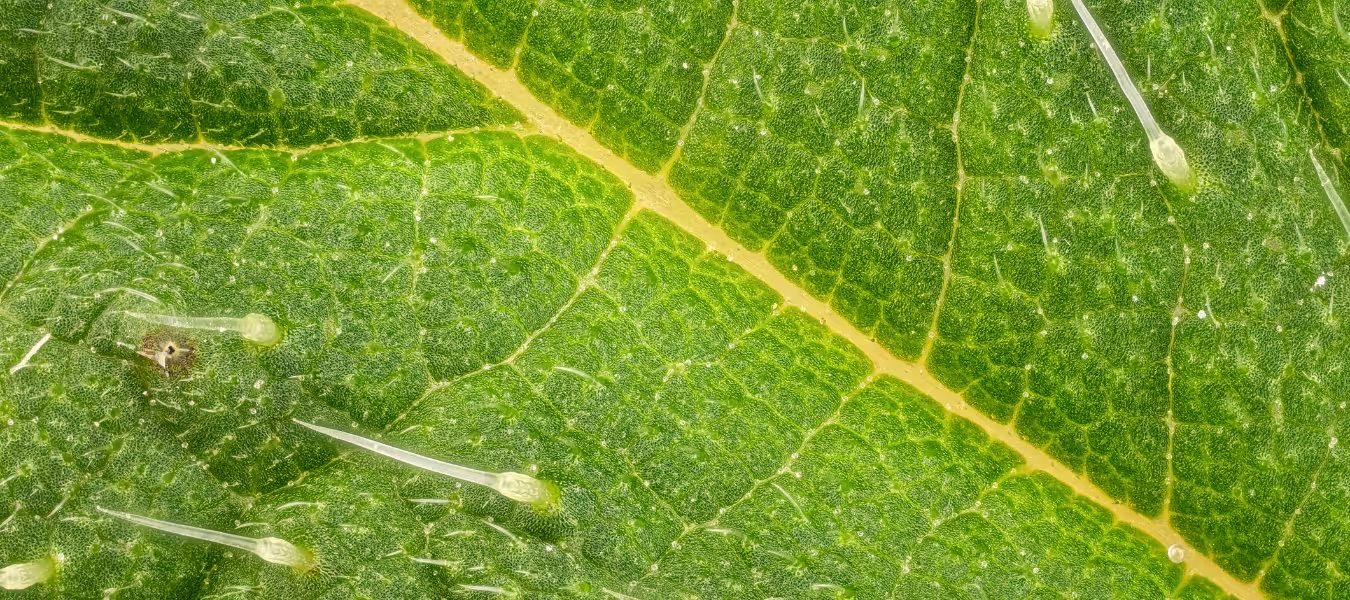
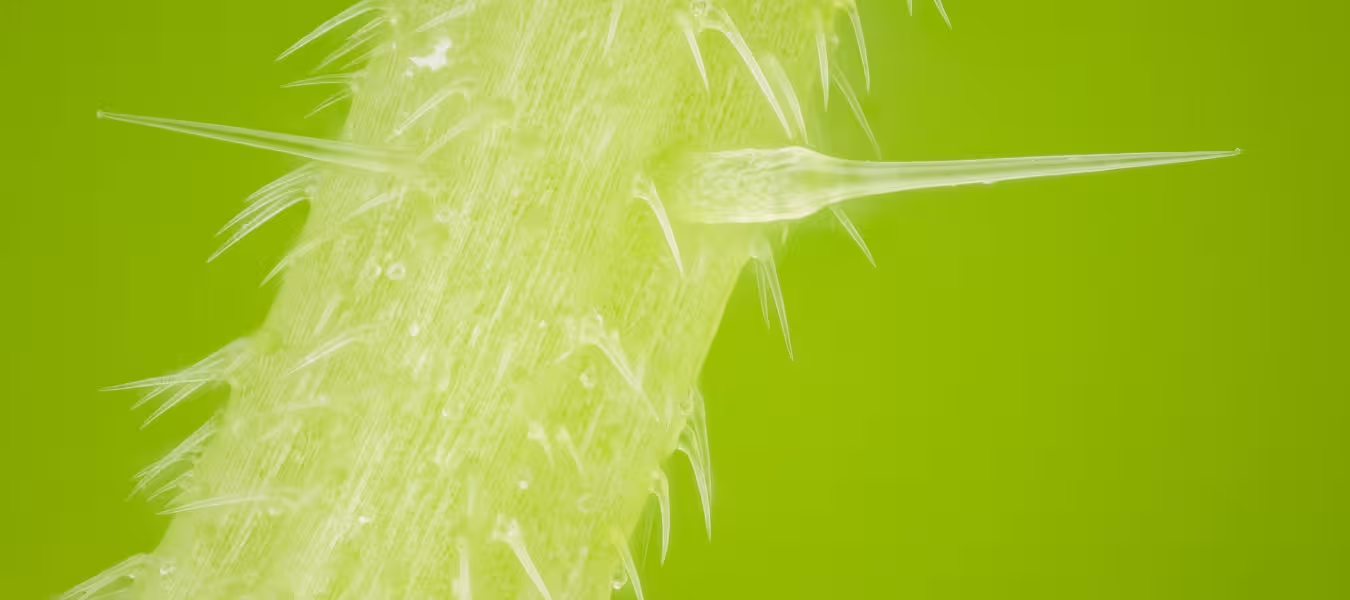
The study focused on the Large Nettle, lat. Urtica dioica L.. The perennial plant is mainly known for its healing hairs of leaves and stems, which cause an unpleasant burning and itching when touched on the skin. First and foremost, this is a self-protection measure of the plant, because the filling hair is an extremely effective defense mechanism against insects and herbivores.
The potential of this nettle as a crop is great: it is hardly susceptible to pest infestation and diseases, requires little water and grows in perennials, which means that there is little work to sowing and soil cultivation. Since it also thrives in colder climates, it can be grown in central and northern European regions.
The cultivation requires few pesticides and fertilizers, and their possibilities for use are also diverse: “Their fibres are not only suitable for textiles, but also for use in composite materials,” says Prof. Dr.-Ing. Müssig. For example, they could be used instead of optical fibers. Some investigations showed that nettle fibres are just as rigid as industrially produced glass fibres.
The superpower of the nettles: A natural pollutant filter
Nettle fibres have another decisive advantage over industrially produced or other plant-based fibres: They also grow on marginalised areas, i.e. soils that are unsuitable for agriculture. This means that one of the biggest hurdles in the cultivation of plant fibres has already been overcome, because this means that land could be used that are unsuitable for the production of food.
But not enough: since the nettle is a so-called nitrophilic plant, it can even improve soil quality, for example in soils that have too high nitrates and phosphate levels. Burning meshes help to improve soil quality and to extract pollutants from marginalised soils. This allows the nettle to play an important role in phytomanagement, i.e. the remediation of contaminated or contaminated areas with the help of plants.
A study by the University of Besancon considers the effect of nettles planted in combination with poplars in terms of soil quality and biomass. The positive effects were quickly recognizable: not only were uncovered by the planting of unused, contaminated areas again, but also more biomass could be generated. “Brennnessn not only supports soil regeneration, but also contribute to the creation of habitats for wildlife,” says Prof. Dr.-Ing. Müssig.
Nettle clones could make the cultivation more efficient
What earlier initiatives around nettle cultivation have failed were profitability and scalability. However, the research team found out, the fibres of the nettle and their yield seem to depend less on cultivation methods or environmental conditions, but of the genotype of the plant. Normally, the large nettle has only a fibre content of about 10 percent. “In addition, burnishing essences drawn from seeds are more inhomogeneous,” explains Prof. The challenges of fiber production are sweet. “They can therefore hold their own against weeds and often have a lower fibre content.”
The fibres are dissolved from the sting of nettles via a process of drying, deforestation, a mechanical and sometimes enzymatically or chemically supported digestion, and a subsequent bell operation. The fibres can then be spun into yarns.
The solution: nettle clones. “The concept of nettle clones is based on genetically identical plants, which are caused by vegetative propagation,” explains Müssig. “Since the 1920s, boiler clones have been developed by scientists such as Gustav Bredemann in order to achieve a higher fibre content for textile purposes.” A particularly successful clone is the B13 clone of the large nettle. “It was selected due to its high fibre and dry matter yields,” says Müssig. And it is impressive, because the fibre content of B13 is up to 22 percent.
A sustainable and resource-saving alternative
Since the end of the 1990s, there have been research projects throughout Europe for the nettle and even medium-sized companies have attempted the cultivation of nettles for fiber production – so far, however, there has been little interest of major investors.
“With projects such as NETFIB, which clearly demonstrates the potential of nettle fiber production on marginalised floors and the possibility of using fibres in composite materials for technical applications, this could change in the future,” hopes Prof. Dr.-Ing. Müssig. “Land use conflicts between food and non-food production can be defused by using contaminated areas for the cultivation of plants for technical products,” concludes the researcher. This makes the cultivation of nettles attractive not only for economic reasons. The use of the Big Nettle as a fiber supplier provides a promising and sustainable alternative for a more conscious use of the finite resources on our planet.