




Potting compounds made of polyurethane (PU) are traditionally used to protect and isolate electrical and electronic parts, e.g. in battery modules or as an insulating layer on circuits or for embedding LEDs. In addition to their electrically insulating properties, they are heat-resistant and mechanically flexible. Furthermore, the transition from the liquid to the solid aggregate state is so convenient that these PU compounds can applied precisely.
The Sächsisches Textilforschungsinstitut e.V. (STFI) is currently developing two applications on textiles. The first involves examining PU potting compounds as a cover layer for sensors that are used to monitor mechanical stress. The second approach is dedicated to 3D printing on pre-stressed textiles to subsequently produce three-dimensionally deformed structures.
The ongoing research project “Texsafe” (Reg. No. 49MF220096) focuses on the development of large-area textile sandwich-structured surface elements for monitoring mechanical loads. For this purpose, coating materials are required to permanently record the permittivity by changing mechanical param-eters during elastic deformation. In addition, these materials must be able to withstand high loads of up to 1000 kg non-destructively and protect the textile against mechanical damage.
Polyurethane-based potting compounds from WEVO-CHEMIE GmbH, Ostfildern-Kemnat with viscoplastic proper-ties and a high elongation at break have proven to be particularly suitable for this purpose. These requirements are fulfilled by the Wevopur products from Wevo, which have already been successfully evaluated in extensive test series. The first functional samples have been produced on a small scale, enabling the detection of mechanical loads.
The potting compound proved to be particularly suitable due to its low mixing viscosity, as the textile was well wetted or saturated. The next step is to scale up to large-area textile sandwich-structured surface elements. Applications include truck loading space detection, parking lot and floor sensors for access control and observation areas.
3D printing on textiles has already been the subject of successful developments at STFI for several years. In this context, new materials for the various 3D application processes are constantly being tested. Selected Wevopur products were also tested as part of the research project “Machine and process development for 3D printing on pre-stretched textiles” (Reg. No. KK5081706WO1).
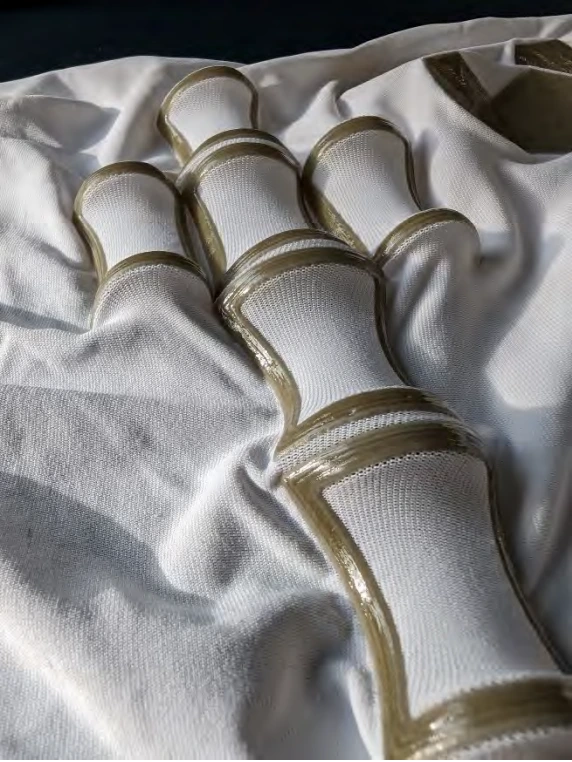
Materials with high flexural strength and SHORE hardness in the upper Shore D range were required for the selective reinforcement of pre-stretched textiles using 3D printing.
Stretchable PES knitted fabrics were stretched homogeneously and without distortion in the longitudinal and transverse directions using a newly developed tensioning system with defined forces. Following this, the textiles were printed with various geometries using 3D printing. In addition to the classic FDM process, in which thermoplastic filaments are used, the LDM process was also tested. In this process, pasty materials or liquids are used.
Products from the Wevopur series also proved to be very useful here. The materials were applied to the pre-stretched textiles using a 2-component print head. This reinforced the textiles at certain points.
After that the printed textile was relieved of pressure and defined deformations were created. This is also called “4D printing”. For example, this technology can be used to produce individual textile lampshades or acoustic panels and open further application possibilities in architecture. The customized viscosity and good adhesion of Wevo materials such as WEVOPUR 71/25 MT/3 with WEVONAT 300 ensure a good and durable bond with the textile.











