




Sapphire Textile Mills Ltd. is preparing the next phase of its rotor-spinning investment after positive operating results from its first Saurer Autocoro 11, commissioned around six months ago.
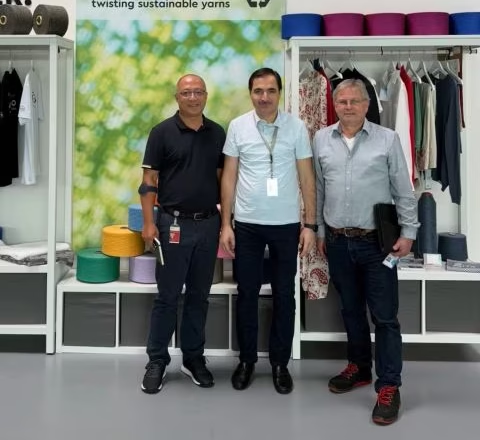
The development was discussed during a meeting in Übach-Palenberg, Germany, where Alam Zeb Burki, Technical Director at Sapphire Textile Mills Ltd., met with Saurer representatives to review the latest developments in rotor spinning and outline the next stage of Sapphire’s investment strategy.
According to Saurer, Sapphire’s management has confirmed that the investment in the first Autocoro 11 was the right strategic move, with the machine’s performance, efficiency and quality surpassing expectations. The result has strengthened Sapphire’s decision to continue expanding along this technology path.
Read More: Saurer Highlights Spinning and Twisting Solutions at NasTex 2026
Sapphire Moves Toward the Next Phase of Autocoro 11 Investment
The latest discussions indicate that the relationship between Sapphire Textile Mills and Saurer is moving beyond the initial installation phase toward further investment and technology expansion.
For Sapphire, the focus is on combining advanced rotor-spinning technology with higher production efficiency, consistent yarn quality and increasingly automated manufacturing processes.
For Saurer, the project provides another reference for the Autocoro 11 platform in a major textile-producing market such as Pakistan, where spinning mills are under growing pressure to improve productivity, energy efficiency and raw-material utilisation.
Autocoro 11 Supports Automated and Recycled-Fibre Spinning
The Autocoro 11 is Saurer’s fully automated rotor-spinning platform and has been developed for applications ranging from conventional raw materials to recycled fibre blends.
Saurer has positioned the machine around automation, energy efficiency, production flexibility and the ability to process challenging recycled fibres. Features such as Recycling Xtreme and Synchropiecing 60 are designed to support stable spinning, high productivity and improved raw-material utilisation.
The technology is particularly relevant as textile manufacturers increase the use of mechanically recycled fibres and look for ways to maintain yarn quality while controlling operating costs.
Read More: Trusted by Experts and Driven by Innovation – Autocoro 11
Sapphire Textile Mills Combines Scale with Circular Production
Founded in 1969, Sapphire Textile Mills has developed into one of Pakistan’s major vertically integrated textile manufacturers, with operations covering yarn, fabrics, home textiles, workwear and other value-added textile products.
The company’s current production profile includes approximately 54,000 tonnes of yarn per year and around 84 million metres of woven fabric annually, based on its stated monthly production capacities.
Sustainability and circularity have also become important parts of Sapphire’s manufacturing strategy. The company operates an in-house recycling facility and continues to develop recycled fibre and circular-material applications across its textile operations.
According to the Saurer LinkedIn post announcing the latest meeting, Sapphire’s mechanical recycling plant processes up to 5,000 tonnes of recycled fibres annually.
Automation and Recycling Shape Sapphire’s Technology Strategy
Sapphire’s continued investment in automated spinning technology reflects a broader shift across the textile industry, where manufacturers are increasingly evaluating machinery not only in terms of production capacity but also through energy use, labour efficiency, fibre utilisation and compatibility with recycled raw materials.
The combination of advanced spinning technology and in-house recycling capacity places these areas at the centre of Sapphire’s future manufacturing strategy.
The latest discussions in Germany suggest that the first Autocoro 11 installation is now serving as the basis for the company’s next stage of investment, with Saurer and Sapphire continuing their cooperation around rotor spinning, automation and sustainable yarn production.











