Executive summary
Textile manufacturing in the Middle East and North Africa (MENA) sits at the intersection of two constraints: (1) water-intensive wet processing (pretreatment, dyeing, washing, finishing) and (2) structural regional water scarcity and high baseline water stress.
Across MENA, “dry” subsectors such as spinning and weaving typically use comparatively little process water, while dyeing/finishing dominates freshwater demand and wastewater generation, often ranging (depending on fabric, shade depth, and machinery) from tens to hundreds of liters per kilogram of material processed.
Pollution risks concentrate in wet processing effluents: high chemical oxygen demand (COD) and biochemical oxygen demand (BOD) from sizing agents, surfactants, and organic auxiliaries; high total dissolved solids (TDS) and salinity from electrolyte salts used in reactive dyeing; persistent color; specific hazardous constituents (e.g., phenols, surfactants, some metals depending on dye/chemistry); and an emerging concern around textile microfibers/microplastics reaching waterways through wastewater pathways.
Over the last decade, several MENA countries and textile clusters have moved from “treat-and-discharge” toward higher levels of treatment and reuse where scarcity and buyer pressure align—illustrated by advanced treatment and reuse in Turkish organized industrial zones and rapid upgrades prompted by enforcement/utility pressure in Morocco.
Still, uneven enforcement, fragmented industrial structures (many SMEs), high energy costs for membranes/evaporation, and the technical difficulty of treating saline-colorful effluent remain key adoption barriers, particularly for “zero-liquid discharge” (ZLD) pathways.
This article synthesizes best-available regional evidence, highlights major data gaps, and proposes targeted actions for mills and policymakers to reduce water withdrawals, toxic loads, and compliance risk while improving resilience and market access.
Regional scope and water scarcity context
What “MENA” covers (and why definitions matter). MENA boundaries vary across institutions. A recent regional water-reuse sourcebook compiles data for 19 Arab countries in the MENA region: Algeria, Bahrain, Egypt, Iraq, Jordan, Kuwait, Lebanon, Libya, Mauritania, Morocco, Oman, Palestine, Qatar, Saudi Arabia, Sudan, Syria, Tunisia, United Arab Emirates, and Yemen. It notes that, in that publication, “MENA region” refers specifically to those 19 countries.
This article uses a pragmatic “MENA+” lens by also discussing Turkey (a major regional textile and apparel powerhouse tightly linked to EU supply chains) because water/pollution dynamics and regulatory pull (e.g., buyer requirements and export exposure) are deeply relevant to MENA textile geography.
Why water scarcity amplifies textile impacts in MENA. The World Resources Institute (WRI) finds the most water-stressed region globally is the Middle East and North Africa, and reports that 83% of the region’s population is exposed to extremely high water stress.
The World Bank has repeatedly warned that water scarcity—worsened by climate change—can suppress growth and intensify broader social and economic risks, making industrial water productivity and pollution control strategic, not optional.
For textiles, this is not abstract: wet processing often needs consistent-quality water (hardness, iron, TDS) to maintain shade reproducibility and finishing performance. When mills fall back on stressed groundwater or variable municipal supplies, quality problems rise (re-dyeing, re-washing), doubling down on water use and effluent load.
Water consumption across textile subsectors
What the evidence says today
Dry manufacturing steps are not the main water burden. Spinning and weaving do use water (humidification, cleaning, some sizing preparation), but the bulk of freshwater demand typically comes from wet processing—washing, scouring, bleaching, mercerization, dyeing, printing, and finishing—because each chemical application step is followed by rinsing/washing to remove unfixed chemicals and byproducts.
A Turkey “snapshot” with facility-level measurements. A 2024 study of 25 facilities in woven fabric dyeing-finishing (plus knitted and non-woven subsectors) reported average specific water consumption of 134 ± 58 L/kg for cotton woven fabric dyeing-finishing, 345 ± 262 L/kg for wool woven fabric dyeing-finishing, and 73 ± 15 L/kg for synthetic woven fabric dyeing-finishing; for knitted fabrics, 90 ± 16 L/kg (cotton knits) and 61 ± 9 L/kg (synthetic knits).
These values are representative of the subsector where most industrial process water is consumed (dyeing/finishing), and they align with the broader literature that wet processing is the dominant water driver.
Egypt practitioner range and process emphasis. A World Water Week (2017) industry presentation (from Egypt’s water sector context) summarizes that textile wet processing water use can range 60–400 L/kg depending on fabric and wet application, and notes that pretreatment and dyeing are major wastewater sources in the cited case.
Process-level benchmark for reactive dyeing. A widely cited process benchmark for cotton reactive dyeing is 70–150 L water per kg, illustrating why reactive cotton dyehouses can dominate a plant’s water footprint.
Comparative table of processes, water use, pollution and mitigation
The table below provides typical manufacturing-phase ranges (not cotton farming/irrigation) and links each step to dominant pollutant issues and practical mitigation levers. Where MENA-specific published data are limited, ranges are drawn from measured Turkey subsector work and cross-validated sector benchmarks; remaining gaps are noted afterward.
| Process / subsector | Typical water use intensity (manufacturing) | Dominant pollutant types / indicators | Why loads are high | Mitigation options most applicable in MENA |
| Spinning (fiber → yarn) | Low (generally minor vs. wet processing; often dominated by humidification/cleaning) | Low-strength wastewater if present; lint/fibers; cleaning chemicals (small volumes) | Mostly “dry” mechanical process; limited process water | Housekeeping, dry cleaning methods, targeted closed-loop cleaning water |
| Weaving/knitting (yarn → fabric) | Low–Medium (depends on sizing and washing) | COD/BOD from sizing (starch/PVA), surfactants; suspended solids | Desizing/scouring steps create organic load | Enzymatic desizing; counter-current washing; size recovery |
| Pretreatment (scour/bleach/mercerize) | High | High COD/BOD; high alkalinity; surfactants; TSS | Multiple washing steps to remove impurities | Low-liquor ratio machines; enzymatic scouring; heat recovery |
| Dyeing & finishing (cotton) | Very High (70–150 L/kg typical) | Color; COD/BOD; salts/TDS; pH swings | Multiple dyeing and washing cycles | Low-liquor ratio dyeing; salt reduction; water reuse (UF/RO) |
| Dyeing & finishing (wool) | Very High | COD/BOD; grease/wax residues; color | Intensive washing and degreasing | DAF + biological treatment; oxidation; reuse |
| Dyeing & finishing (synthetics) | High | Color; COD; dispersants | Requires auxiliaries and washing | Dope-dyeing; filtration; reuse systems |
| Garmenting (cut & sew) | Low | Minimal wastewater | Mostly dry processes | Focus on waste management |
| Garment washing / denim finishing | Medium–High | Indigo color; COD; surfactants | Multiple wash and finishing steps | Ozone/laser; fiber capture; water reuse |
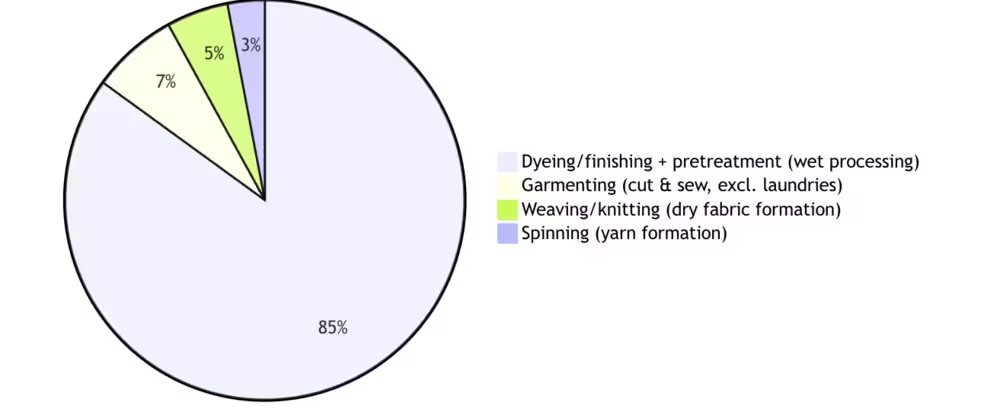
A simple indicative chart of water use by subsector
The literature consistently indicates wet processing dominates manufacturing water demand. Using representative midpoints/ranges reported for wet processing (dyeing/finishing) versus low-use “dry” steps, the following illustrative distribution shows why most water-saving ROI focuses on dyeing/finishing and pretreatment. This is not a statistically representative MENA industry census; it is a derived demonstration based on typical intensity ranges cited above.
Indicative manufacturing water-use share by subsector (derived from typical L/kg ranges)
Data gaps and assumptions. MENA-wide, publicly comparable datasets separating water use by subsector are limited; available evidence is often (a) facility studies, (b) country-cluster work (e.g., Turkey dyeing-finishing), or (c) practitioner ranges.
Where national statistical systems track industrial withdrawals, they typically do not disaggregate to textile subprocess level, and where they do, results are not standardized across countries.
Pollution profile and the drivers of high loads
Core pollutant categories and why they matter
Textile wastewater is complex because it combines high variability (by fabric, shade, machine, and batch schedule) with mixtures of organics, salts, and specialty chemicals that are difficult to treat with a single “silver bullet” process.
The most operationally important pollutant indicators in MENA textile contexts are:
- COD and BOD: Organics from desizing, surfactants, detergents, softeners, and some dye auxiliaries raise COD/BOD and can destabilize biological treatment when loads spike.
- TDS / salinity (and specific ions such as chloride/sulfate): Particularly severe in reactive cotton dyeing, where large quantities of salt are used to drive dye exhaustion—creating high-TDS effluent that is difficult for conventional biological treatment and often pushes plants toward membranes (UF/RO) if reuse is sought.
- Color (dyes and pigments): Even when COD is reduced, color can remain visible and socially/politically sensitive, driving stricter enforcement and reputational risk.
- Metals and specific toxics (context-dependent): Some studies in Tunisia found elevated metals (e.g., chromium in sampled textile dyeing effluent), raising concerns about ecotoxicity and compliance where pretreatment is weak.
- Microfibers / microplastics (emerging): Synthetic textile microfibers are recognized as a meaningful microplastic pathway to aquatic environments; improved capture requires both upstream controls (process and filtration) and effective wastewater treatment.
A “load” example: reactive dyeing salt burdens
Reactive dyeing illustrates the load problem starkly. One benchmark reports dyeing 1 kg cotton with reactive dyes requires 70–150 L water and around 0.6 kg NaCl, with effluents often heavily colored and exhibiting high BOD/COD.
A more recent formulation illustration shows how, at common liquor ratios and salt concentrations, hundreds of grams of salt per kg fabric can be discharged in spent dyebath—directly contributing to TDS loads that are hard to remove without membranes/evaporation.
Drivers specific to MENA conditions
Three region-specific drivers amplify impacts:
- Baseline scarcity and climate volatility heighten the opportunity cost of each cubic meter withdrawn and intensify conflict among municipal, agricultural, and industrial users.
- Water source mix shifts toward groundwater and, in Gulf states, desalinated water—raising both cost and vulnerability to supply disruption.
- Export-market pressure (especially for Turkey and Morocco supply chains linked to EU brands) increasingly ties commercial viability to demonstrable wastewater compliance and water stewardship, accelerating adoption of reuse and advanced treatment in high-exposure clusters.
Regulatory context and enforcement in key MENA countries
Regulation across MENA typically combines (a) environmental laws and discharge standards, (b) industrial licensing and monitoring, and (c) sanitation utility rules for discharge to sewer systems. Enforcement, however, varies materially by country, sector salience, and local institutional capacity.
Egypt. Egypt’s environmental framework requires industrial establishments to treat degradable pollutants before discharge and ties compliance to criteria/specifications set in executive regulations.
Egypt’s executive regulations also include numerical limits for discharges into marine environments (e.g., pH, BOD, COD, TDS among others), illustrating a standards-based approach to receiving-water protection.
In practice, monitoring and standards application can involve comparisons against national requirements and international benchmarks; an environmental monitoring form referencing Ministerial Decree 92/2013 (under Law 48/1982 context) shows a standards table including BOD, COD, suspended solids, oil/grease, and metals for discharge to Nile branches (as used in that project’s monitoring).
Turkey. Turkey’s textile sector faces high water risk and has been pushed toward improved water efficiency and stronger wastewater governance; a sector mapping report documented large industrial water use shares and highlighted the need for improved regulation and monitoring.
Enforcement in major industrial zones increasingly includes online monitoring and integrated treatment; for example, one major organized industrial zone operator notes remote monitoring data submission to ministry databases and describes steps taken to meet color-related discharge standards that became applicable (as stated) due to regulatory requirements.
Morocco. Morocco’s Water Law 36-15 (2016) is framed around integrated water resources management and explicitly recognizes wastewater and desalination as part of planning tools, while strengthening basin agencies and emphasizing water savings and pollution control.
A World Bank annex document also reports major progress in municipal wastewater treatment coverage—from 7% (2005) to 41% (2015)—with targets to rise further, while noting continued shortcomings (institutional framework, expertise, treatment levels, financing), including challenges from small-scale industrial activities such as textile dyeing.
Tunisia. Tunisia’s water governance is anchored in its Water Code and related decrees, with sanitation and industrial discharge oversight involving national institutions and standards.
In textile-specific research from Tunisia, the existence of wastewater emission limits and the gap between standards and real effluent quality (e.g., metals and dyes) is a recurring theme, suggesting enforcement and pretreatment adequacy remain central issues.
Jordan. Jordan’s approach includes national standards for reclaimed domestic wastewater (JS 893) managed through the national standards system and applied to discharge/reuse pathways.
Regional initiatives also focus on strengthening industrial discharge standards and regulating trade effluent to protect sewers and treatment plants.
Saudi Arabia. Saudi Arabia’s regulation includes (a) executive regulations on treated sewage water reuse and (b) environmental regulations for protection of aqueous media, including discharge standards and monitoring expectations. For treated sewage water, regulations include defined monitoring frequencies for BOD, COD, TSS, TDS, pH, fecal coliform, and metals—reflecting a compliance-through-testing model.
For treated wastewater discharge to coastal/marine waters and to land/surface waters, the Ministry of Environment framework specifies numeric standards (e.g., BOD, COD, TSS, TDS limits), indicating increasingly formalized performance requirements for treated effluent before discharge.
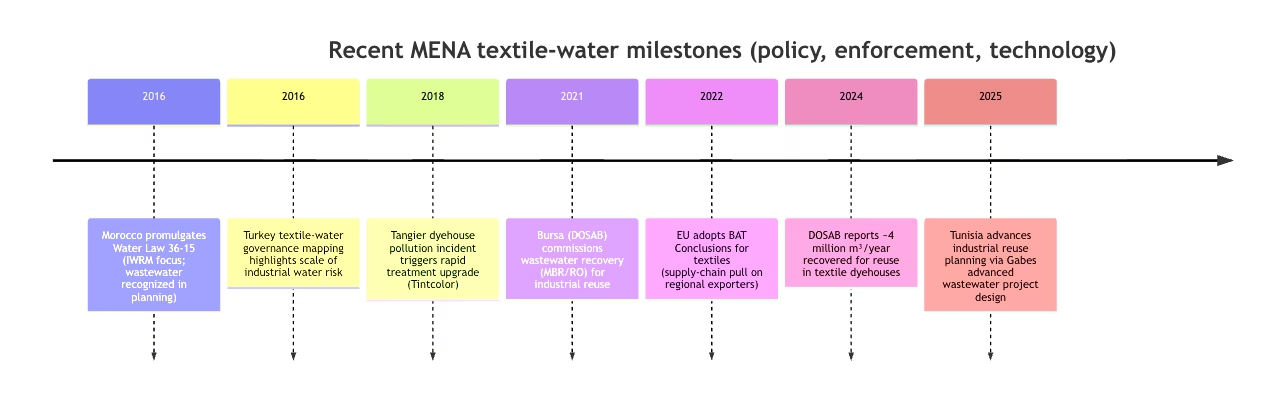
Policy and technology milestones timeline
The following milestones reflect the last decade’s “direction of travel” toward stronger governance and higher levels of treatment/reuse, anchored in documented regional examples and relevant standards/policy changes.
Case studies from the region
Bursa, Turkey: industrial-scale reuse via an organized industrial zone. In Bursa’s Demirtaş Organized Industrial Zone (DOSAB), wastewater treatment began with a plant commissioned in 2007 and has advanced toward recovery and reuse. An official DOSAB page describes an integrated system that includes advanced biological treatment, membrane bioreactor (MBR), reverse osmosis (RO) recovery, and sludge incineration, and reports that in 2022 the zone treated 15,468,004 m³ of domestic and industrial wastewater (combined across conventional and recovery facilities).
A national news report states that about 4 million m³/year of treated water is recovered and reused in textile dyehouses, with 65–70% of recovered water being sent back to factories for production use.
Taken together, DOSAB illustrates a cluster-based pathway: shared CAPEX/OPEX, standardized monitoring, and economies of scale that enable membranes and reuse where individual SMEs would struggle.
Tangier, Morocco: rapid compliance-driven upgrade in a dyehouse. A Morocco-based textile manufacturer (Tintcolor, associated with Hallotex) received an alert in 2018 tracing beach pollution to its discharges, described as up to 700 m³/day with minimal treatment. Within three months, it installed a modern biological treatment plant (reported cost €500,000) with financing support structures; the story reports that the new plant successfully treats 60% of the water, which then receives further treatment by the utility before reuse for urban landscape irrigation, and describes plans to further increase reuse, including reuse back into dyeing.
This case is instructive for enforcement dynamics: a credible threat of shutdown plus utility/financier leverage can compress adoption timelines dramatically.
Monastir, Tunisia: evidence of metals/dyes risks in real effluent. Sampling-based research on textile dyeing wastewater in Monastir (Tunisia) reported elevated levels of metals such as chromium in textile dyeing effluent, exceeding Tunisian emission limits (as discussed in the paper), underscoring that even where factories have physico-chemical treatment, residual risks can remain—especially for mixtures of dyes and metals.
For policymakers, the implication is monitoring must focus not only on BOD/COD but also on salts/metals and persistent color, with pretreatment and chemical substitution strategies to prevent “treatment dead-ends.”
Gabes, Tunisia: municipal-to-industrial reuse infrastructure as a scarcity response. A 2025 preparatory survey for an advanced wastewater treatment plant in Gabes frames the project objective as using treated sewage water as industrial water in a governorate where securing water resources is a serious issue, using membrane treatment and a stated capacity (in the summarized request table) of 6,000 m³/day.
While not textile-exclusive, such infrastructure is highly relevant to industrial clusters (including textiles) in water-scarce coastal production regions: it can shift industry away from freshwater withdrawals if pricing, quality assurance and governance align.
Egypt: wet-processing intensity and cleaner production leverage points. A case-study slide deck (World Water Week 2017; Egypt context) notes wet processing water use of 60–400 L/kg, and describes a textile mill case where water consumption is ~1000 m³/day, with pretreatment and dyeing as major wastewater sources and on-site wastewater treatment with discharge to sewer.
This highlights the practical opportunity: in many MENA settings, simple process measures (bath ratio optimization, counter-current washing, recipe control) can reduce demand before advanced treatment is even considered.
Read more: Textile cascade filter for removing microplastics from wastewater
Mitigation technologies, economic and social impacts, and actionable recommendations
Mitigation pathways that work under MENA constraints
Start with “avoid and reduce” at process level. Because wet processing dominates water use, best practice in MENA typically begins with: minimizing bath ratios, tightening recipe control, and reducing rework. Facility benchmarking in Turkey suggests large water-reduction potential remains in dyeing-finishing subsectors (with many facilities showing substantial reduction ranges against reference practices).
In cotton reactive dyeing specifically, salt reduction via cotton cationization or other low-salt techniques can cut TDS loads and reduce downstream membrane dependence, directly addressing one of the hardest-to-treat pollutant classes.
Then build “fit-for-purpose reuse” using treatment trains matched to salinity and color. Conventional biological treatment can reduce BOD/COD but struggles with high salinity and persistent dyes; increasing TDS can drastically reduce biological COD removal performance, which is why saline textile effluent often pushes systems toward hybrid trains including physical-chemical pretreatment and membranes.
In water-stressed industrial zones, integrated systems such as advanced biological + MBR + RO (as in DOSAB) show how reuse becomes feasible at scale.
ZLD and its tradeoffs. ZLD (typically RO plus evaporators/crystallizers) can eliminate liquid discharge but shifts burdens to energy use, concentrate handling, scaling/fouling risks, and chemical consumption—often challenging in MENA where energy prices and grid carbon intensity vary. These challenges become more severe where TDS loads are high (e.g., reactive dye effluent).
Policy should therefore avoid one-size-fits-all ZLD mandates and instead support tiered pathways: first reduce salt at source, then maximize reuse, then apply high-energy ZLD where justified by location and receiving-water sensitivity.
Microfibers and microplastics control. While much microfiber attention focuses on household laundering, textile production and finishing can also release microfibers. Capturing fibers requires upstream filtration and process controls plus effective treatment. Regional strategy is strengthened when wastewater upgrades are designed to capture a broader pollutant set (not only COD/BOD).
Economic and social impacts
Water scarcity is not only an environmental problem; it is an economic constraint that can limit growth and raise social tensions. The World Bank emphasizes that climate-exacerbated water scarcity can constrain growth and amplify instability unless countries improve allocation and efficiency.
At the local scale, textile wastewater pollution can undermine fisheries, coastal tourism, and public trust—illustrated by Tangier’s beach pollution tracing that forced rapid industrial remediation.
In industrial zones, credible treatment and reuse can become a competitiveness lever: DOSAB-linked reuse is explicitly framed as supporting sustainable production and benefiting firms’ positioning with global brands.
Barriers to adoption
The most persistent barriers in MENA textile manufacturing are:
- Fragmented industry structure (many SMEs) that cannot finance membranes or advanced oxidation alone, making shared infrastructure and green finance crucial.
- Weak or uneven enforcement reducing incentives for compliance investments; where enforcement and utility leverage are strong, adoption accelerates (Tangier), but without it, “race-to-the-bottom” dynamics persist.
- Technical difficulty of salinity and color removal without membranes or intensive oxidation; high TDS can degrade biological treatment performance.
- Water pricing and tariff design that may not reflect scarcity or pollution externalities; Morocco’s analysis notes financial constraints and cost-recovery issues as barriers to reuse expansion.
Actionable recommendations for industry and policymakers
For industry (mills, brands, industrial zones):
- Measure and manage by subprocess: Implement water and chemical KPIs at batch/machine level for pretreatment, dyeing, washing, and finishing; prioritize projects on the highest L/kg lines (often cotton reactive dyeing and heavy pretreatment).
- Attack salts at the source: For cotton reactive dyeing, deploy low-salt or salt-reducing chemistries (e.g., cationization approaches where feasible) to reduce TDS loads and lower the cost/energy of reuse.
- Design for reuse, not just compliance: Where scarcity is acute, target UF/RO-based reuse loops, but only after stabilizing influent quality (equalization, DAF/coagulation for color, robust biological stage).
- Use cluster models when scale is a barrier: The DOSAB case suggests shared CAPEX/OPEX and centralized technical capacity can unlock advanced treatment and reuse for hundreds of firms.
- Integrate microfiber capture: Add filtration and maintenance practices that reduce fiber shedding; ensure treatment upgrades address microfibers alongside classic parameters (COD/BOD/TDS).
For policymakers and regulators:
- Harmonize and enforce discharge standards with transparency: Standards exist across countries, but enforcement credibility is decisive. Focus on high-impact clusters and publish compliance outcomes to strengthen deterrence and public trust.
- Shift incentives toward reuse where it saves basin-level water: Pair water tariffs and permitting with reuse support, and avoid perverse incentives (e.g., cheap freshwater that makes reuse uneconomic). Morocco’s experience highlights the role of institutional capacity, cost recovery, and regulatory clarity for reuse.
- Invest in “common effluent treatment + reuse” infrastructure in textile clusters (industrial zones, export hubs), reducing the compliance burden on SMEs and enabling membrane systems at scale.
- Adopt tiered requirements rather than universal ZLD mandates: Require best available process controls first, then reuse targets, then ZLD only where receiving-water sensitivity and enforcement capacity justify it, recognizing salinity constraints.
- Link market access programs to verified performance: Export-oriented textile sectors can accelerate adoption when public programs align with buyer requirements and credible auditing, as suggested by cluster examples and EU-regulatory pull on textiles supply chains.
Bottom line: In water-stressed MENA settings, textile sustainability is fundamentally a wet-processing transformation problem. The highest-return pathway is: (1) reduce water/salt at the source, (2) treat for reuse using robust hybrid trains, (3) scale via industrial-zone infrastructure and finance, and (4) enforce standards consistently to prevent free-riding—while explicitly acknowledging and addressing data gaps through standardized reporting by subsector.