




Microplastics are now found almost everywhere, even in remote regions of Antarctica. They enter the human body through the food chain. Studies indicate that microplastics may have negative effects on the human health.
One important source of microplastic pollution is the washing of textiles made from synthetic fibers. During washing, significant amounts of microplastics are released into wastewater and then enter aquatic ecosystems. To address this problem, the German Institutes of Textile and Fiber Research Denkendorf (DITF) have developed a textile-based cascade filter system.
Textile Filters Capture Microplastics
The amount of microfibers released per wash cycle and per kilogram of textiles is estimated to range from 12 and 1,400 milligrams. Wastewater treatment plants are already able to remove a large portion of microplastic particles from wastewater, with removal rates of up to 99 percent. However, because of the high volume of wastewater discharged every day, these plants can still contribute significantly to microplastic pollution in the environment.
To date, various mechanical and chemical technologies have been used in wastewater treatment. Filter cascades, on the other hand, have mainly been applied for the analysis and characterization of microplastic particles. In their study, the DITF researchers demonstrated that specialized textile-based filter cascades are also capable of effectively removing microplastics from rinse water in industrial laundries. This is possible even at low water pressure. In addition, the system has a simplified design and requires little maintenance.
Read more: DITF and LEKI Develop Sustainable Hiking Pole Made from Hemp Fibers
The cascade microfilter developed by the Denkendorf research team consists of three filtration stages. Each stage uses a three-dimensional textile sandwich composite made of polypropylene fabric and a 3D spacer knit. The stages have progressively smaller pore sizes, allowing the removal of microplastic particles down to 1.5 μm.
A compressed-air backwashing system is integrated to clean the filter and restore its performance. Because the filter cake moves from the fabric to the spacer layer, backwashing is needed less often, and the operating time can be increased by up to 155 percent.
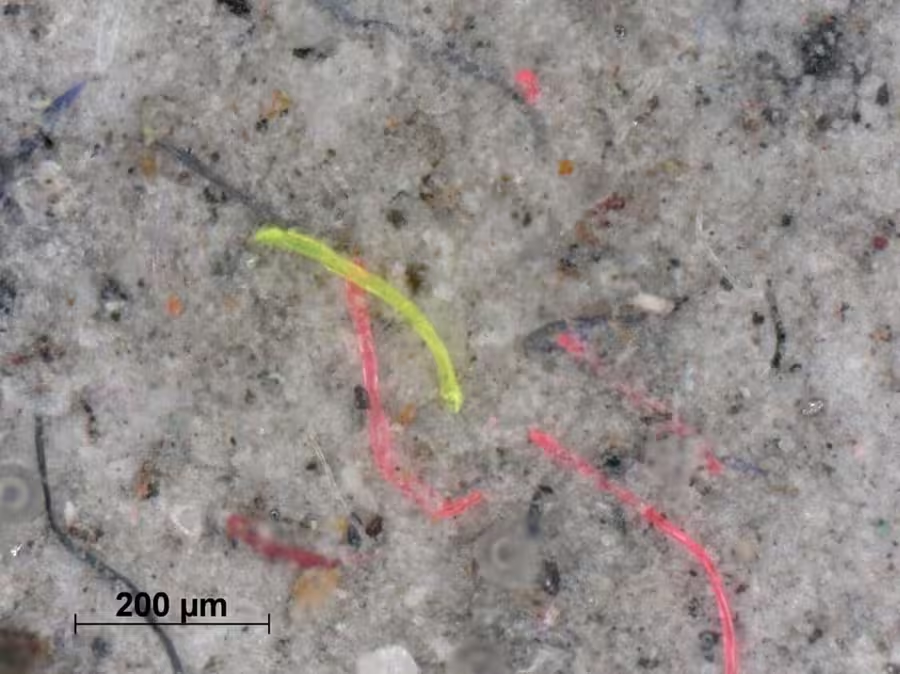
Field trials at an industrial laundry and a municipal wastewater treatment plant confirmed a separation efficiency of 89.7 percent and 98.5 percent for the microfilter cascade. It can thus make a significant contribution to reducing microplastic pollution.
The high microplastic separation efficiency and the long service life of the filter medium make the system a promising solution for wastewater treatment. It is cost-effective, space-saving, and can be adapted to different applications and scales.
The textile composite medium developed at the DITF can be tailored to meet a variety of filtration requirements beyond its application in microplastic filtration.











