




The German Institutes of Textile and Fiber Research (DITF) are breaking new ground with the production of staple fiber yarns made from cellulose. Using the HighPerCell® process—patented by DITF—high-quality textile yarns for the apparel sector are produced from cellulose continuous filaments. A closed-loop recycling system and a low carbon footprint in production offer the apparel industry and consumers a particularly sustainable product.
The research and development project launched under the name “InnoCell” will drive the market-ready development of cellulose yarns for the apparel industry. In the HighPerCell® process developed at the DITF, cellulose fibers are produced as continuous filaments in a closed-loop system. It offers significant advantages over established industrial processes such as the viscose process or the Lyocell process: The viscose process requires extensive chemical processing, which generates large amounts of waste. This is not the case with the Lyocell and HighPerCell® processes, as both enable a closed-loop process with complete recycling of the solvent. This avoids waste products that are harmful to the environment and human health. The HighPerCell® process uses ionic liquids as solvents and is simpler and safer to control than the Lyocell process. Furthermore, the cellulose fibers obtained in the HighPerCell® process are less prone to fibrillation and nodule formation, offering advantages for use in the apparel sector.
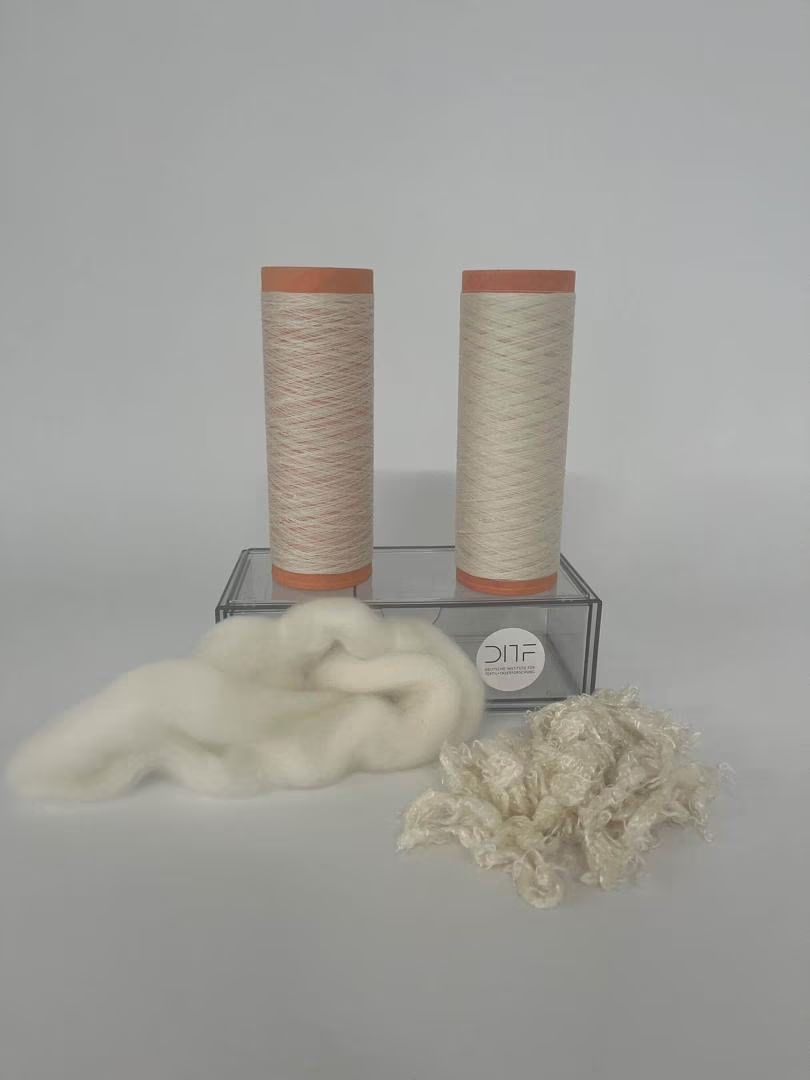
The production of staple fiber yarns from the cellulose multifilaments obtained via the HighPerCell® process is opening up entirely new applications—and thus new markets—for this type of fiber for the first time. Staple fibers consist of short fibers that need to be spun into a continuous yarn. The process of yarn production from staple fibers is technically demanding: it must be tailored to the physical and mechanical properties of the fiber type to ensure the creation of a stable yarn that is easy to process further. This step is carried out by the project partner “Gebr. Otto Baumwollfeinzwirnerei GmbH & Co. KG” (Otto Garne). Crucial for smooth yarn spinning is a high-quality carded sliver, which is produced first. The spinning process is designed to enable the highest possible yarn quality and is the basis for an industrial upscaling. Otto Garne is also responsible for yarn dyeing and will develop a suitable methodology to achieve high color depth and colorfastness.
The produced cellulose staple fiber yarns have different properties than the original continuous fibers. Staple fiber yarns have a fluffy and matte surface. This makes them softer and more breathable, which is especially desired for various fabrics in next-to-skin clothing.
Regional Raw Materials Support Sustainable Textile Manufacturing
The choice of raw material for fiber production is a key aspect of the development project. The laboratory samples produced so far utilized chemical pulp, which offers a high degree of purity. These raw materials are easy to process but have undergone extensive chemical treatment and are therefore not environmentally friendly. For upscaling to industrial use, locally sourced plants that are readily available will be used as raw materials. This makes the process both sustainable, as it reduces CO2 emissions, and economically viable. The focus is on the use of regional beech wood, which is available in large quantities for cultivation. However, native annual plants such as hemp and flax will also be investigated for their suitability as raw materials. The HighPerCell® process has already proven to be highly flexible with regard to various raw material sources. It is expected that the fiber production process can be adapted to the respective raw materials.
For manufacturers of apparel textiles, the source of raw materials is a key factor in marketing their products. In addition to fiber production within a fully closed recycling loop, the use of regional, sustainable raw materials enables product positioning that can be promoted as highly environmentally friendly.
The staple fiber yarns spun and dyed by “Otto Garne” are returned to DITF for further processing. This is where the first prototype is being produced as part of the project: a T-shirt that is extremely comfortable to wear and has an excellent environmental footprint.











