



Intertextile Shanghai 2026
cinte techtextil 2026
itma 2027

Sharp Decline in Italian Textile Machinery Exports to Turkey Signals Crisis in Turkish Textile Industry

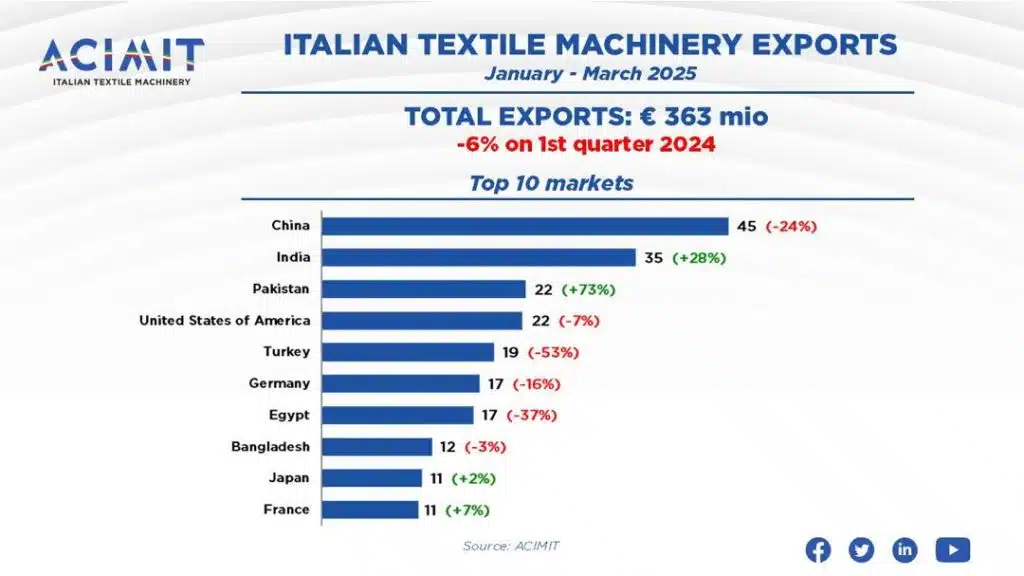
According to the latest report by ACIMIT (Association of Italian Textile Machinery Manufacturers), Italian textile machinery exports dropped by 6% in the first quarter of 2025 compared to the same period in 2024, reaching a total value of €363 million. Imports of textile machinery to Italy also decreased by 3%, with a cumulative value of €92 million.
Among Italy’s main export markets, demand for Italian machinery grew significantly in Pakistan (+73%) and India (+28%). While China remains the largest market for Italian textile machinery, exports to the country saw a decline of 24%.

53% Drop in Exports to Turkey: A Warning Sign for Turkish Textile Sector the most significant decline was recorded in Turkey, where Italian textile machinery exports plummeted by 53%. This sharp drop is widely viewed as a reflection of the deepening crisis in Turkey’s textile industry, an industry that has historically been one of the pillars of the country’s economy and exports.

In recent years, Turkey’s textile sector has been grappling with multiple challenges, including rising production costs, severe currency fluctuations, declining global demand, and pressures from shifting global supply chains. The steep reduction in machinery imports suggests a slowdown in investments in modernizing and upgrading production lines, which could threaten Turkey’s future competitiveness in the global textile market.

Meanwhile, Pakistan and India are rapidly strengthening their positions in global textiles, with significant investments in machinery upgrades and technological innovation. These trends indicate a strategic shift in the global textile supply chain, favoring emerging Asian economies over traditional players like Turkey.

This data should serve as a wake-up call for Turkish policymakers and industry stakeholders to implement supportive measures and encourage investments in production modernization to prevent further decline in one of Turkey’s key industries.

LEAVE A REPLY

Please enter your comment!
Please enter your name here

spot_img
spot_img
spot_img
spot_img
spot_img
spot_img
AMEC AMETEX
spot_img
spot_img
spot_img

Related News

Brazil’s Textile Industry Calls for Tax Incentive Extension Until 2032

São Paulo Manufacturers Warn That Ending ICMS Tax Credit...

When Trade Policies Hurt Domestic Textile Manufacturing: Lessons from Iran’s Textile Industry

By Behnam Ghasemi For decades, the global textile industry has...

How Uzbekistan Is Transforming the Global Textile Industry Through Investment and Sustainability

Introduction Over the past decade, Uzbekistan has emerged as one...

Welspun Living Strengthens Global Brand with Wimbledon Partnership

Welspun Living Ltd is reinforcing its position in the...

U.S. Textile and Apparel Industry Unites Behind New Trade Incentive Proposal

For the first time in recent years, leading U.S....

Textile and Apparel Industry in Angola: Revival, Challenges and Investment Outlook

The textile and apparel industry in Angola is gradually returning...

Thies Highlights Water-Saving Dyeing Technology and Expands Focus on Africa at ITM 2026

At ITM 2026 in Istanbul, Behnam Ghasemi, Editor-in-Chief of...

India–Oman CEPA Opens New Export Opportunities for Textile and Apparel Industry

The implementation of the India–Oman Comprehensive Economic Partnership Agreement...

Kenya Exports More Apparel to the US but Earns Less, Raising Concerns for Textile Industry

Kenya’s textile and apparel industry achieved a record export...

Nigerian Government Launches Textile Revival Plan to Create 1.5 Million Jobs

The Nigerian government has stepped up efforts to revive...

The Global Fabric Industry in 2026: Who Will Lead the Next Decade?

The global textile industry has never been static. For...

The Countdown to ITM 2026 Has Begun: Global Textile Investors Will Meet in Istanbul

The countdown has begun for ITM 2026 International Textile...









