




Carpets Inter cooperated with our exclusive Australian Distributorship and commissioned Marshall Day Acoustics to review and report on independent Acoustic facility tests undertaken with EcoSoft® back modular carpet tiles over the last seven years by sound labs at: BCTC (UK), RMIT, CSIRO, and AIRO.
Recycled PET Backing Enhances Carpet Acoustic Properties
The review of the laboratory tests was commissioned to assist Carpets Inter and their clients to better understand the Acoustic properties of EcoSoft® and the metrics from the various tests, relative to the internal noise levels in occupied spaces.
The focus of these tests was on the properties of EcoSoft® back, a recycled PET felt cushion manufactured from used plastic drink bottles. Among a number of positive attributes, the felt-like structure of EcoSoft® is ideal for absorbing both ambient and impact noise by lowering the reverberation time in a room. In combination with good sound insulation design, the reduction in reverberation time will contribute to the room qualifying for the internal noise level requirements.
Excerpts from the Marshall Day Acoustics report gives an overview of EcoSoft’s performance:
The comparative tests show that carpet tiles with EcoSoft® backing demonstrate improved acoustic performance in both acoustic absorption and sound impact tests when compared to the same density carpet tile with a traditional hard backing (e.g. PVC, Bitumen, etc.,) applied.
The test results conveyed that carpet tiles with EcoSoft® PET Cushion backing had twice the Sound Absorption Average (SAA) when compared to typical hardback carpet tiles. This means that EcoSoft® backed tiles achieve a Sound Absorption Class of D, making them ideal for a wide range of facilities, such as assisted living, education, lecture & conference, office, library, theatre, etc.
The term ambient internal noise in a room refers to background noise levels. This is the sound that can be heard when there are no direct activities in the room, normally emanating from traffic outside the building, activities in adjacent spaces, or the noise from fluorescent lights or HVAC systems.
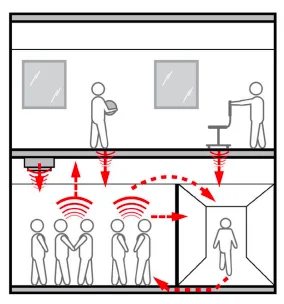
Ambient noise levels are reduced when:
– a room has a high level of acoustic insulation from the noises around it.
– noise from mechanical services such as air conditioning is controlled through the acoustic design of ductwork and air attenuators.
– noise from lighting is limited by avoiding cooling fans and noisy transformers in lighting systems.
The SAA is the Sound Absorption Average of a material. The value of SAA is between one and zero. It represents a proportion of incident sound that is absorbed by the material.
A high value of SAA indicates a high degree of acoustic absorption. A high SAA contributes to a lower reverberation time (RT) in the room. It shortens the length of time a sound takes to dissipate within a room, and reduces build-up of sound inside it in the presence of continuing sound sources, such as conversation echo during a busy party.
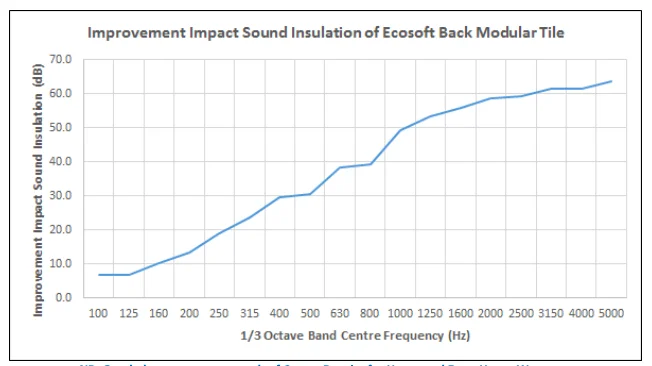
NB: Graph denotes average result of Carpet Density for Heavy and Extra Heavy Wear usage
A carpet tile will not contribute significantly to the sound insulation. The walls, floor, windows, ceiling and doors of the room also act as barriers to sound entering the room.
However, the use of a carpet tile with a high sound absorption does contribute to lowering the RT of a room; the use of carpet can significantly lower the reverberation time in a room. In combination with good sound insulation design, the reduction in RT can help the room to significantly reduce theambient noise.
Source: Carpet Inters











