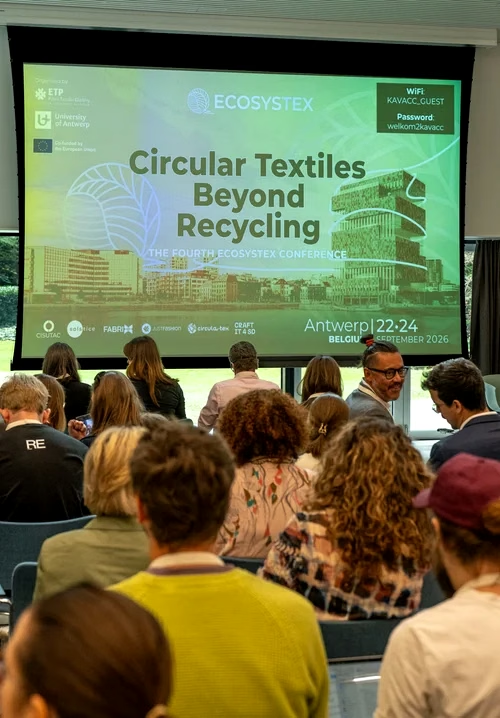
The fourth ECOSYSTEX Conference brought more than 130 textile professionals to Antwerp to examine how Europe’s circular textile transition can advance beyond its current focus on recycling.
Held from September 22 to 24 in collaboration with the University of Antwerp, the conference brought together participants from industry, research, policymaking and design. The programme focused on reuse, repair, ecodesign, digital product passports, bio-based materials, local production systems and new circular business models.
Six European Projects Put Circularity into Practice
Six EU-funded projects—CISUTAC, Circula-TEX, SOLSTICE, FABRIX, JUST FASHION and CRAFT-IT4SD—jointly shaped the programme through technology demonstrations, prototype showcases and interactive workshops.
CISUTAC presented the results of four years of work across circular textile value chains. Its findings highlighted the importance of reliable data, common standards and digital product passports in enabling repair, reuse and recycling. The project also identified continuing technical and economic barriers preventing textile recycling from reaching commercial scale.
Circula-TEX concentrated on the practical implementation of extended producer responsibility. Its work examined the need for stronger ecodesign incentives, better-structured digital product passports and market conditions that allow recycled fibres to compete more effectively with virgin materials.
SOLSTICE presented locally focused circularity pilots in Berlin, Grenoble, Prato and Catalonia. The project is examining whether regional systems for reuse, repair and recycling can be replicated across different European markets.
FABRIX introduced an open-access platform designed to map regional textile stakeholders and facilitate industrial symbiosis. The project explores how manufacturers, designers, service providers and material suppliers can exchange resources and create stronger urban production networks.
JUST FASHION addressed the challenges facing fashion micro, small and medium-sized enterprises during the sustainability transition. Its self-assessment tool is intended to help businesses evaluate their environmental and socioeconomic performance.
CRAFT-IT4SD examined the role of craft-based production in circular and sufficiency-oriented business models. Its workshop included a Romanian deadstock collection and the “Weaving Identities” initiative, exploring how traditional skills and unused materials can form the basis of commercially viable products.
Read More: UAE Launches ‘Naseej’ Initiative to Advance Textile Circularity and Reduce Waste
Textile ETP Launches Bioeconomy Innovation Strategy
A major development during the conference was the official launch of the Bioeconomy Innovation Strategy for the European Fibres, Textiles and Apparel Industry.
Developed through Textile ETP’s Circular and Biobased Textiles Innovation Hub, the strategy identifies research priorities and innovation pathways intended to support European bio-based and circular textile value chains.
Representatives from the European Research Executive Agency, DG Environment, DG Research and Innovation, and the Circular Bio-based Europe Joint Undertaking also outlined the direction of EU textile policy, upcoming research priorities and potential funding opportunities.
The discussions demonstrated that Europe’s circular textile transition will depend on more than improvements in recycling machinery. It will also require coordination between regulation, research funding, material development, product design, manufacturing infrastructure and consumer-facing business models.
Digital product information is expected to play an increasingly important role in connecting these areas. Better data could allow companies to identify fibre composition, trace production history and determine whether a textile product is suitable for reuse, repair, dismantling or recycling.
Antwerp Projects Demonstrate Circularity Beyond the Conference
The conference programme extended beyond formal presentations through visits to circular textile and fashion initiatives operating in Antwerp.
One group visited Kringwinkel Antwerp, a social enterprise handling approximately 1.5 million kilograms of textiles annually. Participants observed repair, garment restoration, sorting and material-recovery activities developed through CISUTAC pilots.
These included a repair workshop, a dismantling station recovering aramid fibres from used firefighter clothing and an enhanced sorting pilot designed to direct textiles toward suitable reuse or recycling routes.
The initiatives also combine textile recovery with training and employment opportunities for people facing barriers to entering the labour market, demonstrating the social dimension of circularity.
A second group joined a sustainability-focused visit organised with MoMu Fashion Museum Antwerp. The programme examined how reuse, upcycling and recycling have influenced the city’s fashion history and design community.
The third day continued through Textile ETP visits in Ghent and Brussels.
The conference concluded that the technologies, strategies and pilot projects required for textile circularity are increasingly available. The next challenge is turning isolated projects into widely adopted systems capable of working across the European textile value chain.