A Shift from Niche to Strategic Relevance
The textile industry is entering a new phase—one where certain applications are no longer treated as niche opportunities, but as strategic capabilities. Among these, camouflage textile printing is emerging as one of the most important and rapidly evolving segments…
🎧 Listen to the Podcast Version
For years, camouflage was largely associated with limited production lines and specialized contracts. It was relevant, but not central to the broader textile conversation. That perception is now changing, and the shift is happening faster than many expected.
At Techtextil 2026, this transformation was clearly visible—not through marketing claims, but through the nature of the discussions taking place across the exhibition. Conversations were more focused, more technical, and increasingly connected to real production decisions.
Camouflage Printing Is No Longer a Niche
Insights from Zimmer Austria
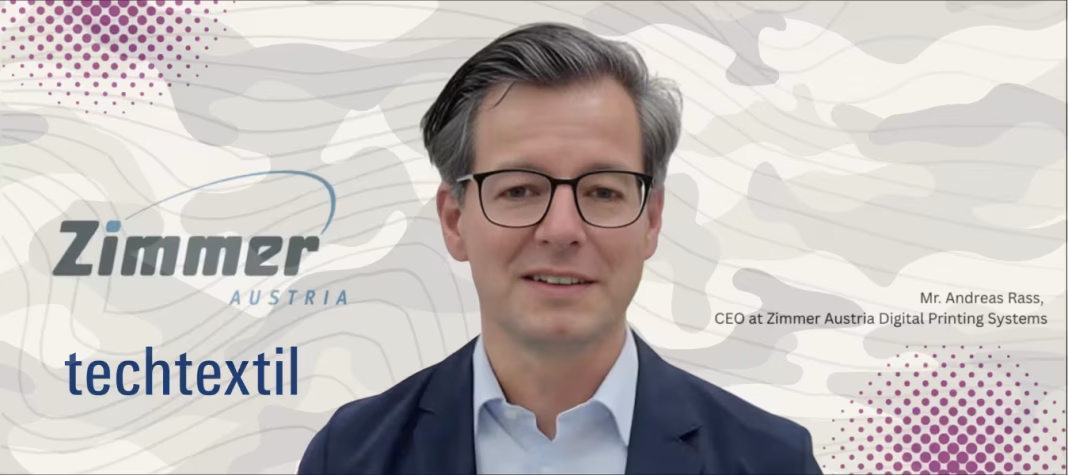
During our interview with Andreas Rass, CEO of Zimmer Austria Digital Printing Systems, this change was articulated with notable clarity. He described camouflage printing not as an emerging niche, but as something that has already crossed into a different category.
“Camouflage printing is no longer a niche subject, but a serious industrial growth area,” Rass told Kohan Textile Journal, pointing to a shift that reflects deeper changes across global textile production.
This shift is not happening in isolation. It is closely linked to broader developments shaping the industry today—geopolitical tensions, supply chain restructuring, and the growing need for regionalized and resilient manufacturing.
Investment Trends in a Challenging Market
A Serious but Constructive Industry Mood
As global uncertainty increases, manufacturers are being pushed to rethink their production strategies and invest in capabilities that go beyond traditional volume-based models.
Rass emphasized that the current market environment reflects this reality. According to him, the industry is no longer driven by short-term optimism, but by a more focused and pragmatic mindset.
“The atmosphere is serious, but constructive,” he explained. “Companies are still investing—especially where technology creates strategic value.” This perspective highlights a key transformation: investment is becoming more selective, targeting flexibility, efficiency, and resilience.
Why Camouflage Requires Industrial Precision
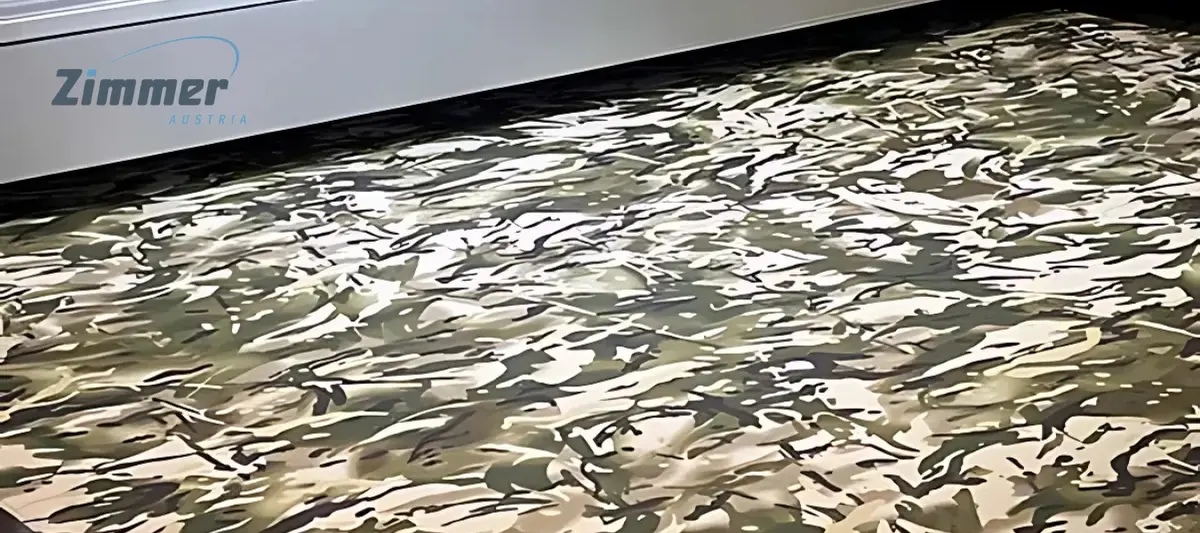
What makes this segment especially relevant is not only the demand behind it, but the technical and operational requirements it imposes. Unlike standard textile applications, camouflage production requires a high degree of precision, strict repeatability, and complete process control.
It is not simply about printing a pattern—it is about delivering consistent performance under demanding conditions. As Rass highlighted, the industry is increasingly moving toward more controlled and regionally reliable production structures.
“The market is increasingly looking at resilient, regional, and trusted production structures for technical and protective textile applications,” he noted during our conversation.
The Role of Digital Textile Printing
Flexibility Meets Industrial Control
Technology plays a central role in enabling this transition, and digital textile printing is at the heart of it.
While digital printing has been evolving for years, its relevance today is defined by how well it aligns with current market needs. The ability to adapt designs quickly, produce smaller and more flexible batches, and maintain consistent quality across production runs is no longer optional—it is essential.
Zimmer Austria has positioned itself within this shift by focusing on industrial-scale digital solutions that combine flexibility with reliability.
“Digital printing offers flexibility, fast design adaptation, and controlled, repeatable production on demanding technical substrates,” Rass said.

Moving Toward Higher-Value Textile Production
The growing importance of camouflage printing extends beyond its immediate applications. It reflects a broader strategic opportunity for textile manufacturers. For many producers, particularly in Europe and emerging regional hubs, this segment offers a pathway toward higher-value production.
Rass addressed this directly: “For many producers, camouflage printing represents an opportunity to move into more advanced, specification-driven, and higher-value applications.This transition is becoming increasingly critical in a market where margins are under pressure.”
From Machines to Complete Solutions
A Changing Expectation from Technology Providers
Another important aspect of this shift is how it is redefining expectations toward machinery suppliers.
Manufacturers are no longer looking for standalone equipment; they are seeking integrated production concepts that cover the entire process.“Customers do not want isolated machines; they want partners who understand the entire process,” Rass emphasized. This marks a fundamental shift in the role of technology providers—from equipment suppliers to solution partners.
Regional Opportunities: Türkiye and the Middle East
Markets such as Türkiye and the Middle East are becoming increasingly important—not only for traditional segments like carpets and home textiles, but also for advanced and specialized applications.
Their geographical advantage, combined with existing industrial capabilities, positions them as key players in this transformation.
Camouflage textile printing offers a strong entry point into these higher-value segments while supporting regionalized and resilient production models. What makes camouflage textile printing particularly important is not just its growth, but what it represents. It signals a deeper transformation in the textile industry—toward flexibility, specialization, and resilience.
As the insights from Zimmer Austria clearly indicate, this is not a temporary trend. It is a structural shift—one that is already reshaping how textile manufacturers invest, produce, and compete.