Introduction
Automation is rapidly transforming the global textile industry. From spinning mills to large-scale garment factories, manufacturers are adopting advanced technologies to increase efficiency, reduce labor costs, and improve operational accuracy. Among the most important innovations in modern textile manufacturing are Automated Guided Vehicles (AGVs) and Autonomous Mobile Robots (AMRs).
Both technologies are used to automate material handling and internal logistics in textile factories. They help move yarn packages, fabric rolls, pallets, and finished goods across production facilities without human intervention.
However, many textile manufacturers are still asking an important question:
What is the difference between AGV and AMR systems, and which one is better for textile factories?
While both technologies aim to improve factory automation, their design, navigation methods, flexibility, and applications differ significantly.
In this article, we explore the key differences between AGV and AMR systems in textile factories, their applications in the textile industry, and how they contribute to the future of smart manufacturing.
What Is an AGV (Automated Guided Vehicle)?
An Automated Guided Vehicle (AGV) is a driverless transport vehicle used in industrial environments to move materials along predefined routes. AGVs typically follow fixed paths that are guided by magnetic strips, laser markers, wires embedded in the floor, or optical sensors.
AGVs have been widely used in manufacturing and logistics for several decades and are now becoming increasingly common in textile production facilities.
How AGVs Work
AGVs operate by following predetermined navigation paths inside factories. These paths are often programmed during system installation and rarely change unless the factory layout is modified.
Most AGVs rely on one of the following navigation technologies:
- Magnetic tape guidance
- Laser navigation
- QR code floor markers
- Wired guidance systems
- Optical sensors
Once programmed, AGVs move along these routes to transport materials between different production areas.

Common AGV Applications in Textile Factories
In textile manufacturing facilities, AGVs are typically used for repetitive logistics tasks such as:
Yarn Package Transportation
In spinning mills, AGVs transport yarn packages from spinning machines to storage or winding areas.
Fabric Roll Movement
Large rolls of fabric produced in weaving or knitting departments can be automatically moved to finishing sections using AGVs.
Pallet Handling
AGVs are often used to transport pallets between warehouses, dyeing units, and packaging zones.
Warehouse Automation
Many textile factories use AGVs in warehouses to manage the movement of raw materials and finished goods.
The main advantage of AGVs is their reliability and efficiency in repetitive transport operations.
However, AGVs have limitations when it comes to flexibility and dynamic navigation.
What Is an AMR (Autonomous Mobile Robot)?
An Autonomous Mobile Robot (AMR) is a more advanced form of industrial robot designed to move freely within factory environments without relying on fixed guidance paths.
Unlike AGVs, AMRs use advanced technologies such as:
- Artificial intelligence
- LiDAR sensors
- Computer vision
- Real-time mapping systems
- Machine learning algorithms
These technologies allow AMRs to navigate factories dynamically and adapt to changing environments.
AMRs create their own digital map of the facility and can find the most efficient route to reach a destination.
How AMR Technology Works
AMRs rely on advanced navigation technologies known as Simultaneous Localization and Mapping (SLAM).
SLAM enables the robot to:
- Map the factory environment
- Detect obstacles
- Adjust routes dynamically
- Choose the fastest path to reach a target location
For example, if a worker or forklift blocks the robot’s path, an AMR can automatically find an alternative route.
This makes AMRs far more flexible compared to traditional AGVs.

Key Differences Between AGV and AMR Systems
Although both technologies automate material transportation, there are several critical differences between AGVs and AMRs.
Navigation Method
AGVs rely on predefined routes, while AMRs navigate autonomously.
AGVs must follow fixed paths created during installation. AMRs, on the other hand, use sensors and AI algorithms to move freely throughout the facility.
Flexibility
AMRs offer greater flexibility in factory environments.
If a factory layout changes, AGV routes must often be reprogrammed or physically modified. AMRs can quickly adapt to new layouts without major system adjustments.
Installation Complexity
AGV systems usually require physical infrastructure installation, such as magnetic strips or floor markers.
AMR systems require less physical modification because they rely mainly on sensors and digital mapping.
Cost Considerations
AGVs are typically less expensive than AMRs in terms of initial investment.
However, AMRs may offer better long-term efficiency due to their flexibility and intelligent navigation capabilities.
Operational Intelligence
AMRs are equipped with advanced software systems that allow them to interact with factory management platforms, warehouse management systems, and Industry 4.0 solutions.
AGVs generally have simpler control systems designed for repetitive tasks.
AGV Applications in Textile Manufacturing
Despite their limitations, AGVs remain widely used in textile manufacturing because many production environments involve repetitive material movement.
AGVs are particularly effective in the following textile sectors:
Spinning Mills
Spinning mills handle large quantities of yarn packages that need to be transported between machines and storage areas. AGVs provide a reliable solution for this process.
Weaving Plants
In weaving facilities, AGVs can transport warp beams, fabric rolls, and pallets between departments.
Dyeing and Finishing Units
AGVs can move fabric rolls between dyeing machines, finishing lines, and inspection areas.
Logistics Centers
Large textile warehouses use AGVs to automate internal logistics operations.
For many textile companies, AGVs offer a cost-effective entry point into automation.
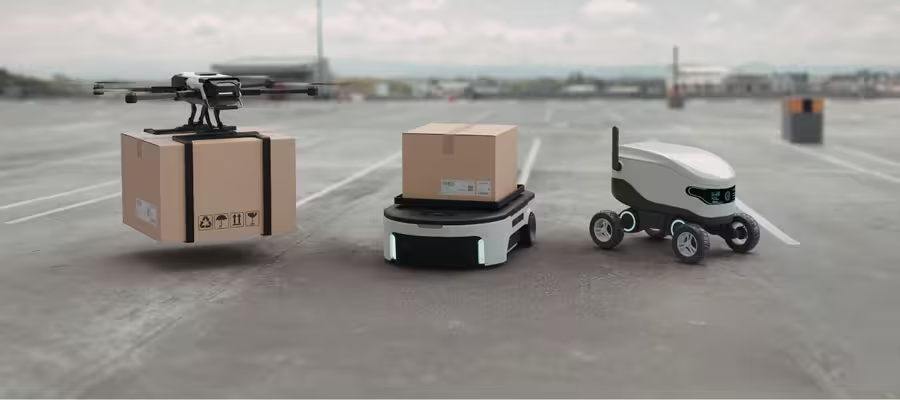
AMR Applications in Textile Factories
As textile factories become more digitalized, AMR technology is gaining popularity in advanced production facilities.
AMRs are especially useful in environments where factory layouts frequently change.
Smart Textile Warehouses
AMRs are widely used in automated textile warehouses where products and materials need to be transported dynamically.
Garment Manufacturing
Garment factories often require flexible logistics systems to move semi-finished products between production lines.
AMRs can adapt easily to changing production flows.
E-commerce Fulfillment
With the growth of online fashion retail, AMRs are increasingly used in textile distribution centers to automate order fulfillment processes.
Smart Textile Factories
Factories implementing Industry 4.0 technologies often prefer AMRs because they integrate better with digital manufacturing systems.
AGV or AMR: Which Technology Is Better for Textile Factories?
Choosing between AGV and AMR systems depends largely on the type of textile operation and production environment.
AGVs Are Ideal For
- Structured production environments
- Repetitive transport tasks
- Factories with stable layouts
- Lower automation budgets
AMRs Are Better For
- Flexible production environments
- Smart factories with digital infrastructure
- Complex logistics operations
- Facilities undergoing frequent layout changes
Many modern textile factories are now combining both technologies to achieve maximum efficiency.
The Future of Textile Factory Automation
Automation will continue to play a crucial role in the future of textile manufacturing.
As factories move toward Industry 4.0, the integration of robotics, artificial intelligence, and smart logistics systems will become essential.
Technologies such as:
- AGVs
- AMRs
- AI-driven production systems
- Industrial IoT
- Digital twins
will shape the next generation of textile factories.
Manufacturers that invest in intelligent automation will gain a competitive advantage in productivity, efficiency, and cost management.
Conclusion
Both AGV and AMR systems are transforming the way textile factories manage internal logistics and material handling.
AGVs remain a reliable and cost-effective solution for structured production environments, while AMRs offer greater flexibility and intelligence for modern smart factories.
As the textile industry continues to adopt automation technologies, the combination of AGV and AMR solutions will play a key role in improving factory efficiency, reducing labor dependency, and supporting the transition toward intelligent manufacturing.
For textile manufacturers seeking to modernize their operations, understanding the differences between these two technologies is the first step toward building a smarter and more efficient factory.
To understand the basics of AGVs, read our guide:
What is an AGV and How Is It Used in the Textile Industry