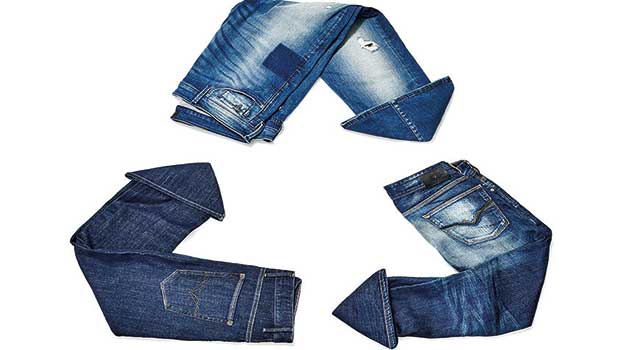
Second-quality jeans are those that don’t quite meet quality standards – the wash may be too dark, the stitching may not be quite right or the cut may be irregular. Usually, they are sold for discount prices or just thrown away.
But Nudie Jeans, a global leader in sustainable fashion, is looking at ways to make use of second-quality jeans to maintain the highest quality of its products, while reducing the environmental impact of the production process.
Eliina Brinkberg, the Swedish company’s environmental manager, explains, “At Nudie Jeans, we are constantly exploring new ways that can improve our environmental footprint. Using post-industrial waste as recycled input to new denim fabric is one of the multiple methods we need to work with to decrease the resource use in the production of our products.”
Two companies in Tunisia are responsible for over half of Nudie Jeans’ production value. To develop greener production processes in Tunisia, Nudie Jeans has been working with the United Nations Industrial Development Organization (UNIDO) as part of the European Union-funded SwitchMed project.
A two-phase project
In December 2020, a two-phase pilot project began to test the feasibility of recycling second-quality jeans into fabric for new jeans in Tunisia. Brinkberg says that in the first phase, to be completed by May 2021, “Eight thousand pairs of second-choice jeans are being used, together with virgin denim fabric, to create 20,000 meters of new fabric. From this new fabric, 15,000 pairs of new jeans will be created.”
The data from this initiative will enable UNIDO to assess the feasibility of recycling second-quality jeans into fibers for new denim fabric at scale.
A second phase will focus on developing an upcycling and remanufacturing scheme with local designers in Tunisia and will explore the possibilities for recycling post-industrial cutting waste from jeans production.
Roberta De Palma, Chief Technical Advisor at UNIDO, explains, “The current production system for fashion goods uses high volumes of virgin fibers, which creates a significant pressure on valuable resources, such as water.” According to the United Nations, approximately 10,000 liters of water are required to make one single pair of jeans from the production of the cotton to the delivery of the final product to the store.
She says, “Exploring ways for recycling post-industrial textile waste could reduce this dependency and support the development of a recycling infrastructure in the production countries.”
Water scarcity has long been a challenge in Tunisia but climate change, combined with rapid urbanization, has made the problem even more acute. With demands from industry and agriculture putting immense pressure on Tunisia’s water resources, Nudie Jeans and UNIDO are hoping their project will show a way to do more with less.
The SwitchMed Program was launched in 2013 by the European Union to speed up the shift to sustainable consumption and production patterns in eight countries in the Southern Mediterranean: Algeria, Egypt, Israel, Jordan, Lebanon Morocco, Palestine and Tunisia.

Through policy development, demonstration activities and networking opportunities, SwitchMed supports and connects stakeholders to scale-up eco and social innovations.
Founded in 2001, Nudie Jeans is a denim brand that offers free repair services and sales of reused denim. Sustainability, both social and environmental, is at the core of the company which can be seen in its work with living wages, sustainable fiber use and transparency of the supply chain.