👉 Listen Now: Why Nearshoring Alone Is Not Enough?
As global supply chains continue to shift under geopolitical pressure, rising costs, and sustainability demands, nearshoring has re-emerged as one of the most discussed strategies in the textile and apparel industry. For regions close to major consumption markets—particularly Europe—this trend has created new opportunities. But the reality is more complex than it appears.
From the perspective of Kohan Textile Journal, nearshoring is not a long-term strategy in itself. It is a window of opportunity—one that requires structural transformation to become sustainable.
The Illusion of Nearshoring as a Competitive Advantage
Over the past few years, disruptions in global logistics have pushed many European brands to diversify their sourcing strategies. Proximity has become a key factor. Faster delivery times, greater flexibility, and reduced risk have encouraged brands to shift part of their production closer to home.
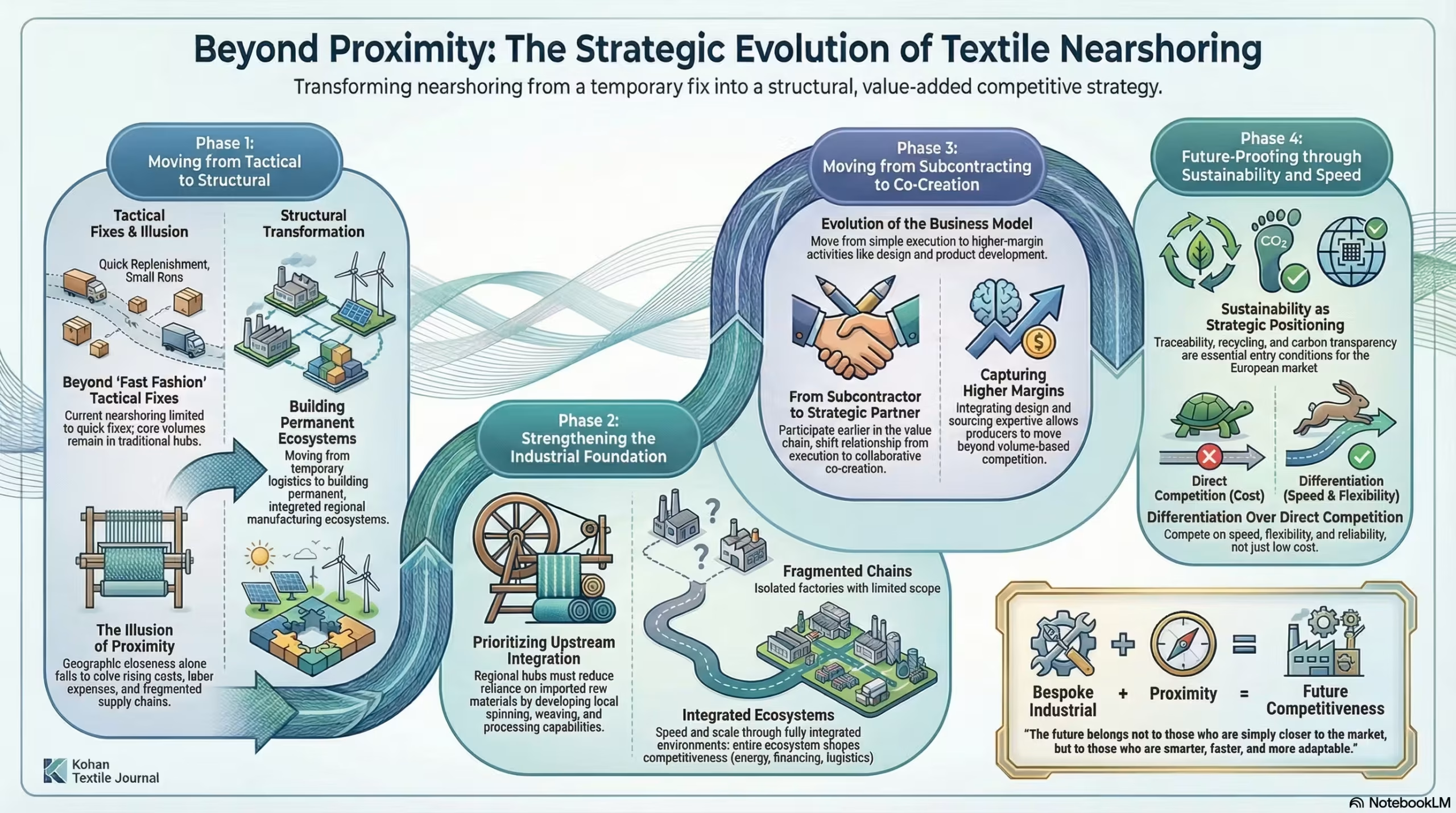
However, this shift has largely been tactical rather than structural.
In many cases, nearshoring has been limited to specific segments such as quick replenishment orders, smaller production runs, and fast fashion cycles. While these segments are valuable, they do not represent a full transformation of global sourcing patterns.
The core volumes of production often remain in traditional manufacturing hubs where cost efficiency and scale are still unmatched.

Structural Challenges Behind the Opportunity
The real limitation of nearshoring lies in structural weaknesses within emerging production hubs. While proximity offers speed, it does not automatically solve deeper industrial challenges.
One of the most critical issues is the lack of upstream integration. Many nearshoring destinations still rely heavily on imported raw materials, which reduces their flexibility and increases costs. Without strong local capabilities in spinning, weaving, and processing, the supply chain remains fragmented.
Read more: Morocco Textile Industry: How It Became Africa’s Nearshoring Hub for Europe

At the same time, rising energy costs, labor expenses, and compliance requirements are placing additional pressure on manufacturers. These factors erode the very competitiveness that nearshoring is supposed to provide.
In contrast, more established players with integrated textile ecosystems are better positioned to offer both speed and scale—making competition increasingly difficult.
Moving Beyond Subcontracting: The Value-Added Imperative
For many textile-producing regions, subcontracting has long been the dominant business model. While often perceived as a limitation, it has in fact provided a stable industrial base and access to international markets.
The challenge today is not to abandon subcontracting, but to evolve it.
A growing number of manufacturers are moving toward a more integrated model, incorporating design capabilities, product development, and sourcing expertise. This shift allows them to participate earlier in the value chain and capture higher margins.
Rather than competing solely on manufacturing capacity, the focus is gradually shifting toward co-creation with brands. This transformation—from execution to collaboration—is where real competitiveness begins to emerge.

Sustainability: From Compliance to Strategic Positioning
Environmental regulations, particularly in Europe, are redefining the rules of the game. Traceability, recycling requirements, and carbon footprint transparency are no longer optional—they are becoming entry conditions.
While some manufacturers have already begun investing in sustainable practices, the level of readiness remains uneven across the industry. For many companies, the transition is costly and complex, requiring both financial investment and technical expertise.
This creates a risk of fragmentation within the sector, where only a limited number of players are able to meet the new standards.
At the same time, sustainability presents a significant opportunity. Regions that can align proximity with sustainable production capabilities have the potential to position themselves as preferred partners for global brands.

Competing with Asia and Turkey: A Question of Strategy
Direct competition with low-cost Asian producers or highly integrated manufacturing hubs is neither realistic nor strategic.
Instead, the path forward lies in differentiation.
Speed, flexibility, and reliability are areas where nearshoring regions can create real value. These strengths are particularly relevant for short production cycles, rapid replenishment, and mid-sized collections.
However, these advantages must be supported by improvements in industrial infrastructure, logistics efficiency, and overall business environment. Competitiveness is not determined solely at the factory level—it is shaped by the entire ecosystem, including energy costs, financing, and regulatory frameworks.
The African Market: Potential Without Immediate Impact
The African market is often highlighted as a future growth opportunity for textile producers. While the potential is undeniable, the reality remains challenging.
Limited purchasing power, strong competition from low-cost imports, and underdeveloped logistics networks continue to restrict large-scale expansion.
Opportunities do exist, but they are highly targeted—particularly in segments such as uniforms, workwear, and institutional supply. In this context, success depends less on export strategies and more on long-term partnerships and regional integration.
Final Perspective: From Opportunity to Strategy
Nearshoring has opened an important door for the global textile industry, but it is not a solution on its own.
The real challenge lies in transforming short-term opportunities into long-term strategies. This requires investment in upstream integration, a shift toward value-added services, and a serious commitment to sustainability.
In an increasingly competitive and regulated global market, the winners will not be those who are simply closer—but those who are smarter, faster, and more adaptable.
From our editorial perspective, the future of textile competitiveness will be defined not by geography alone, but by the ability to combine proximity with capability.