Interview by Behnam Ghasemi, Editor-in-Chief, Kohan Textile Journal
During Egypt Stitch & Tex 2026 in Cairo, Behnam Ghasemi, Editor-in-Chief of Kohan Textile Journal, spoke with Lin Linwang, International Sales Manager at Jiangsu Niupai Textile Machinery Co., Ltd., about the company’s weaving technologies, the growing importance of Egypt, the evolution of Chinese textile machinery, and the increasing role of research and development in China.
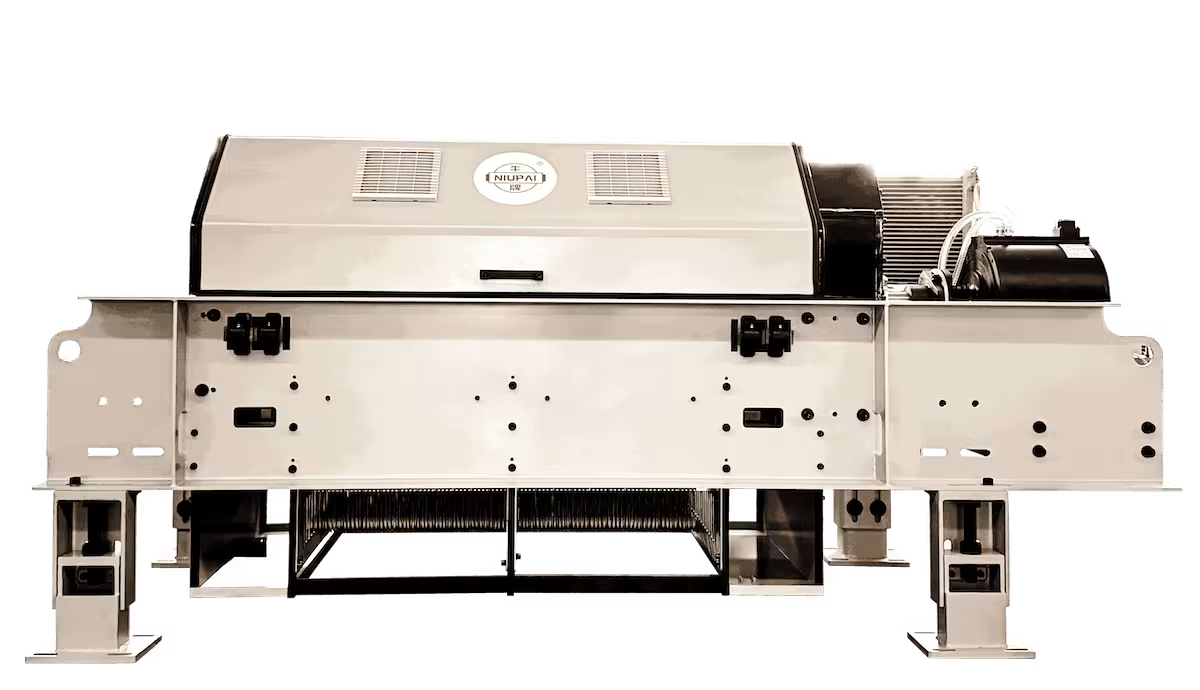
Based in Jiangsu, China, Jiangsu Niupai Textile Machinery has more than 30 years of experience in the textile machinery industry and exports its products to approximately 35 countries. The company specializes in shedding technologies for weaving machinery, including cam, dobby and Jacquard systems for water-jet and air-jet looms.
In this interview, Lin Linwang also speaks openly about competition with established European technology suppliers, particularly Stäubli, and explains how Chinese textile machinery manufacturers are gradually moving from learning existing technologies toward developing their own technical capabilities and innovations.
Jiangsu Niupai’s Weaving Technology and Global Reach
Could you introduce Jiangsu Niupai Textile Machinery and the technologies you manufacture?
Our company is based in Jiangsu, China, and we are a professional manufacturer of shedding systems for weaving machines.
Our product range includes cam, dobby and Jacquard systems, as well as related solutions for water-jet and air-jet weaving machines. We have been active in this business for more than 30 years, and our products have been exported to around 35 countries worldwide.
Quality is very important to us, particularly because we are supplying customers across many different international markets.
How do you see the Egyptian textile market today?
I believe Egypt is a very promising market.
During the past two years, we have seen many Chinese companies investing in Egypt and establishing textile manufacturing operations, including yarn production facilities.
This shows the growing importance of the Egyptian market.
Egypt is also strategically positioned. It can serve as a gateway to African markets while also providing access to European and other international markets.
For these reasons, I believe Egypt has considerable potential for textile manufacturing and future investment.
Chinese textile machinery has become increasingly visible in Egypt and across Africa. How would you describe the development of Chinese machinery quality?
Chinese textile machinery has developed significantly over the past 20 to 30 years.
The quality has improved substantially. In some areas, I believe Chinese machinery can now provide a similar level of quality to European products, and in certain applications it can even be very competitive technologically, while generally offering a lower price.
At the same time, we have to be realistic. There are still areas where Chinese manufacturers have room to improve and where we need to continue catching up with leading international technology providers.
One of our important advantages is cost competitiveness. But today, Chinese manufacturers are also paying much more attention to product quality and after-sales service than they did in the past.
These areas have improved considerably.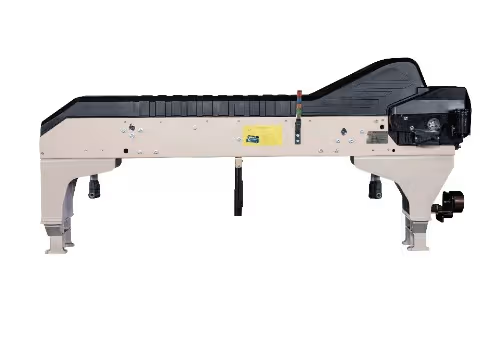 When you compare Jiangsu Niupai’s products with international competitors, where do you see your position?
Globally, one of our biggest competitors — but also, in a way, one of our teachers — is Stäubli.
We respect their technology.
In terms of quality, we recognize that there are still areas where we need to improve. Stäubli has very advanced technology, particularly in electronic dobby and Jacquard systems.
We are working continuously to reduce this technological gap.
Competition is important because it gives manufacturers a benchmark and encourages us to continue improving our own technology and products.
Are you currently developing any new products or technologies?
Yes. We are working on expanding our product range.
Currently, our electronic dobby systems are available with a maximum of 16 levers. We are now developing and expanding this range toward 20- and 24-lever electronic dobby systems.
Our objective is to continue developing more products and broaden the solutions we can provide to weaving customers.
In the past, Chinese manufacturers were often associated with learning from Western technologies. Today, however, many Chinese companies are investing heavily in R&D. How do you see this transformation?
I think development has to begin with learning.
China was previously far behind many Western countries in modern industrial technology. We therefore had to study and learn from countries that were technologically more advanced.
But learning is only the beginning.
You first study the technology, then develop your own technical capabilities. As your engineers and technicians gain more experience year after year, you become capable of improving products and eventually creating your own innovations.
This is the process that many Chinese companies have gone through.
Today, Chinese manufacturers are increasingly investing in technology development and innovation.
Has the size of China’s domestic textile industry helped accelerate this development?
Absolutely.
One of the major advantages Chinese textile machinery manufacturers have is the size of our domestic market.
China has a very large textile industry and strong demand for textile machinery. This gives manufacturers many opportunities to install machines, receive customer feedback, modify products and continuously improve their technologies.
When you have a large number of customers using your products under different production conditions, you can learn from their experience.
Their feedback helps manufacturers identify what needs to be changed and where quality or technology can be improved.
This continuous interaction between machinery manufacturers and textile producers has contributed significantly to the development of Chinese textile machinery.
Read More: Egypt Stitch & Tex 2026: What the Exhibition Revealed About the Future of Egypt’s Textile Industry
Do you believe international cooperation and technological exchange are still important for the industry?
Yes, definitely.
I believe the world needs communication and countries need to learn from each other.
Technological development does not happen in isolation. Companies and countries can study each other’s experiences, learn from different technologies and then continue developing their own capabilities.
China itself has benefited from this process of learning and development, and today Chinese companies are increasingly contributing their own technologies and innovations to the global market.
Finally, how do you see the future of Chinese textile machinery in international markets?
Chinese textile machinery has already improved significantly in terms of quality, technology and service, but the development process is continuing.
We have advantages in manufacturing scale, cost competitiveness and a very large domestic textile market that allows us to continuously test and improve our products.
At the same time, we understand that in certain advanced technologies there is still more work to do.
The objective is therefore not simply to compete on price. Chinese manufacturers need to continue improving quality, service, technology and innovation.
That is the direction in which the industry is moving.
Interview conducted by Behnam Ghasemi, Editor-in-Chief of Kohan Textile Journal, with Lin Linwang, International Sales Manager at Jiangsu Niupai Textile Machinery Co., Ltd., during Egypt Stitch & Tex 2026 in Cairo.