






By: Gabrielle Davenport
Whether worn as a skirt or hanging on a museum wall, Kuba cloth is usually identified by bold, graphic black patterns that suggest movement. The textile often prominently features both repeated themes and irregularities between sections, which remind you that an artist’s handcrafted each stitch.
This style originated in the 17th century in the Kuba kingdom of central Africa, in the modern-day Democratic Republic of Congo. Traditionally woven using raffia palm fibers, Kuba cloths range in size and shape and are renowned as a significant art tradition from this part of the world.
The Kuba kingdom was founded by Shyaam a-Mbul in 1625 and historians often note its highly developed political system, which included elections and trial by jury (both of which were uncommon at the time). Comprised of more than 17 ethnicities, the Kuba kingdom drew much of its strength from creating this alliance between distinct groups, and as the larger nation-state gained power, its arts industry flourished. The kingdom gained wealth by controlling the ivory and rubber trades, and commissioning artists for sculpture, basketry, and textiles became an important signal of the region’s prosperity.
One primary cultural export from this bustling society is the Kuba cloth, which is borne of a time-intensive process involving multiple people. First, the raffia fibers are stripped and kneaded for an initial softening. The strands are then colored using vegetable dyes, creating the shades of ivory, brown, clay red, and indigo blue that are associated with many arts of the Kuba kingdom.
A flatweave textile is then produced on an inclined heddle loom, usually by male weavers. At this point, another round of dyeing or kneading may take place, before handing the piece off for “finishing” work typically carried out by Kuba women. These decorative techniques can include embroidery, appliqués, or patchwork, and result in a cut pile cloth whose texture resembles velvet.
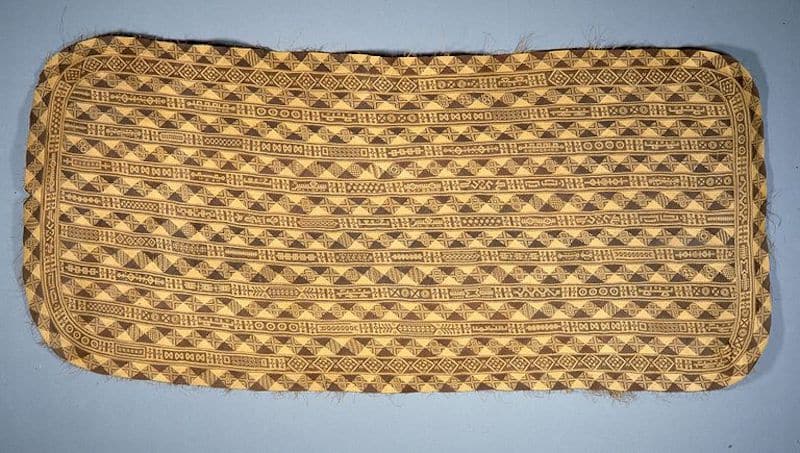
A single placemat-sized Kuba cloth can take several days to complete. Often, many articles are joined together for larger prestige pieces, which were historically used to denote the wealth and supremacy of Kuba rulers.
As Lamine Berete, who has sold vintage African textiles in the US for over 25 years, has noted, an outsider might not be able to look at a Kuba cloth and discern meaning from its patterns and markings. Because of the rich and diverse history of these cloths, which spans several centuries and various ethnic groups, there are innumerable meanings to be found in the vast world of Kuba tapestry-making. There are traditional overskirts used in funerals and other ceremonies, and the simpler flatweaves, which were used as currency at the apex of the Kuba kingdom. However, the designs were often named after the weaver who created them, or the person who commissioned them. Some designs were passed down as family heirlooms, but you’re less likely to find a sort of glossary of symbols for Kuba cloths as you might for the kente cloths of West Africa, for example.
Because of the intricacy and diversity of techniques used for Kuba cloths, they have been a fascination of Western traders, scholars, and collectors since the 19th century. The Kuba kingdom was able to resist colonization for longer than many of its neighbors because it was so highly developed, but as Belgium advanced on the region, Kuba cloths were highly sought after and were featured in the earliest major exhibitions of African art in Europe in the late 1800s.
These days, you may find Kuba-inspired designs on wallpapers, curtains, or pillows from retailers like Society6 or Wayfair, though handwoven Kuba cloths are still widely available and used for wall hangings, table runners, and upholstery. Because of the craftsmanship intrinsic to the process, there’s a sizable market of vintage Kuba cloths to be found for a range of prices. If you’re seeking an eye-catching, handsome print to bring richness to a certain corner of your home, you’ll likely find a Kuba cloth style to incorporate beautifully into your decor.











