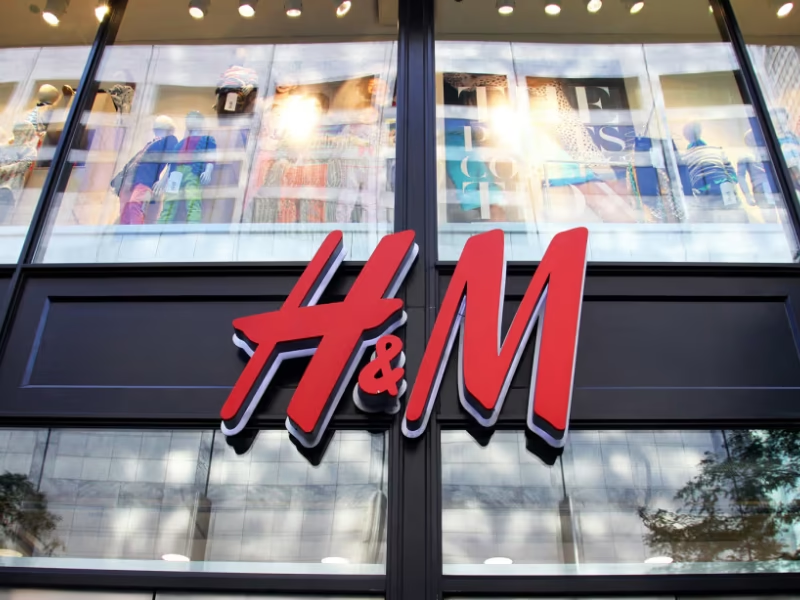
H&M stands for Hennes & Mauritz. “Hennes” means “hers” in Swedish, while “Mauritz” comes from the name of Mauritz Widforss, a company acquired in 1968.
H & M (Hennes & Mauritz AB) is a Swedish-based multinational retailer recognized internationally for its low-cost and runway-inspired clothing, bringing vogue looks to everyday wardrobes worldwide while conserving its sustainability practices. The brand stands out among others as it facilitates accessibility through stylish fashion at affordable prices, making trends available to a mass audience. By deploying the idea of “fashion for all,” H and M embodies the mission of making fashion universal to balance affordability, vogue-aware design, and sustainability, while maintaining a strong international presence. For H and M, design is not limited to physical goods; it is about strategic processes, efficient operations, meaningful experiences, and smart solutions that serve every customer.
What is the story of H & M?
H & M empowers its customers to express their individuality through accessible fashion and delivers fashion that unites people through inclusivity. Each brand within the H & M Group contributes its own individuality, and together they create a powerful and cohesive identity that enhances H&M Group’s impact. The result ensures customers receive exceptional value while advancing the vision of a more circular fashion practice.
The History of H & M Clothing
H and M, one of the leading retailers in the market, was incorporated in 1947 by Erling Persson in Västerås, Sweden. The brand has grown from a single women’s clothing store into one of the world’s largest fashion groups, with thousands of stores across more than 75 markets and a strong online presence.
The concept spawned after Persson’s visit to America, where he noted the booming popularity of affordable, off-the-rack fashion outlets. Drawing inspiration from this trend, he set out to establish a European counterpart that combined quality garments with reasonable pricing.
H & M Clothing started its operations as Hennes, meaning “hers” in Swedish. Hennes was the first H & M store opened by Persson. The launch was warmly received by customers, and the brand soon became known for providing everyday shoppers with affordable style.
What Does H&M stand for?
In 1968, it expanded to menswear after acquiring Mauritz Widforss, a Stockholm hunting shop, along with its inventory to become Hennes & Mauritz, which is currently recognized as H&M. A few years later, in 1976, H&M crossed borders, debuting its first international store in London.
International Expansion of H and M
Across the following decades, H&M expanded outside Sweden and rose to become a major global fashion brand. H and M clothing has nurtured itself by centering on affordable apparel, trendy collections, and high-quality fabric, yet continues to honor Erling Persson’s original goal of bringing fashion to the masses.
H&M’s growth across Europe eventually led to its entry into e-commerce in 1998, following the registration of the hm.com domain in 1997. The company’s international expansion beyond Europe began on 31 March 2000, when it inaugurated its first U.S. store on Fifth Avenue in New York City.
In 1982, Persson’s son, Stefan, stepped in as managing director, eventually rising to chairman of the board. Today, the Persson family maintains significant influence, owning nearly half the company and holding three-quarters of its voting rights. Erling Persson’s journey ended in Stockholm on 28 October 2002.
Current Achievements
Following Inditex, H&M is the world’s second-largest international clothing retailer. The brand specializes in clothing endurance by increasing focus on circular fashion, with 80% of materials in 2024 sourced sustainably or recycled.
In 2024, H and M also hit 234 billion SEK in net sales and reached 89% recycled or sustainably sourced materials in their commercial products, with 29.5% recycled materials.
In 2024, Daniel Ervér took over from Helena Helmersson as CEO of H&M Group, while remaining CEO of the H&M brand. H and M has been able to climb up the ladder by expanding its production in the retailing market by manufacturing clothing, accessories, home furnishings, and cosmetics for women, men, teenagers, and children.
Also read: Is Mavi a good brand?
Is H & M a fast fashion brand?
H and M operates as a fast fashion approach, as it quickly translates runway trends into affordable everyday wear. The company earned its international credibility by producing trendy, store-bought fashion clothing quickly and at reasonable prices, making fashion accessible to the world.
Its business pathway is based on rapid turnaround from design to store shelves with frequent new collections and large-scale production, which are all the attributes of fast fashion. While H&M has increasingly invested in sustainability projects and circular practices in recent years, its foundation remains in the fast fashion industry.
Is H & M a Turkish brand?
H & M clothing is not a Turkish brand. The brand is a Swedish multinational fashion retailer born in 1947 in Sweden, and headquartered in Stockholm.
The company, officially known as Hennes & Mauritz AB, has grown into one of the world’s largest fashion groups, providing clothing, accessories, and homeware products across more than 75 markets. While H & M is Swedish in origin, it does hold a significant manufacturing presence in Turkey, where many of its garments are produced. With the help of Turkey’s strong textile industry and skilled workforce, H & M has matured further in the fashion industry.
Is H & M sustainable?
H&M regards itself as a sustainable brand, but its reality is diverse. The company has set ambitious goals such as achieving net-zero emissions by 2040, sourcing 100% of its materials from recycled or sustainable sources by 2030, and reducing water and plastic use across its supply chain.
The brand reports major progress, counting 89% of materials already meeting sustainable criteria and 92% reliance on renewable electricity. However, critics argue that H&M’s fast fashion model, with high production volumes and frequent new collections, undermines these efforts. Despite all, H & M is making strides toward sustainability, but its scale and marketing structure mean its environmental and ethical impact remains heavily debated.
Is H & M an expensive brand?
As an affordable fast-fashion retailer, H & M is not reviewed as an expensive brand. It is categorized as a budget-friendly retail store. The company has forged its identity on offering trendy, ready-to-wear clothing at accessible price points, enticing cost-sensitive yet style-savvy consumers.
Its pricing strategy indicates affordability and volume sales, allowing it to deliver fashionable products at lower costs compared to higher-end competitors like Zara, Lc Waikiki or Topshop. While some of H & M’s premium lines, such as COS or & Other Stories, target a more upscale market, the core H & M brand remains focused on providing stylish, everyday fashion that balances affordability with quality.
Where are H & M clothes made?
H & M clothes are made across a wide global supply chain, with the majority produced in Asia, particularly in countries like China, Bangladesh, India, Vietnam, and Cambodia, while additional manufacturing takes place in Europe (notably Turkey, Bulgaria, and Romania) and smaller volumes in regions such as Africa and Central America.
H & M does not own factories but instead works with more than 570 suppliers and over 1,100 factories worldwide. It relies on independent manufacturers to deliver its collections.
This network allows the brand to balance cost efficiency, speed, and trend responsiveness, while also supporting quality and transparency procedures by publishing detailed supplier lists and factory information.
Does H & M have an outlet?
H & M Clothing does operate outlet stores in select locations. These outlets typically offer discounted merchandise, past-season collections, and special deals, making them a more economical option compared to regular H & M stores.
In addition to physical outlet locations, H & M also provides online promotions and clearance sales through its websites, giving customers multiple ways to access reduced-price fashion.
Is H & M a good brand?
H & M is considered a popular and accessible fashion brand, but opinions on whether it is “good” depend on the criteria used. On one hand, it is praised for offering trendy, affordable clothing and maintaining a strong global presence as one of the largest fashion retailers in the world. On the other hand, critics underline concerns about its fast fashion model, pointing to environmental impact and labor practices. Generally, H&M is a successful and widely recognized brand, but its reputation is mixed, valued for affordability and style, yet scrutinized for ethical and environmental shortcomings.
Why is H & M so popular?
H & M’s popularity derives from its capability to deliver modern, trendy, and cost-efficient fashion speedily and on a massive scale, making style available to a wide variety of individuals. H & M Kids, the children’s fashion division of H&M, is highly valued for its diverse collections, offering clothing, shoes, and accessories for newborns, toddlers, and young teens.
The brand’s fast fashion model guarantees constant new collections that revolve around current trends, while its global existence delivers convenience and recognition across markets. Moreover, H & M women’s wear quickly adapts to global fashion trends, ensuring women can access the latest styles without delay.
H & M also pleases consumers through collaborations with high-profile designers, diverse product ranges, and increasing investments in eco-friendliness, which together strengthen its image as both fashionable and approachable.
How many branches does H & M have?
As of 2025, H & M operates around 4,000 stores worldwide across 79 markets, supported by online retail in 61 markets, and employs more than 140,000 members.
The company has modernized its network in recent years, closing nearly 1,000 stores since 2019 as part of a shift toward integrating digital and physical channels, but it remains one of the largest global fashion retailers with thousands of outlets spanning Europe, Asia, the Americas, and beyond.
In which countries does H & M have branches?
H & M is active in 79 countries across multiple continents, with thousands of stores worldwide. Its presence covers Europe, Asia, the Americas, Africa, and Oceania, making it one of the most globally distributed fashion retailers.
H&M in Europe
Sweden, Norway, Denmark, Finland, Germany, France, UK, Ireland, Spain, Portugal, Italy, Netherlands, Belgium, Luxembourg, Austria, Switzerland, Poland, Czech Republic, Slovakia, Hungary, Romania, Bulgaria, Greece, Turkey, Lithuania, Latvia, Estonia, Croatia, Slovenia, Serbia, Bosnia & Herzegovina, Montenegro, North Macedonia, Ukraine, Russia (limited), Belarus
H&M in North America
United States, Canada, Mexico
H&M in South America
Chile, Colombia, Peru, Ecuador, Uruguay
H&M in Asia
China, Japan, South Korea, India, Pakistan, Bangladesh, Vietnam, Thailand, Indonesia, Malaysia, Singapore, Philippines, Hong Kong, Taiwan, Kazakhstan, Georgia, Israel, UAE, Saudi Arabia, Kuwait, Qatar
H&M in Africa
South Africa, Egypt, Morocco
H&M in Oceania
Australia, New Zealand
What is H & M mission in the Turkish fashion industry?
H&M’s mission in the Turkish fashion industry is to make fashion and quality attainable at the best price while aligning with global sustainability goals. In Turkey, this means balancing affordability with challenges like high inflation and currency volatility, while leveraging the country’s strong textile base for near-shore sourcing to reduce costs and improve responsiveness.
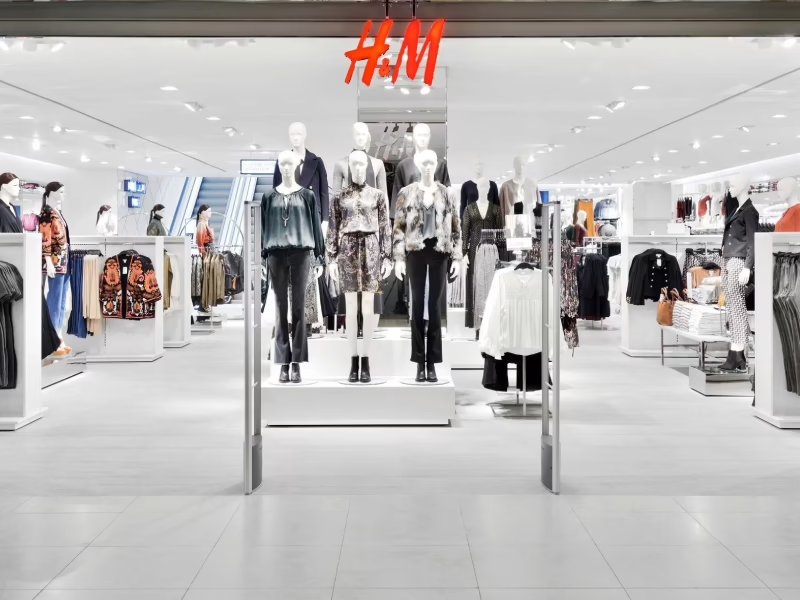
H&M in Türkiye also seeks to expand through e-commerce and mobile platforms, adapting to the rapid growth of online shopping, and to connect with younger, environmentally aware consumers by prioritizing its global sustainability programs, such as sourcing 85% of materials sustainably. Despite competition from local brands like LC Waikiki and DeFacto, H&M’s mission remains focused on democratizing style, strengthening brand equity, and positioning itself as a forward-looking, obtainable, and responsible fashion retailer in the Turkish market.
Is there any H & M near me?
Shoppers looking for the closest H & M store are best served by turning to the brand’s official website or localized branch sites.
These channels are consistently updated to provide accurate details on store locations, operating hours, and the specific services offered at each site.
By using these trusted resources, customers can easily pinpoint the most accessible store and enjoy a seamless shopping experience.
Moreover, the platforms frequently highlight ongoing promotions, seasonal collections, and product availability, enabling visitors to plan their trips more effectively and make the most of current deals.
More Information about H & M Clothing
- Website: Click Here
- Number of Branches: over 4,000 stores
- Subsidiaries: H&M, COS, Weekday, Cheap Monday, Monki & Other Stories, ARKET, Singular Society
- Area served: Worldwide
Conclusion
H&M has secured its place as one of the most prominent names in global fashion, guided by a mission to deliver style and quality at prices within reach for everyone.
The H&M Group’s diverse selection of brands and business ventures provides customers worldwide with an extensive range of fashion, beauty, accessories, and homeware, complemented by contemporary dining options featuring fresh, locally sourced produce in select in-store eateries.
Looking ahead, H&M’s greatest opportunity will be to transform its acceptance and trend-led appeal into a model that not only serves today’s consumers but also protects the future of the fashion industry and the planet.