






Abstract
Ginning remains one of the most critical yet underrepresented stages of the cotton textile value chain. While modern textile engineering programmes often begin with bale opening and spinning, the omission of ginning creates a conceptual disconnect between fibre origin and downstream processing performance. This article argues that ginning is not merely an agricultural operation but a foundational engineering discipline that determines fibre quality, system efficiency, and economic competitiveness. Reintegrating ginning into textile education and research is essential for advancing both industrial performance and global textile sustainability.
The Structural Blind Spot in Textile Education
Across many universities worldwide, introductory textile engineering curricula begin at the spinning mill. Students are taught bale management, carding, drawing, and yarn formation, yet rarely receive structured exposure to the upstream process that defines the raw material itself: ginning.
This curricular gap is significant.
Cotton fibre properties entering the spinning system are not neutral inputs; they are the result of mechanical, aerodynamic, and thermal decisions made at the gin. When textile engineers lack foundational knowledge of ginning, fibre variability is often treated as an unavoidable constraint rather than a controllable engineering variable.
Ginning is not a preliminary agricultural task; it is a precision engineering operation that establishes the baseline for every subsequent manufacturing stage.
Ginning as a Determinant of Fibre Integrity
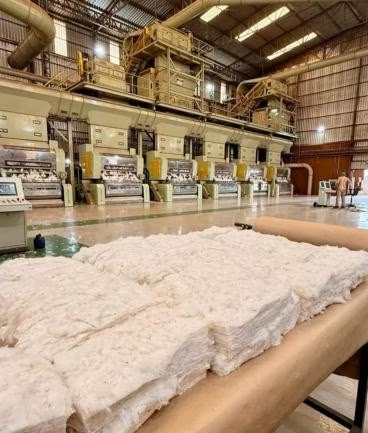
The ginning process directly influences fibre length retention, nep formation, seed coat fragments, trash content, and moisture distribution. These characteristics define spinning efficiency and yarn performance.
Research consistently shows that aggressive ginning conditions increase short fibre content and nep generation, reducing yarn strength and increasing end breakage rates (Anthony & Mayfield, 2007). Conversely, optimised ginning parameters preserve fibre structure and improve downstream processing stability.
Industry data from the International Cotton Advisory Committee (ICAC) indicate that improvements in ginning efficiency can reduce fibre damage by up to 15–20%, translating into measurable gains in yarn uniformity and mill productivity.
The implications extend beyond quality metrics:
- Reduced waste in spinning lines
- Lower energy consumption per kilogram of yarn
- Increased loom efficiency
- Enhanced fabric consistency
- Higher export value of cotton lint
In short, fibre performance is engineered at the gin.
Economic Significance of Advanced Ginning
Globally, cotton contributes approximately US$50 billion annually to the textile economy (FAO, 2023). The efficiency and technological sophistication of ginning infrastructure play a decisive role in determining how much of that value remains within cotton-producing regions.
Countries investing in modern ginning technologies, including automated lint cleaning systems, real-time fibre monitoring, and contamination detection have demonstrated increased lint grades and improved market competitiveness. The Australian cotton sector, for example, is frequently cited as a model of integrated agricultural-engineering collaboration, where ginning is treated as a research-intensive discipline rather than a peripheral activity.
Efficient ginning is therefore not only a technical concern; it is a driver of regional economic development.
Bridging Agriculture and Textile Engineering
Ginning sits at a unique intersection: it is both an agricultural post-harvest operation and an industrial engineering system. This dual identity has historically contributed to its marginalisation within textile education, where it is sometimes viewed as outside the traditional scope of engineering curricula.
This separation is artificial.
Modern textile systems demand integrated thinking. Fibre quality, sustainability metrics, contamination control, and lifecycle optimisation cannot be addressed solely within spinning mills. Engineers must understand fibre behaviour from field to fabric.
A curriculum that excludes ginning risks producing professionals skilled in machinery but disconnected from material science at its origin.
Reframing the Fibre-to-Garment Narrative
The widely used “fibre-to-garment” framework often begins at bale opening. Conceptually, this is incomplete. The framework should explicitly start with ginning as the first industrial transformation of cotton.
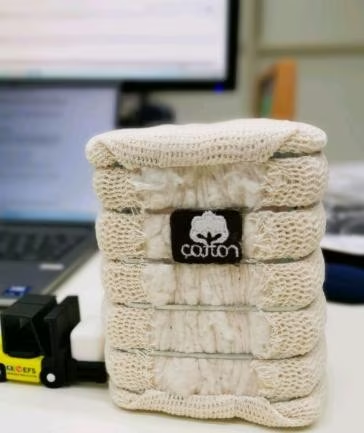
Ginning represents:
- The interface between agriculture and manufacturing
- The primary determinant of fibre integrity
- A critical control point for contamination
- A key contributor to sustainability outcomes
- The foundation of textile value creation
Removing ginning from the conceptual model weakens the entire engineering narrative.
Reintegrating it strengthens system-wide understanding.
Implications for Future Textile Innovation
Emerging priorities in textile engineering sustainability, traceability, smart manufacturing, and circular systems cannot be fully realised without attention to upstream fibre preparation.
Advanced ginning technologies support:
- Reduced fibre waste
- Improved lifecycle assessment
- Enhanced traceability systems
- Contamination prevention
- Precision fibre grading Data-driven supply chain optimisation
These capabilities position ginning as a central pillar of next-generation textile systems, not a legacy process.
Conclusion
The textile industry’s future depends on holistic engineering education. Ginning must be recognised as a foundational discipline that shapes fibre behaviour, industrial efficiency, and economic value.
Reintroducing ginning into academic curricula, research agendas, and professional discourse is not an act of nostalgia, it is a strategic necessity.
The fibre-to-garment chain does not begin in the spinning mill.
It begins at the gin.
References
Anthony, W. S., & Mayfield, W. D. (2007). Cotton Ginners Handbook. USDA Agricultural Research Service.
International Cotton Advisory Committee (ICAC). (2023). Global Cotton Market Statistics.
Food and Agriculture Organization (FAO). (2023). Cotton and Global Textile Economy Report.
Australian Cotton Research and Development Corporation (CRDC). (2022). Advances in Modern Cotton Ginning Technologies.
Author Bio
Prof. Dr. Nurullah Soomro is an academician, researcher and ginning and textile industry advocate focused on fibre quality optimisation, ginning systems, and integrated textile value chains. His work promotes bridging agricultural science and textile engineering to strengthen global cotton competitiveness and educational frameworks.












I congratulate and support the ideas of the author, Professor Dr. Nurullah Soomro. Indeed, high-quality ginning—separating the fiber from the seed without compromising its quality—directly influences the spinning of high-quality thread, the production of high-quality textiles, and the sewing of high-quality clothing. Abdurakhim Khojiev, Professor at Namangan State Technical University
Dear Professor Abdurakhim Khojiev,
Thank you very much for your thoughtful comment and for sharing your valuable perspective. We truly appreciate your support for Professor Dr. Nurullah Soomro’s ideas. As you rightly pointed out, high-quality ginning is a fundamental step in the entire textile value chain, directly affecting yarn quality, fabric performance, and ultimately the quality of finished garments.
Your insight as a professor at Namangan State Technical University adds great value to this discussion, and we are pleased to see experts from academia contributing to this important topic.
Thank you again for engaging with the article and for being part of the conversation.
Kohan Textile Journal