Four months ago, the world watched how the Taliban regained control over Afghanistan after 20 years.
“It was unimaginable that something like this would happen overnight,” Farshied Jabarkhyl, whose parents fled Afghanistan in 1979-80 after the Soviet invasion, told Arab News. Jabarkhyl was born in London and has been living in the UAE for the past 15 years.
“I’m definitely grateful that I do have an option to be abroad,” he told Arab News. “I think it’s most difficult for the Afghans there, and that’s why I personally want to be involved in trying to support them.”
 Carpet Craft as a Path to Economic Independence
 Carpet Craft as a Path to Economic Independence
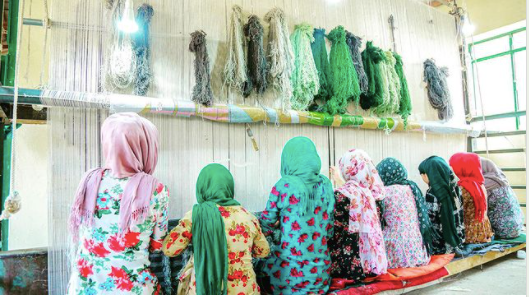
Jabarkhyl is the director of the Fatima bint Mohamed Bin Zayed Initiative, which empowers female artisans in rural areas of Afghanistan to achieve economic independence by producing the country’s best-known export — carpets.
Since its establishment in 2010, FBMI has employed more than 8,000 multi-ethnic Afghans, providing them with crucial social services from health check-ups to free schooling for their children.
“Being a part of this project is close to my heart,” said Jabarkhyl. Some of the women involved have disabilities, others are widows and the sole breadwinners for their families. “Women have faced a lot of challenges. It’s been 40 years of continuous war,” he remarked, adding how women’s progress in media, politics, and journalism during the past 20 years has now been lost almost instantaneously.
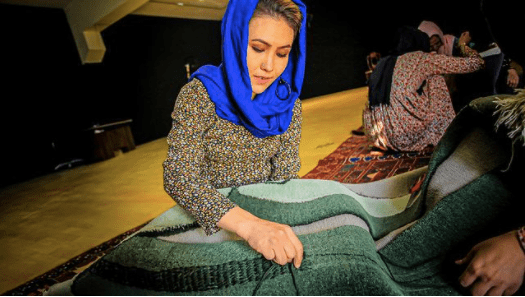
Carpet weaving is a centuries-old part of Afghan culture; a form of craftsmanship passed down from one generation to the next. It is most common in the northwestern part of Afghanistan, bordering the weaving epicenters of Iran and Uzbekistan. It requires concentration, dexterity, and attention to detail.
“It’s not as easy at it looks,” explained Jabarkhyl. “It’s something the women should be proud of, and that’s what we try to showcase to the world — the value in carpets, the effort that goes into them, and the story behind them, which a lot of people unfortunately tend to miss. A carpet takes months to weave, it’s made with love in a home by people with a very strong story behind them. It’s a work of art, which I think needs to be appreciated more.”
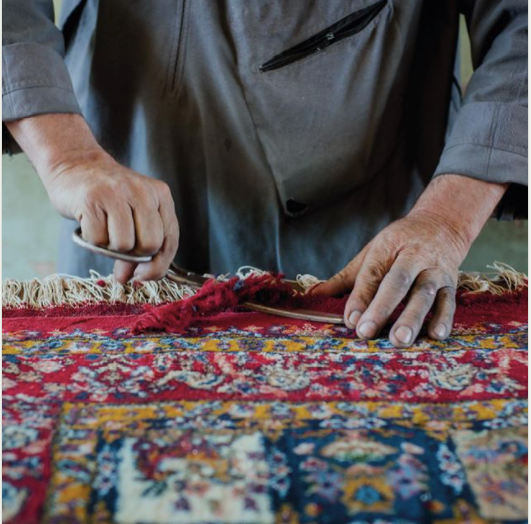
It is also apparently considered a culturally acceptable profession for Afghan women, who do not have the same working rights as their male counterparts.
“Women in Afghanistan cannot go to a workplace, unfortunately, especially in villages,” said Jabarkhyl. “We chose a form of employment where we give women the looms and materials in their homes, and the men are out working.” The sociable process, in which two or three women work together on a single carpet, commences by collecting sheep wool from nomads and shepherds. The wool is hand-spun into yarn, which is dyed by natural pigments derived from fruits and vegetables. The colored material is then distributed to the weavers, who create the hand-woven carpets using the supplied looms.
The final product is shipped from FBMI’s Afghan processing centers to Dubai — to the organization’s Dubai Design District showroom (and social enterprise) Zuleya (which means ‘carpet’ in the Emirati dialect), thus following Zuleya’s concept: ‘From sheep to shop.’ In an auction hosted with the United Nations High Commissioner for Refugees, a selection of the weavers’ unique carpets — intricately woven floral and geometric patterns in a plethora of colors and shapes — were on display at this year’s Downtown Design.
The FBMI team hope to shed light on Afghanistan’s national treasure amidst a prolonged time of political uncertainty. “The issue with Afghan culture is that it never made it out there in a positive way,” said Jabarkhyl. “People tend to associate Afghanistan with Iran or Pakistan. But the national language is different and there are different tribes; Afghanistan has a very strong heritage and culture that goes back thousands of years. When people hear ‘Afghanistan’, they think of war, but it has a very rich identity.”
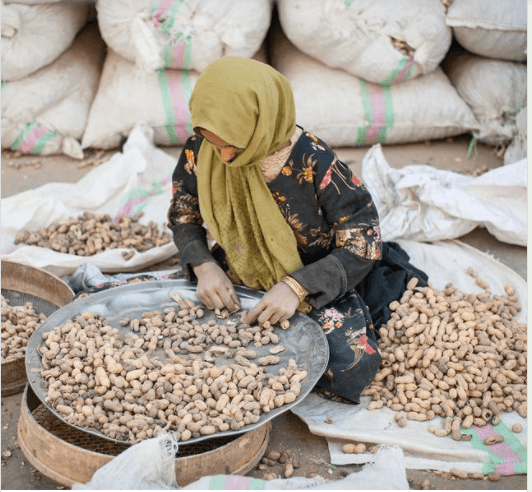
The big question, however, is whether the recent government change will hinder FBMI and other initiatives’ operations in Afghanistan. Jabarkhyl admitted that it hasn’t been a smooth transition, as flights between the UAE and Afghanistan have been halted, prompting a need to figure out alternative routes for importing the carpets. The people on the ground in Afghanistan, meanwhile, are understandably more focused on ensuring the women’s safety than on maintaining output.
“It’s been challenging,” Jabarkhyl said. “But our work goes on. We have to continue.”