




By Ana Carolina Nielson, Founder of Casa da Toalha, Brusque, Brazil
Brazil is a large towel market that rarely appears in export-planning conversations, and when it does, it is often reduced to one word: price. Our own data suggests that this is the wrong way to read the market.
We have sold towels online in Brazil since August 2009 from Brusque, Santa Catarina, one of Brazil’s established textile regions. In August 2026, we published our first annual study of the Brazilian towel market.
It is based on 21,546 real orders placed between January and July 2026, 46 months of transaction seasonality, 12 months of search data, and two checkout surveys with 502 and 226 respondents.
We also released the aggregated dataset as open data under a CC BY 4.0 licence. For us, that matters: we would rather have our arithmetic checked than have our conclusions quoted vaguely.
Here is what we believe matters to a mill or exporter looking at Brazil.

The Buyer Is Afraid of Quality, Not Price
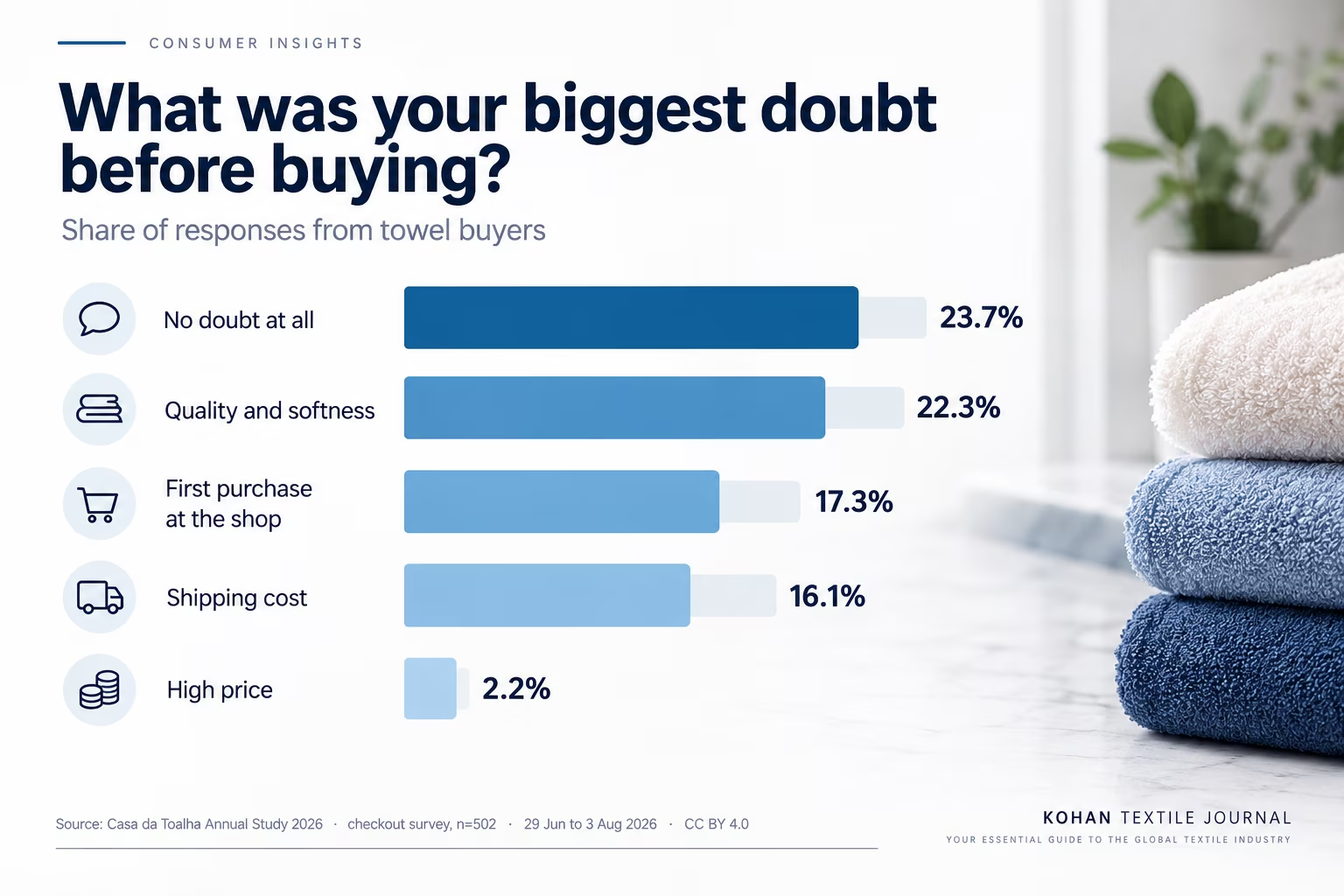
We asked 502 shoppers what worried them most before completing a purchase. Quality and softness came first, at 22.3%. High price was the main concern for only 2.2%. Shipping cost worried 16.1%, while 17.3% said they had never bought from us before.
For a supplier, this reframes the brief. The retailer’s hardest job is not simply to be cheap. It is to prove the hand feel and expected performance of a towel through a screen. Anything a mill can provide that makes that proof easier — verified grammage, a clear yarn description, dimensions, construction details or wash-cycle performance — can be more valuable to the retailer than another small discount.
The End Consumer Now Speaks Our Language
Grammage used to live mainly on technical sheets and in sourcing meetings. In 12 months of Google Search Console data, technical queries such as “bath towel 500 GSM” and “what is the best GSM for a bath towel” generated more than 20,000 impressions for a single shop. A second cluster around hotel towels generated roughly 15,000 impressions.
The consumer is borrowing the hospitality industry as a quality benchmark and borrowing the industry’s technical vocabulary to describe what they want. For an exporter, this cuts both ways: the technical sheet becomes a marketing asset, but it also becomes something the end customer can compare and question.
Grammage Without Dimensions Is an Incomplete Quote
None of this is new inside a mill, but it is increasingly relevant to the person paying for the product.
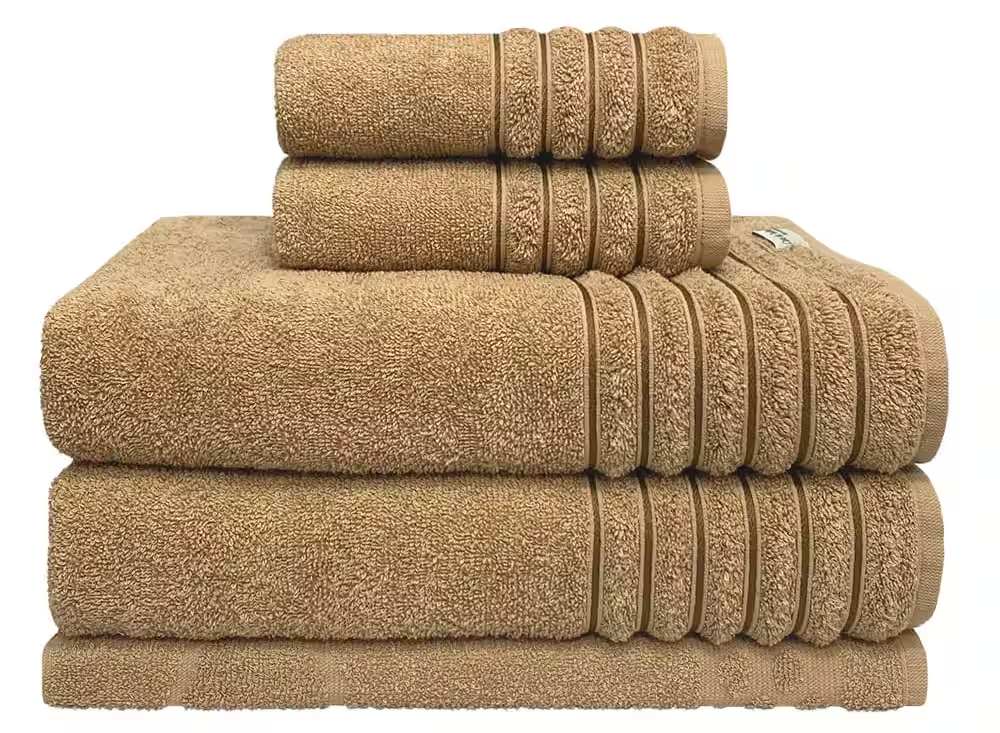
A bath towel measuring 78 × 145 cm at 500 g/m² has a textile mass of about 565.5 grams. A towel measuring 70 × 135 cm at the same 500 g/m² weighs about 472.5 grams. The larger towel therefore contains approximately 20% more material by weight, even though both carry the same GSM figure.
Once consumers learn to compare grammage, retailers need both numbers stated together — GSM and dimensions — on the quote and on the product page. We left dimensions off some of our own product pages for years, so this is not a complaint about suppliers. It is a request for clearer product information.
Towels Leave the Shelf in Fives
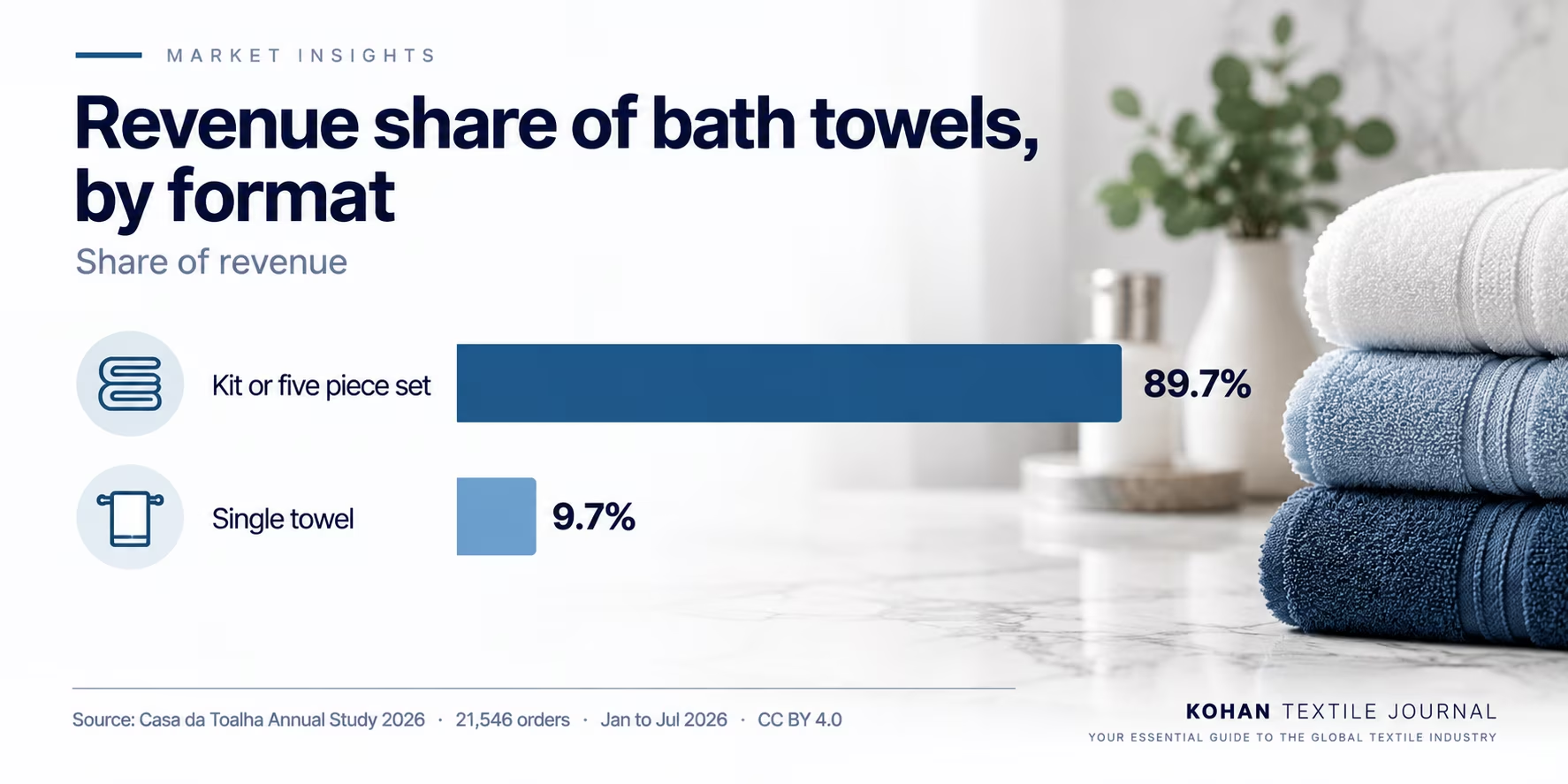
In our study, 89.7% of bath-towel revenue came from five-piece sets and kits, while single towels accounted for 9.7%. The average order value was around R$332.
For mills, that has production consequences a single-piece price does not capture. A set requires colour consistency across several pieces and sizes, dye-lot matching between bath, face and floor towels, and packaging designed around the complete set rather than the individual item. A mill can produce excellent single towels and still create a retail problem if colour drifts across the different pieces in the set.
November Is the Peak Month in the Measured Series
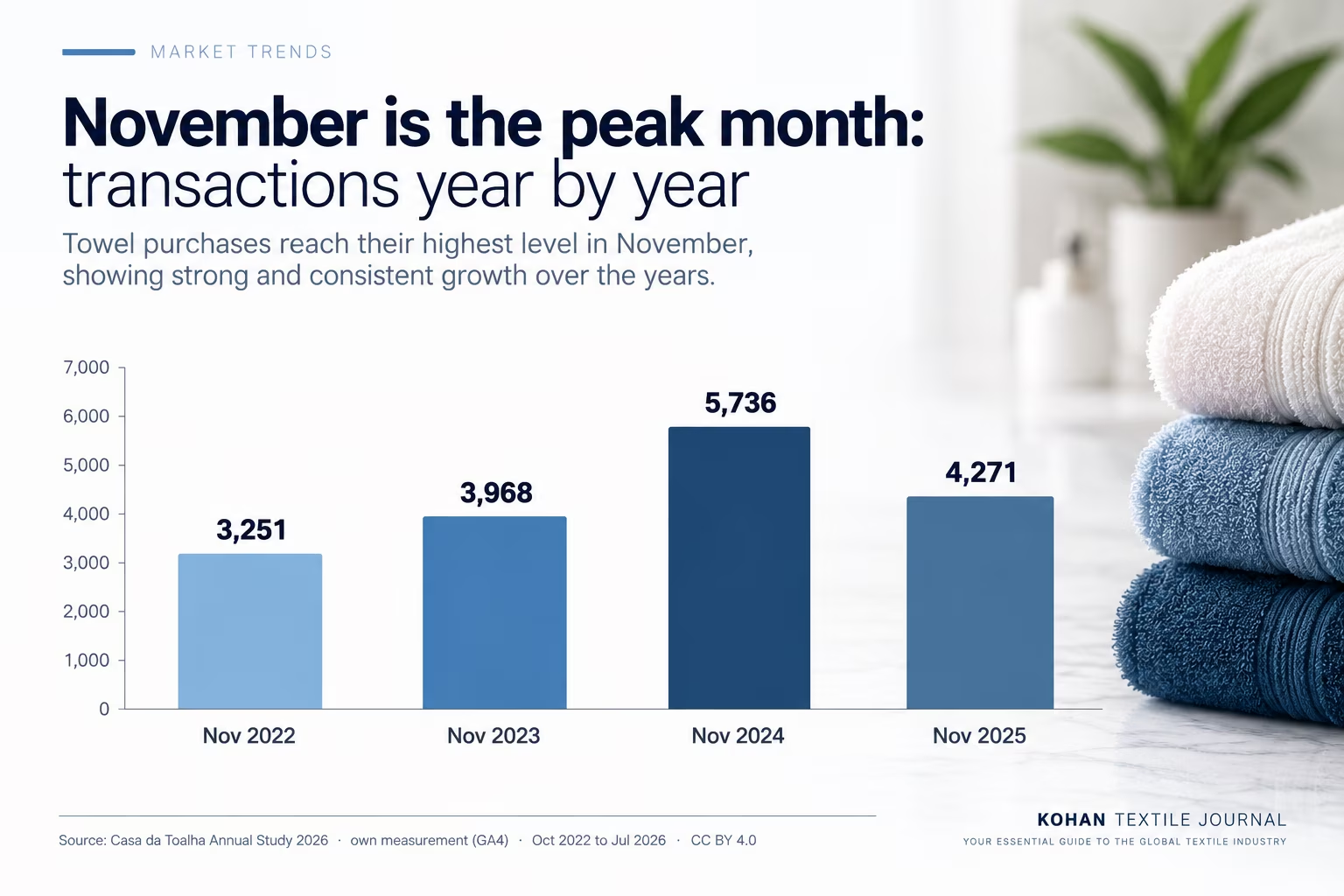
Across the measured series, from October 2022 to July 2026, November was the peak month in each of the four completed years containing a November. The underlying figures supplied with the study record 3,251 transactions in November 2022, 3,968 in 2023, 5,736 in 2024 and 4,271 in 2025. In November 2024, transactions nearly doubled relative to a typical month in that year.
The second demand wave is the Southern Hemisphere winter, from June to August. The quietest stretch is December through February. For anyone planning shipments into Brazil, this means lead times should be worked backwards from November rather than from Christmas.
Reputation Travels With the Cloth
Among 226 buyers who told us what gave them confidence to complete a purchase, 12.4% named Reclame Aqui, Brazil’s major consumer reputation platform, while 7.1% cited other customers’ reviews and photos. Together, that is 19.5% — roughly one in five respondents.
For a mill, the implication is indirect but important. The retailer’s reputation becomes part of the product experience. If a shopper cannot validate the retailer through reviews, customer photos or an external reputation signal, the towel may be judged almost entirely from its product page and photography.
What We Got Wrong — and Published Anyway
For years, we registered each colour as a separate product instead of treating colour as a structured attribute. When we analysed the historical data, roughly three-quarters of order lines had no usable colour value. That means we cannot publish a reliable colour-preference breakdown this year — even though it is precisely the kind of information a mill would find useful.
We publish that limitation openly. The dataset reflects the customers of one online retailer; it is not a probabilistic sample of Brazil. The 226-response checkout survey covers one week and is treated as a signal rather than a national conclusion.
Read more: Top Towel Manufacturers in Turkey: Inside the Global Success of Turkish Towels
Why We Opened the Data
The aggregated table behind the study is published as a downloadable CSV under a CC BY 4.0 licence, allowing journals, mills, researchers and students to reuse the data with attribution and to check the calculations themselves.
Product discovery is also moving beyond lists of links toward direct answers generated by digital systems. In that environment, technical information has to be clear, structured and verifiable.
The knowledge that once travelled with a sales representative and a sample book now also has to survive the journey to a product page, a data feed and a digital answer delivered to a buyer who may never touch the towel before paying for it.
That is the work we are doing in Brusque, and we would be glad to hear how textile manufacturers and retailers in Iran and across the wider region are approaching the same challenge.











