




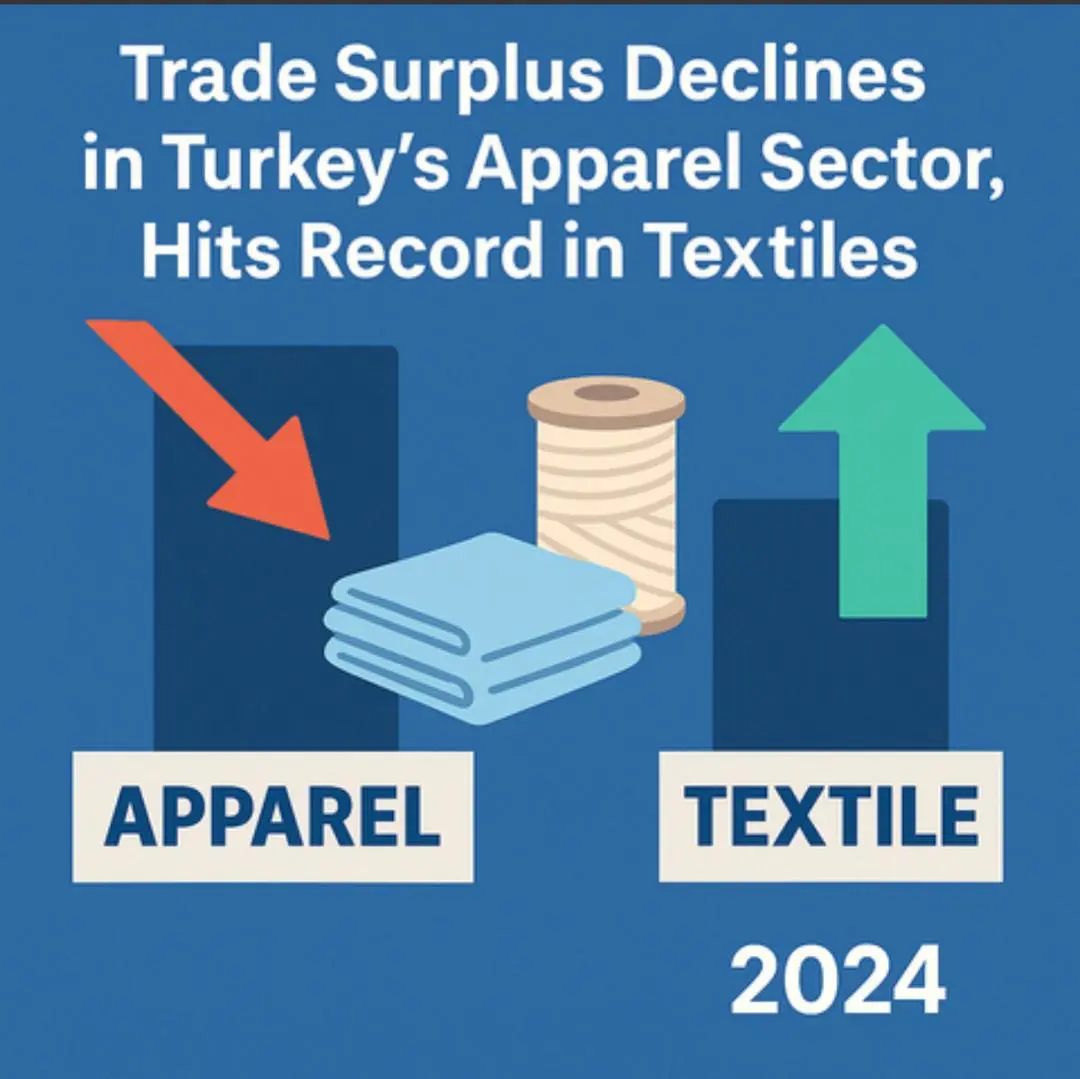
Turkey’s ready-to-wear (apparel) industry has recorded its lowest foreign trade surplus in six years, reflecting the mounting pressure of rising production costs and growing import volumes. In contrast, the textile and raw materials sector celebrated a milestone, achieving an all-time high trade surplus in 2024, signaling a major shift within the broader textile value chain.
According to annual foreign trade reports published by the Istanbul Apparel Exporters’ Association (İHKİB) and based on data from the Turkish Exporters Assembly (TİM), the apparel and garment sector posted exports of $19.7 billion in 2024. However, imports surged by 23.1% to $3.96 billion, setting a historic record and pulling the trade surplus down to $15.7 billion. This figure marks the lowest level since 2018 and reflects a three-year trend of declining surpluses, which peaked at $19.6 billion in 2022.
Industry experts attribute this downward trend to high domestic production costs, which are prompting several brands to shift manufacturing operations abroad. This move, if sustained, could result in a permanent loss of production capacity in Turkey’s apparel sector, which has long been one of the country’s key export drivers.
Textile Sector Achieves Record Trade Surplus
While the apparel segment is under strain, the textile and raw materials sector demonstrated remarkable resilience and growth. In 2024, textile exports reached $9.04 billion, while imports declined to $7.9 billion. This resulted in a trade surplus of $1.14 billion—more than doubling the previous year’s surplus of $520 million, representing a 112% year-on-year increase and marking the highest surplus in the history of the sector.
The surge in textile trade performance was aided by an 11.5% reduction in imports. Significant declines were noted in imports from key supplier countries such as China (down 12.3%), Italy (down 14.4%), and India (down 38%). On the other hand, imports from Brazil surged by 57.2% to $475 million.
Import Spike from Competitor Countries
As domestic costs soared, Turkey witnessed a notable rise in apparel imports from competitive markets. Garment imports from China climbed 28.6% to $748 million, while imports from Bangladesh increased 49% to $698 million. Cambodia recorded a 54.5% increase with $230 million in exports to Turkey, and Egypt’s exports to Turkey rose 21.7% to $254 million.
Egypt, in particular, is gaining ground due to its lower labor costs, tax-exempt trade agreements with the United States, and government-backed incentives, making it an increasingly attractive sourcing destination.
Concerns Over Competitive Advantage
The erosion of Turkey’s foreign trade surplus in apparel is raising concerns about the country’s long-term competitiveness in global markets. Industry representatives warn that Turkey risks losing its edge unless immediate steps are taken to support domestic production.
Calls have intensified for reforms to make local production conditions more attractive, especially in light of intensifying international competition. Experts advocate for cost-reduction incentives, supply chain investment, and targeted support for local manufacturers to restore balance and regain market share.
At the same time, the impressive performance of the textile sector suggests a potential reallocation of value within the broader industry. The data indicates that some of the capacity lost in apparel manufacturing is being absorbed by the textile and raw materials sector, contributing to its record-breaking performance.
Looking Ahead
While the apparel sector’s declining surplus underscores the challenges of maintaining global competitiveness under current economic conditions, the robust performance of the textile sector provides a silver lining. If effectively supported by industrial policy, Turkey’s textile industry could serve as a foundation for renewed strength across the entire textile-apparel value chain.
The divergent trends call for a comprehensive strategy that balances competitiveness, sustainability, and value creation—ensuring that both the apparel and textile industries can continue to thrive in an increasingly complex global trade environment.











