Textiles are an integral part of our everyday lives, and yet very few people realise how much work and care goes into their production. Without finishing, i.e. without dyeing, printing or coating, many fabrics cannot fulfil their function and would therefore be worthless.
Textilveredlung Drechsel GmbH, a family business based in Selb, Bavaria, has dedicated itself to this important task and transforms textile raw materials into high- quality products. In doing so, the company has long relied on its co-operation with machine manufacturer Mahlo.
The history of Textilveredlung Drechsel GmbH is an impressive journey from humble beginnings to a renowned service provider in the textile industry. The company was founded in 1950 by Emil Geipel and Friedrich Drechsel under the name „Färberei Geipel & Drechsel“.
The company originally started out dyeing yarns for the carpet and scarf industry and re-dyeing clothes and blankets. As early as 1952, they revolutionised the industry by using the first stenter frame to dry the dyed and washed textiles, which significantly accelerated the process.
Over the next 30 years or so, the company grew steadily. Today, Textilveredlung Drechsel GmbH is a leading service provider and finishes a wide range of textile products, including sun protection textiles such as vertical blinds, roller blinds and pleated blinds, as well as household and home textiles, upholstery fabrics and, increasingly, technical textiles. With around 150 employees, the company processes between 10 and 15 tonnes of textiles every day, which corresponds to around 80,000 to 150,000 square metres.
Today, the management of the family business is in the hands of Managing Director Dr Ernst Drechsel, his son Bernd Drechsel and his niece Annette Herold. ‘Our aim is to always fulfil the growing demands of the market and offer innovative solutions,’ says Bernd Drechsel.
The systems from Mahlo GmbH + Co KG in Saal an der Donau, Bavaria, have been an important part of realising these requirements for many years. The beginnings of the business relationship go back over 40 years. And even in the recent past, the family business has repeatedly opted for Mahlo. ‘In 2001, we purchased a coating stenter frame. Due to our product diversity, we had the requirement that a wide variety of goods could be transported with it.’
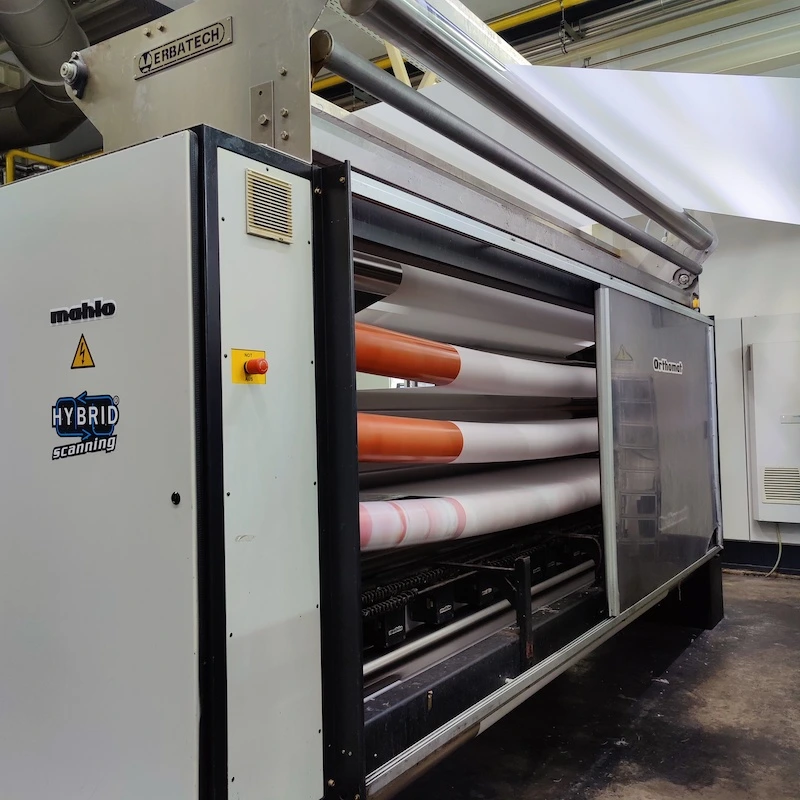
After extensive testing, only Mahlo was able to fulfil the requirements as desired. The clamping frame was therefore fully equipped with a Mahlo levelling machine, three measuring bridges of the Qualiscan QMS quality measuring system and a process control system.
Technological innovations for maximum precision
With the Orthopac RVMC automatic straightening system, distortions can be recognised and rectified in almost all textile applications. ‘This is absolutely essential before the fabric goes into the finishing process, as distortions can then no longer be corrected or can only be corrected with a new fabric pass,’ explains Drechsel.
Among other things, the three QMS systems check whether the coating application corresponds to the specified quantities or whether the product has the correct moisture content. ‘In this way, we not only ensure the function of the textile, but also enable sustainable production, as we do not consume any unnecessary raw materials or energy.’
Customised solutions for complex requirements
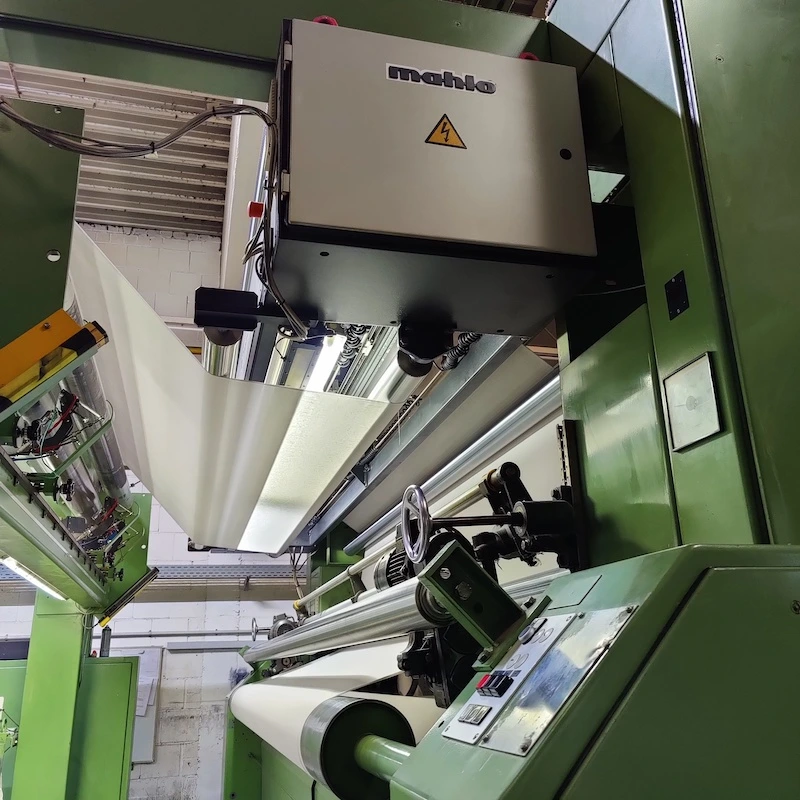
In 2004, Drechsel modernised its stenter frame – and at the same time created a special project for Mahlo. The space available for installation was not exactly generous. Matthias Wulbeck, Product Manager QCS at Mahlo, remembers the customisation of the straightening machine for Drechsel: „As there were space problems at the outlet, we customised the straightening machine for Drechsel.“
The machine manufacturer redesigned a space-saving fine straightener so that it could be integrated into the outfeed. „That was a lot of work and investment on both sides, but it was worth it.“ Mahlo‘s ability to find solutions even in difficult cases characterises the company and is a decisive factor in the long-standing cooperation between the two family businesses.
Another example of this close partnership is the anecdote about the breakdown of a straightening machine that required special rollers with a special width. In a night and fog operation, Mahlo employees in Saal removed the rollers from another machine, transported them to Selb and installed the parts so that the production line could start up again smoothly on Monday. ‘Responding quickly to customer problems and utilising systems as effectively as possible is what unites us,’ says Wulbeck.
Expanded capacities for a sustainable future
The successful collaboration between these two companies continues to this day. In 2023, Drechsel invested in an additional coating stenter frame to increase capacity and minimise the risk of downtime. And of course, this investment was also made in close cooperation with Mahlo. Another Qualiscan QMS quality measuring system with three scanning frames supports the smooth running of the production line.
Through reliability and quality, also thanks to the Mahlo systems, Textilveredlung Drechsel GmbH has established itself as an important partner in the textile industry. With a combination of tradition and innovation, a wide range of applications and a dedicated workforce, the company has proven that textile finishing is not only an art, but also a central component of the textile industry.