Intertextile Shanghai 2026
cinte techtextil 2026
itma 2027

South Africa to Enforce Stricter Penalties for Corporate Carbon Emissions Under New Climate Law

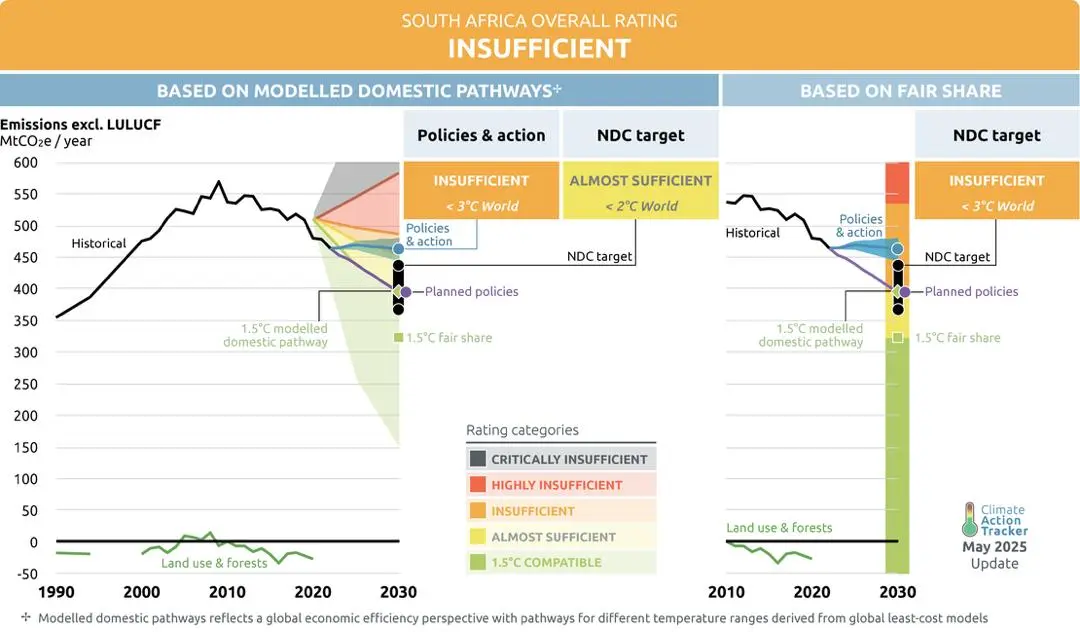
The South African government is preparing to enact a groundbreaking climate law that will impose strict penalties on companies and executives who breach newly introduced carbon emissions limits. The move is part of the country’s intensified efforts to combat climate change and align with its international climate commitments.

Under the new Climate Change Act, signed into law last year, companies in most sectors will be assigned carbon budgets—caps on the amount of greenhouse gases (GHGs) they are permitted to emit. These budgets are determined by the Department of Forestry, Fisheries and the Environment (DFFE) and are tailored to each sector based on a variety of criteria, including historical emissions, industry benchmarks, activity type, and national climate goals.

Companies that fail to comply with the emissions caps could face serious consequences. Executives of non-compliant firms may be fined between R5 million and R10 million (approximately £215,000–£430,000). Additionally, jail sentences of up to ten years could be imposed for first and second offences, particularly if companies fail to submit required GHG mitigation plans or are found to have provided false or misleading information to authorities.

The technical guidelines for setting sector-specific emissions benchmarks are currently available for public comment until 30 September. Once finalized, they will inform the carbon budget allocations across various industries.

This legislation marks a major shift in South Africa’s environmental policy, reflecting a move from voluntary to enforceable climate accountability. It signals a clear message to corporations that environmental negligence will come at a steep cost, both financially and legally.

The law is also expected to encourage companies to invest in decarbonization strategies, adopt cleaner technologies, and contribute meaningfully to South Africa’s broader climate resilience goals.

Follow us on YouTube for more

LEAVE A REPLY

Please enter your comment!
Please enter your name here

spot_img
spot_img
spot_img
spot_img
spot_img
spot_img
spot_img
AMEC AMETEX
spot_img
spot_img

Related News

Nigerian Government Launches Textile Revival Plan to Create 1.5 Million Jobs

The Nigerian government has stepped up efforts to revive...

The Global Fabric Industry in 2026: Who Will Lead the Next Decade?

The global textile industry has never been static. For...

The Countdown to ITM 2026 Has Begun: Global Textile Investors Will Meet in Istanbul

The countdown has begun for ITM 2026 International Textile...

Texprocess 2026 Reflects a New Era of Integrated Digital Manufacturing in the Textile Industry

Digital Transformation Moves Beyond Experimentation The 2026 edition of Texprocess...

Vietnam Textile Industry Attracts High-Tech FDI

Vietnam’s textile and garment sector is increasingly attracting high-tech...

12 Things You Should Know About Türkiye’s Textile and Apparel Industry

Türkiye has long been recognized as one of the...

EU Backs Net-Zero Roadmap for Sri Lanka’s Textile Sector

The European Union has reinforced its support for Sri...

Can Africa’s $164 Billion Sovereign Wealth Funds Accelerate Textile Industrialization?

An Editorial Analysis by Kohan Textile Journal Introduction: Africa’s Industrial...

TAYAL Highlights Growing Algeria–Türkiye Textile Partnership at Ankara Business Forum

TAYAL, one of Algeria’s leading textile manufacturers and a...

Water Use and Pollution in the MENA Textile Industry

Executive summary Textile manufacturing in the Middle East and North...

All You Should Know About Physical AI in the Textile Industry

Executive summary “Physical AI” is the next step beyond dashboards...

China Expands Zero-Tariff Access to 53 African Countries

China has fully implemented zero-tariff treatment for 53 African...