






A Kohan Textile Journal discussion on manufacturing, nearshoring, circularity, sourcing and Morocco’s emerging role in the Euro-Mediterranean textile supply chain
From a LinkedIn Post to an Industry Conversation
When Kohan Textile Journal recently launched its Morocco Textile Industry Hub, our objective was straightforward: to create a dedicated and continuously updated resource for professionals sourcing from, investing in, supplying to, or researching Morocco’s textile and apparel industry.
The Hub brings together key areas of the sector, including manufacturing, trade, investment, textile machinery, sustainability, Morocco’s textile heritage and relevant exhibitions. Following the launch, we shared the initiative with our professional community on LinkedIn. What we expected to be a straightforward announcement quickly developed into something much more interesting.
The post attracted textile executives, manufacturing specialists, industrial consultants, sustainability and certification experts, suppliers and sourcing professionals. Within only a few days, as of September 2026, it had generated around 1,950 impressions, more than 50 reactions and 27 comments.
But the numbers were not what caught our attention.
It was the quality of the conversation.
Industry professionals began sharing their own experiences and perspectives on Morocco’s manufacturing potential, nearshoring, sourcing transparency, sustainability, recycling and the development of a stronger textile ecosystem.
The discussion soon moved beyond the launch of the Morocco Textile Industry Hub and raised a much bigger question:
Could Morocco evolve from an important apparel manufacturing base into one of the Euro-Mediterranean region’s leading textile, sourcing and circularity hubs?
Rather than allowing these valuable perspectives to disappear into a LinkedIn comment thread, Kohan Textile Journal decided to bring some of the most interesting contributions together, combining them with our editorial analysis to explore where Morocco’s textile industry could be heading next.
Join the original industry discussion on LinkedIn
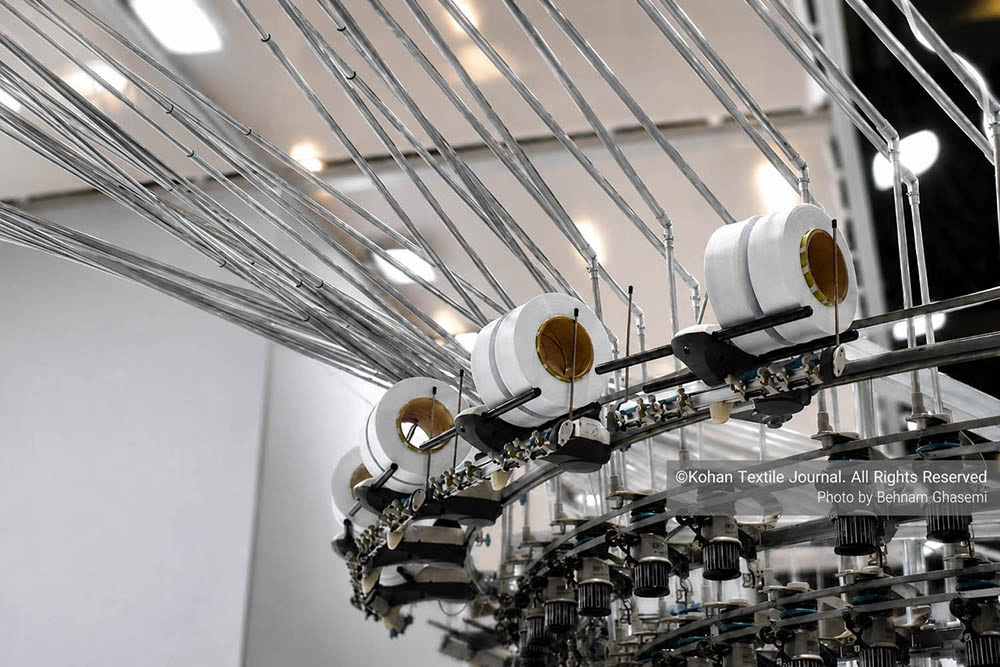
Morocco’s Textile Opportunity Is Bigger Than Nearshoring
Geography remains one of Morocco’s most obvious competitive advantages. Its proximity to Europe gives manufacturers the possibility of serving European customers through shorter and potentially more responsive supply chains than many distant production centres.
But geography alone does not create a competitive textile industry.
Bernard Samaraweera, an international apparel manufacturing executive with experience setting up factories across Ethiopia, Ghana and Madagascar, described Morocco as a “rising star in African textile manufacturing.” He also highlighted the growing need for structured sourcing information as international buyers evaluate manufacturing opportunities across the continent.
His observation points to an important distinction.
The next stage of Morocco’s textile development should arguably not be measured only by how many factories the country attracts or how much apparel it exports. The more important question is how much of the textile value chain Morocco can build around those factories.
During the discussion, Samaraweera identified four important areas separating industrial potential from genuine international competitiveness: reliable infrastructure, supporting industries, efficient logistics and supply chains, and technical knowledge transfer.
These factors are particularly relevant for Morocco.
A successful nearshoring model cannot depend indefinitely on importing a significant share of its yarns, fabrics, accessories, technology and technical expertise while competing primarily through garment assembly.
The greater opportunity is to develop a deeper ecosystem capable of offering European and international customers speed, flexibility, quality, innovation and increasingly sophisticated production capabilities.
In other words:
Nearshoring can bring orders to Morocco, but industrial depth will determine how much value Morocco captures from those orders.
Read More: Morocco Textile Industry: How It Became Africa’s Nearshoring Hub for Europe
Potential Is Not Enough: Building the Textile Ecosystem
This distinction between having manufacturing capacity and having a complete textile ecosystem is crucial.
International experience shows that garment production can develop relatively quickly, but building the industries surrounding it takes considerably longer.
Spinning, weaving, knitting, dyeing, finishing, accessories, chemicals, machinery services, testing laboratories, logistics, recycling and technical expertise all contribute to the competitiveness of the final garment manufacturer.
The stronger these supporting industries become, the less dependent manufacturers are on long and complicated international supply chains. A closer look at Morocco’s textile manufacturing landscape shows where these supporting industries currently stand.
For Morocco, therefore, attracting another apparel factory is valuable. But attracting investment into a missing part of the textile value chain could sometimes create an even greater long-term impact.
That is where the country’s next industrial opportunity may lie.
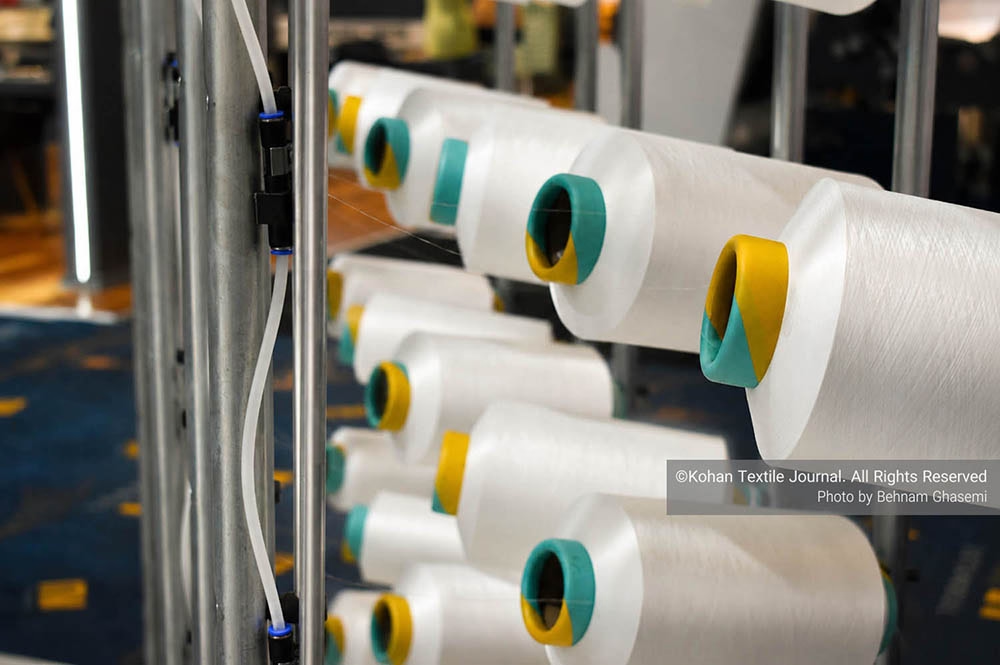
Could Morocco Become a Circular Textile Hub for Europe?
Perhaps the most interesting discussion generated by the LinkedIn post concerned textile circularity and recycling.
Redouane Lachgar, an industrial consultant specialising in textiles, apparel, supply chains and industrial development, contributed extensively to this part of the conversation and shared two reports produced as part of the IFC-backed MoroccoTex Circularity initiative: Closing the Loop: Scaling Circularity in Morocco’s Textile Industry and Accélérer la circularité textile au Maroc.
His perspective shifted the discussion from sustainable manufacturing towards a larger industrial question:
Could Morocco eventually become an important textile recycling and circularity centre serving both its domestic industry and nearby European markets?
Lachgar argued that one of the biggest challenges is not necessarily recycling technology itself, but creating the ecosystem capable of feeding recycling operations at industrial scale.
This begins with collection.
Recycling plants require sufficient and predictable volumes of material. Those materials need to be collected, sorted, classified and traced before they can reliably become industrial raw materials.
According to Lachgar, Morocco has already demonstrated that textile recycling can be technically and commercially viable, but developing a reliable and structured collection ecosystem remains essential for scaling the industry. These developments form part of a broader picture of sustainability across Morocco’s textile sector.
This changes the nature of the challenge.
The question is no longer simply:
Does Morocco have access to textile recycling technology?
It becomes:
Can Morocco build the collection, sorting, traceability and recycling infrastructure necessary to operate that technology economically at scale?
That distinction will determine whether circularity remains a collection of individual projects or develops into an entirely new industrial value chain.
Read More: IFC Pilot Demonstrates Strong Potential for Textile Circularity in Morocco
From European Textile Waste to Moroccan Raw Material?
The discussion then moved one step further.
Could Morocco’s proximity to Europe eventually allow it to play a role not only in manufacturing clothing for European consumers, but also in processing textile materials returning from European markets?
Lachgar believes this could become a significant industrial opportunity.
He pointed to Morocco’s positioning in relation to the EU Waste Shipment Regulation and the possibility of developing capacity to receive, sort, reuse and recycle appropriate used garments and textile waste streams under the applicable regulatory and environmental framework.
His argument is important because it changes how textile waste is viewed.
Instead of treating used textiles exclusively as an environmental burden, suitable waste streams can potentially become industrial feedstock.
Materials could be sorted according to their condition and fibre composition. Products suitable for continued use could remain within reuse channels, while recyclable textiles could enter fibre-recovery processes and potentially return to textile manufacturing.
For Morocco, the theoretical industrial loop could become:
Europe → Collection → Sorting → Recycling → Fibre/Yarn/Fabric → Manufacturing → European & International Markets
This possibility becomes particularly interesting as Europe moves towards stronger textile circularity requirements.
However, there is an important distinction.
Morocco should not aim to become a destination for Europe’s unwanted textile waste.
The opportunity is fundamentally different:
Morocco could position itself as a destination for transforming suitable textile waste streams into industrial value.
That requires regulation, environmental safeguards, traceability, investment and sufficient processing capacity.
If these elements develop successfully, recycling could become another component of Morocco’s textile manufacturing ecosystem rather than a separate waste-management activity.
Sustainability Is Becoming a Market-Access Issue
Circularity is only one part of the sustainability equation.
Another contributor to the discussion was Amine M., who works with OEKO-TEX and Hohenstein on textile certification, lab testing, compliance and audit/inspection services, covering international market access and sustainability for Morocco and Tunisia.
His participation highlights an important reality for Morocco’s export-oriented textile manufacturers:
Sustainability is increasingly connected to market access.
Certification, chemical compliance, testing, traceability and environmental performance are becoming increasingly relevant to international textile trade.
For factories supplying demanding international customers, particularly European brands and retailers, these requirements can directly influence sourcing decisions.
This means sustainability should not necessarily be considered simply as an additional cost imposed on manufacturers.
Handled strategically, it can become a competitive advantage.
Factories capable of demonstrating credible environmental performance, product safety, traceability and internationally recognised compliance are better positioned to work with global brands seeking to reduce supply-chain risks.
For a manufacturing country located so close to Europe, this could become an increasingly valuable differentiator.

Global Buyers Need Transparency
Another important perspective came from Tejaswi Thumu, Founder of Pangea & Co. and a GOTS-certified B2B export specialist turning Indian heritage art into kidswear for boutiques and retailers worldwide, who highlighted the importance of verified industry directories in cross-border sourcing.
As she noted in the discussion:
“Verified industry directories are essential. Cross-border sourcing needs transparency to trust quality and processes.”
Her point was directly connected to the need for transparency around quality and manufacturing processes when buyers source internationally.
This issue is sometimes underestimated.
A country may have hundreds of capable textile manufacturers, but if international buyers cannot easily identify those companies, understand their capabilities or verify their credentials, part of that manufacturing capacity effectively remains invisible to the global sourcing community.
A buyer evaluating a potential supplier wants practical information.
- What does the company manufacture?
- What machinery and technologies does it operate?
- What is its production capacity?
- Which export markets does it currently serve?
- What certifications does it hold?
- Which fibres, yarns and fabrics can it process?
- Can it meet sustainability and traceability requirements?
- Can it accommodate smaller quantities and shorter lead times?
These are precisely the types of connections the Kohan Textile Journal Morocco Textile Industry Hub aims to strengthen over time.
For Morocco, visibility and transparency should become part of the country’s sourcing competitiveness.
Read More: Top Textile Companies and Manufacturers in Morocco
International Suppliers Are Watching Morocco
The discussion also demonstrated that Morocco’s textile opportunity is attracting attention beyond Moroccan manufacturers themselves.
Mrunal Kadia, International Business Manager at COLORZ INDIA, helping textile reactive dyeing and washing units achieve sustainability and profitability through reduced dyeing costs, chemicals, energy, water and ETP load, observed that increasingly stringent sustainability and ecological requirements from European apparel buyers could create opportunities for suppliers capable of helping textile mills improve environmental performance while maintaining commercial viability.
He specifically identified Morocco, alongside Egypt and Türkiye, as a market of interest.
This is an important signal.
As Morocco’s textile industry becomes more sophisticated, the commercial opportunity expands beyond apparel production.
Demand can increase for textile machinery, automation, dyes and chemicals, testing and certification, fibres, yarns, recycling technologies, digital solutions and specialised technical services.
The LinkedIn conversation provided another practical example.
A Turkish manufacturer specializing in regenerated yarn, based in Istanbul and producing GRS-certified open-end recycled cotton and cotton/polyester blended yarns, joined the discussion to highlight recycled cotton and cotton/polyester blended yarns and expressed interest in exploring cooperation with Moroccan textile producers.
The subsequent discussion touched on quality consistency, reliable supply, certification and meeting specific yarn requirements as important factors for increasing recycled-yarn adoption.
These exchanges illustrate something fundamental about textile industrialisation:
A textile cluster does not grow through manufacturers alone.
Machinery companies, chemical suppliers, fibre and yarn manufacturers, laboratories, technology providers, recyclers, logistics companies, consultants and financial institutions all form part of the ecosystem.
The stronger those connections become, the more sophisticated Morocco’s textile industry can become.
Morocco Must Move Up the Textile Value Chain
A broader conclusion therefore emerged from the discussion.
Morocco should not define its textile future exclusively around being a lower-cost alternative to another manufacturing country.
Cost competition alone is difficult to sustain.
There will almost always be another country offering cheaper labour or lower production costs.
Morocco’s stronger opportunity is to compete through a combination of advantages that are much more difficult to replicate:
- Proximity to Europe.
- Shorter lead times.
- Flexible manufacturing.
- A deeper domestic textile supply chain.
- Skilled production.
- Automation and technology.
- Sustainable manufacturing.
- Certification and traceability.
- Recycling and circularity.
- Reliable access to international markets.
This would represent an important change in how the industry measures Morocco’s success.
Instead of simply asking:
“How much apparel can Morocco manufacture?”
the more strategic question becomes:
“How much textile value can Morocco create?”

From Manufacturing Hub to Euro-Mediterranean Textile Platform
Morocco already possesses something many emerging textile destinations spend decades trying to develop: an established manufacturing industry, export experience, proximity to major consumer markets and international recognition as a sourcing destination.
The next phase is about connecting those advantages.
- Manufacturing must connect with technology.
- Sustainability must connect with market access.
- Recycling must connect with manufacturing demand.
- Factories must connect with international buyers.
- International suppliers must connect with Moroccan manufacturers.
And investment should increasingly target missing parts of the textile value chain rather than simply adding more of the same production capacity.
If these elements develop together, Morocco could occupy an increasingly distinctive position — not merely as another apparel-producing country, but as a Euro-Mediterranean textile platform connecting manufacturing, sourcing, technology, sustainability and circularity.
The Conversation Has Only Started
What began as the launch of Kohan Textile Journal’s Morocco Textile Industry Hub unexpectedly developed into a broader conversation about the future of the country’s textile industry.
And perhaps that is the most valuable outcome of the initiative so far. Manufacturing executives brought practical factory experience.
Industrial consultants raised questions about infrastructure and circularity.
Sustainability specialists highlighted compliance and international market access.
Sourcing professionals emphasised transparency.
Material and chemical suppliers identified new commercial opportunities.
Together, these perspectives demonstrate that Morocco’s textile story is no longer simply about apparel manufacturing.
It is increasingly about how the country can position itself within a rapidly changing regional and global textile supply chain.
Morocco clearly has potential. But its long-term success will depend on whether the country can translate geographic advantage, manufacturing experience and proximity to Europe into a deeper, technologically advanced and increasingly circular textile ecosystem.
The central question therefore remains:
Can Morocco become one of the Mediterranean’s leading textile manufacturing, sourcing and circularity hubs?
Frequently Asked Questions
Why is Morocco becoming an important textile nearshoring destination for Europe?
Morocco’s proximity to Europe allows manufacturers to offer shorter, more responsive supply chains than many distant production centres. However, as the discussion highlighted, geography alone is not enough; Morocco’s longer-term competitiveness depends on deepening its domestic textile ecosystem, including spinning, weaving, dyeing, finishing and technical expertise, rather than relying on nearshoring advantages alone.
Could Morocco become a textile recycling and circularity hub?
Industry consultant Redouane Lachgar, drawing on IFC-backed research through the MoroccoTex Circularity initiative, argued that Morocco has already shown textile recycling can be technically and commercially viable. Realising this potential at scale depends on building a reliable collection, sorting and traceability infrastructure rather than recycling technology alone.
What is the Kohan Textile Journal Morocco Textile Industry Hub?
The Morocco Textile Industry Hub is a dedicated, continuously updated resource from Kohan Textile Journal covering manufacturing, trade, investment, textile machinery, sustainability, heritage and exhibitions relevant to Morocco’s textile and apparel sector, created for professionals sourcing from, investing in or researching the industry.
At Kohan Textile Journal, we believe this conversation deserves to continue.
We invite Moroccan textile manufacturers, industry associations, international brands, sourcing professionals, machinery manufacturers, recyclers, investors, certification organisations, technology providers and other textile professionals to share their perspectives.
Your insights may help shape the next chapter of this discussion — and perhaps the next stage of Morocco’s textile industry itself.
Join the original discussion on LinkedIn.
Explore the Kohan Textile Journal Morocco Textile Industry Hub.











