




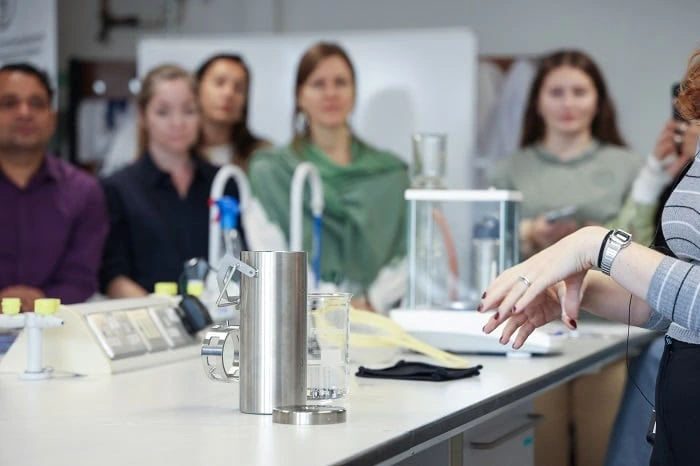
The Microfibre Consortium (TMC) has teamed up with specialist test instrument manufacturer James Heal to hold the first public demonstration of a test method for fibre fragmentation from fabric. The event took place during the Textile Exchange Conference, when delegates embarked on a field trip to King’s College, London, where they were shown the TMC Test Method in action, which utilises James Heal’s Gyrowash to assist in measuring microfibres released from simulated domestic laundering.
The TMC Test Method was developed through a collaborative relationship between The University of Leeds, the European Outdoor Group and The Microfibre Consortium, as well as the larger stakeholder network, following many rounds of testing and validation within the industry.
PhD student Alice Hazlehurst, a researcher at The University of Leeds, who worked on an award-winning paper ‘Quantification of microfibre release from textiles during domestic laundering’, published in January 2023, demonstrated the TMC Test Method for over 40 delegates who were keen to learn more about fibre fragmentation testing and measurement.
Fibre fragmentation refers to the process where small quantities of fibres, often referred to as microfibres, are lost from textiles at various stages of a product’s lifecycle. Estimates suggest that between 6,490 tonnes to 87,165 tonnes of tiny fibres from natural and man-made textile sources, such as cotton and polyester, are released from UK domestic washing machines into the environment each year. These microfibres enter the environment through a number of pathways, such as through wastewater, soil and air.
Microfibres have a persistent nature and whilst their impacts are not yet fully understood, evidence is growing. Due to their shape and/or added chemicals, fibre fragments can cause harm when ingested by organisms, and have been found in humans. Academics from the IMPACT+ Network shared with delegates how the environmental impact of microfibres go under the radar as they are not currently considered in any life cycle assessments.
Created originally for testing colour fastness in laundering fabrics and leather, the James Heal GyroWash was used in controlled laboratory testing throughout the research that led to the final TMC Test Method. This instrument is used in textile testing laboratories worldwide.
In attendance at the event, James Heal technical textiles specialist Helen Warburton commented, “As a company focused on innovation, we are delighted that a James Heal instrument, in this case the GyroWash, continues to be used in this groundbreaking research. We hope it will make a difference in helping the textile industry to recognise and reduce their impact on environmental pollution through relevant testing.”
Dr Kelly Sheridan, research director of The Microfibre Consortium added, “It is fantastic to see so many delegates of Textile Exchange Conference 2023 actively engaged in the topic of fibre fragmentation. The Microfibre Consortium bridge the gap between academia and the industry. It is only through such science-led, industry aligned action that together we will be able to combat microfibre pollution to the environment.”











 has teamed up with specialist test instrument manufacturer James Heal to hold the first public)