An Editorial Analysis by Kohan Textile Journal
Introduction: Apparel Manufacturing Is Entering a Defining Decade
The global apparel industry is moving through one of the most important industrial transformations in its modern history.
For decades, apparel manufacturing relied heavily on a relatively predictable formula: lower labor costs, large-scale production, global sourcing networks, and increasingly aggressive speed-to-market strategies. Factories competed primarily through production capacity and pricing efficiency, while operational systems often remained fragmented and heavily dependent on manual coordination.
That model is now under growing pressure.
Today’s apparel manufacturers face a completely different industrial environment—one shaped by supply chain instability, labor shortages, sustainability demands, rising operational costs, digital consumer behavior, and increasingly unpredictable market cycles. At the same time, brands and retailers are demanding faster production, better visibility, smaller inventory risks, and more flexible manufacturing capabilities.
As a result, technology is no longer viewed simply as a support tool for apparel operations. It is becoming the central driver of competitiveness.
Across the industry, digital transformation is reshaping how garments are designed, sourced, manufactured, tracked, distributed, and even predicted before production begins.

The Traditional Apparel Production Model Is Losing Efficiency
The apparel industry has historically been one of the most fragmented manufacturing sectors in the world.
In many factories, production planning, sourcing, inventory control, warehouse management, quality monitoring, and logistics operations evolved separately over time. Different departments often operated with disconnected systems, delayed reporting structures, and limited real-time visibility.
For years, this inefficiency remained manageable because the industry compensated through low-cost labor and large production volumes.
However, the market no longer operates under those conditions.
The speed of modern fashion cycles has accelerated dramatically. Consumer behavior changes faster than ever before. Retailers expect shorter lead times, more accurate forecasting, and greater flexibility. At the same time, disruptions across global supply chains have exposed how vulnerable traditional apparel production systems can be.
The result is a growing realization throughout the industry: operational inefficiency is becoming too expensive to ignore.
Why Digitalization Has Become a Necessity
Digital transformation in apparel manufacturing is not happening because companies simply want modernization. It is happening because many traditional production models are no longer sustainable under current market conditions.
Modern apparel operations generate enormous amounts of data every day. Raw material flows, production efficiency, inventory levels, order tracking, supplier coordination, delivery schedules, and workforce performance all create operational information that directly affects profitability.
Factories that cannot manage this information effectively struggle to respond quickly when disruptions occur.
Digital systems are changing this dynamic by creating real-time operational visibility throughout the manufacturing chain. Instead of waiting for delayed reports or manually coordinating departments, manufacturers are increasingly relying on integrated digital ecosystems that allow faster and more accurate decision-making.
In many ways, the apparel industry is moving away from reactive management toward predictive manufacturing.
ERP Systems Are Becoming the Operational Backbone of Apparel Factories
Among the technologies reshaping the industry, Enterprise Resource Planning systems have emerged as one of the most influential.
Modern apparel ERP platforms are designed to connect sourcing, procurement, inventory management, warehouse operations, production planning, financial control, and supply chain coordination within a centralized operational structure. This integration allows manufacturers to monitor business performance continuously rather than through disconnected departmental reporting.
The importance of this shift cannot be overstated.
In apparel manufacturing, even small delays in raw material allocation or inventory miscalculations can create serious consequences throughout the production process. Missed delivery timelines can damage relationships with retailers, while inaccurate inventory management can lead to overproduction or costly shortages.
ERP systems help reduce these risks by improving operational synchronization.
Factories can now monitor inventory movement in real time, track supplier performance more accurately, and optimize production schedules based on actual operational data rather than assumptions.
This level of visibility is becoming increasingly critical as apparel supply chains grow more complex.
Also Read: Webinar: Digitalisation and AI to Drive the Future of Turkish Apparel Manufacturing

Inventory Management Has Become a Strategic Battlefield
Inventory instability remains one of the biggest financial challenges in apparel manufacturing.
For decades, fashion companies often relied on overproduction as a safety mechanism against demand uncertainty. However, changing consumer behavior and shorter product life cycles have made this approach increasingly risky.
Excess inventory ties up capital, increases warehousing costs, and creates vulnerability when fashion trends shift unexpectedly. At the same time, insufficient inventory creates lost sales opportunities and weakens customer trust.
Balancing these two risks has become far more difficult in today’s market environment.
Digital inventory systems are therefore becoming essential tools for modern apparel manufacturers. Advanced forecasting technologies now allow companies to analyze historical demand patterns, monitor inventory performance dynamically, and adjust procurement decisions more precisely.
This transition is transforming inventory management from a reactive operational function into a strategic competitive advantage.
PLM Systems Are Changing How Apparel Products Are Developed
Product Lifecycle Management platforms are also transforming the apparel industry’s development structure.
Traditionally, communication between design teams, sourcing departments, suppliers, and production units often involved delays, duplicated work, and fragmented information flows. Product development cycles could become inefficient, particularly as brands increased collection frequency.
PLM systems are helping solve this problem by centralizing product information across the development process.
Design specifications, material selections, compliance requirements, supplier communication, costing information, and sampling revisions can now be managed through integrated digital environments. This improves collaboration while reducing costly errors during product development.
Perhaps more importantly, PLM systems are accelerating speed-to-market capabilities.
As global fashion cycles continue shortening, manufacturers and brands need to move collections from concept to production much faster than before. Digital development tools help reduce delays while also lowering the need for excessive physical sampling.
This not only improves efficiency but also contributes to sustainability goals by reducing material waste during development stages.

The Factory Floor Is Becoming Smarter
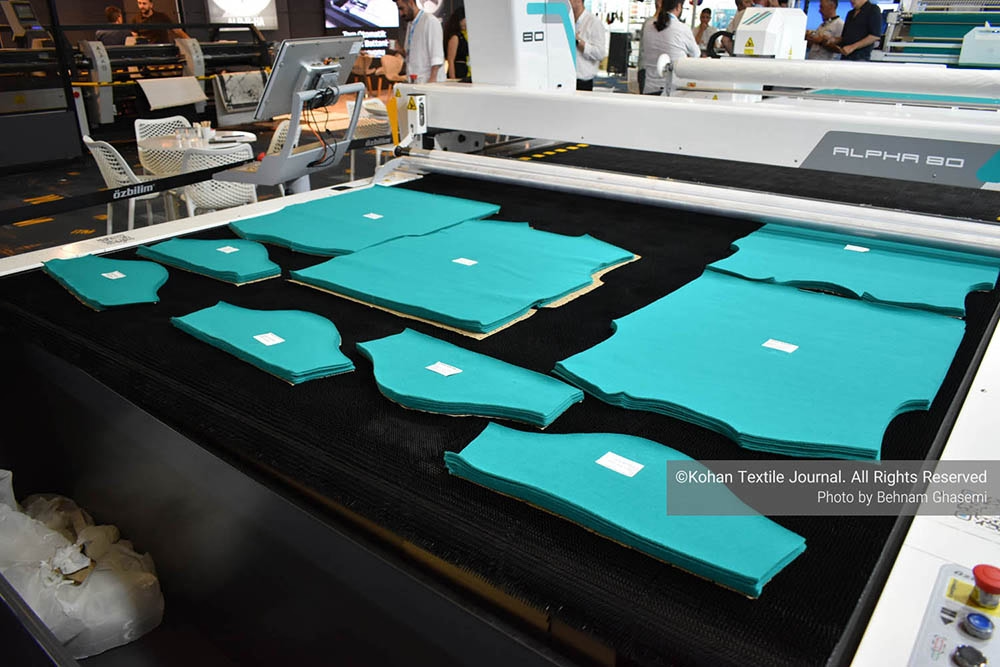
One of the most visible transformations is taking place directly inside production facilities.
Traditional apparel factories often relied heavily on manual supervision to monitor productivity, operator efficiency, machine performance, and workflow coordination. This created limitations in visibility and slowed response times when production bottlenecks occurred.
Modern shop floor systems are changing that environment significantly.
Real-time production monitoring technologies now allow manufacturers to track operational performance continuously throughout the factory floor. Production managers can identify inefficiencies more quickly, monitor labor productivity more accurately, and respond faster to operational disruptions.
This has become especially important as labor shortages affect many manufacturing regions globally.
The apparel industry remains highly dependent on skilled labor, yet workforce dynamics are changing rapidly. Many factories are struggling to recruit and retain experienced workers while also facing rising wage pressures.
Digital technologies are helping manufacturers improve productivity without relying solely on workforce expansion.
In many factories, operational intelligence is becoming just as valuable as labor capacity itself.
Supply Chain Visibility Is Becoming a Competitive Requirement
Recent global disruptions exposed a critical weakness in the apparel industry: limited supply chain visibility.
Shipping delays, geopolitical instability, material shortages, and transportation bottlenecks demonstrated how vulnerable global sourcing systems can become under pressure. Many companies discovered that they lacked real-time visibility into supplier performance, logistics operations, or inventory movement.
As a result, supply chain digitalization has accelerated dramatically.
Manufacturers increasingly require systems capable of tracking raw materials, monitoring warehouse operations, analyzing transportation timelines, and responding rapidly when disruptions occur.
This visibility is no longer viewed as an operational luxury. It is becoming a core business requirement.
Companies that can adapt quickly during supply chain disruptions now hold major competitive advantages over slower, less connected organizations.

Sustainability Is Accelerating Technological Change
Another major force behind digital transformation is sustainability pressure.
Consumers, retailers, and regulators are demanding greater transparency regarding sourcing, waste reduction, environmental responsibility, and ethical production practices. Apparel manufacturers are increasingly expected to prove—not simply claim—that their operations are becoming more sustainable.
Digital technologies are helping companies address these expectations more effectively.
Improved material planning systems reduce excess purchasing and minimize production waste. Digital sampling reduces unnecessary fabric consumption during development stages. Integrated production monitoring improves operational efficiency while lowering resource loss.
At the same time, traceability systems are becoming increasingly important as brands seek greater transparency across global supply chains.
Sustainability is no longer separate from operational strategy. It is becoming deeply integrated into how apparel manufacturing systems are designed and managed.
Artificial Intelligence May Redefine Apparel Manufacturing
Artificial intelligence is now beginning to influence apparel manufacturing in ways that were almost unimaginable a decade ago.
AI-supported systems are increasingly being used to improve forecasting accuracy, optimize production schedules, predict maintenance requirements, analyze supply chain risk, and even assist with product development decisions.
Although adoption remains in relatively early stages, the long-term implications are significant.
The apparel manufacturers of the future may rely heavily on predictive operational systems capable of identifying problems before disruptions occur. Factories may increasingly use AI to improve efficiency, reduce waste, and accelerate decision-making across the entire production chain.
This does not necessarily mean human expertise becomes less important. In fact, the opposite may be true.
As technology becomes more sophisticated, the ability to combine operational experience with digital intelligence may become one of the industry’s most valuable competitive skills.
The Real Challenge Is Organizational Transformation
Despite rapid technological progress, digital transformation is not simply about purchasing software.
One of the biggest obstacles facing apparel manufacturers is organizational adaptation.
Factories built around traditional operational structures often struggle when implementing integrated digital systems. Successful transformation requires workforce training, management alignment, process redesign, and cultural change throughout the organization.
Technology alone cannot solve operational inefficiency if decision-making structures remain outdated.
The most successful manufacturers are usually those that approach digital transformation as a long-term strategic evolution rather than a short-term software implementation project.
Conclusion: The Future Apparel Industry Will Be Built on Intelligence
The apparel industry is gradually moving away from a production model driven primarily by scale and labor cost advantages.
The next generation of competitiveness will likely depend on visibility, flexibility, operational intelligence, speed, and adaptability.
ERP systems, PLM platforms, real-time factory monitoring technologies, digital supply chain systems, and AI-supported operational tools are no longer secondary technologies within apparel manufacturing. They are becoming foundational infrastructure for survival and growth.
Factories that successfully integrate these technologies into agile operational ecosystems will likely define the future direction of global apparel manufacturing.
Those that fail to modernize may increasingly struggle in an industry that is becoming more connected, more data-driven, and more demanding every year.

Editor’s View – Behnam Ghasemi, Editor-in-Chief of Kohan Textile Journal
“In our opinion, the apparel industry is entering a period where operational intelligence will become just as important as manufacturing capacity itself. The companies that will lead the next decade are unlikely to be those relying only on low-cost production models. Instead, future leadership will belong to manufacturers capable of combining technology, agility, sustainability, and data-driven decision-making into fully integrated production ecosystems. Digital transformation is no longer a future vision for apparel manufacturing—it is rapidly becoming the industry standard.”