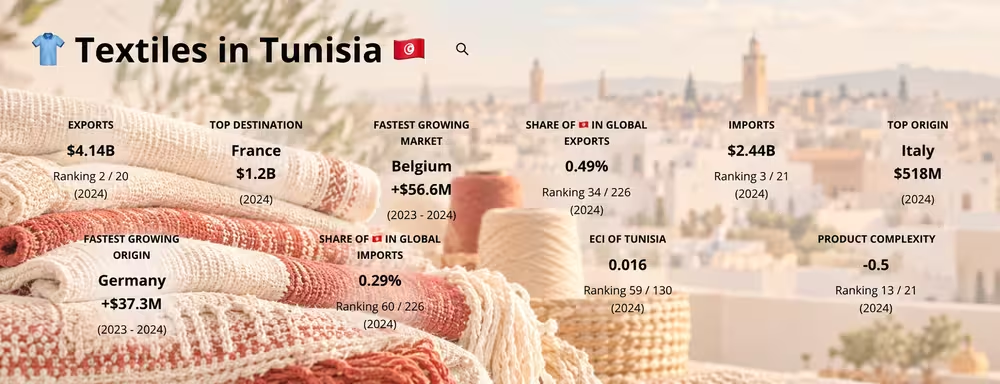
According to the official sector profile published by CEPEX (Tunisia’s Export Promotion Centre, accessed September 2026), the textile and apparel sector counts 1,385 exporting companies, more than 80% of which are fully export-oriented, employs 151,944 people, and is the country’s second-largest export sector, accounting for 16% of Tunisia’s exports. Expertise is spread over spinning and thread-making, fabric weaving, finishing, hosiery, knitting, the manufacture of woven and knitted clothing as well as other textile products.
Tunisia has long been positioned among the world’s leading garment suppliers, with a strong trade relationship with the European Union, which remains its primary market.
Other important products are workwear and lingerie. The main foreign investors in the apparel sector in Tunisia are France, Germany, Belgium and Italy.
This article draws in part on a project initiated by the Chamber of Commerce and Industry of the Centre and funded by FAMEX (Foreign Markets Access Fund), originally aimed at connecting Scandinavian companies with Tunisian manufacturers.
Textile industry in Tunisia
The Scandinavian apparel and fashion industry is characterized by the emergence of many new brands and designers; the Tunisian apparel industry offers many opportunities to Scandinavian countries thanks to its flexibility, reactivity, adaptable production volumes, just-in-time delivery, communication skills and respect for social and environmental standards.


Tunisia enjoys several comparative advantages, such as competitive labor costs and proximity to the EU market.
The Tunisian apparel sector has traditionally positioned itself around shorter delivery times than more distant manufacturing hubs such as India and China, an advantage often attributed to its proximity to European markets.
Thanks to its proximity to Europe, Tunisian workers are familiar with the European mentality and work culture. Italy is only 1 hour away from Tunis by airplane, France and Germany 2 hours away, Copenhagen and Stockholm are 2h 30 and 3h away respectively. Most of the Tunisian factories employ multilingual skilled workers: French, English, Italian and German are widely used.
Fundamental Respect for Social and Environmental Standards and Norms
Tunisia has ratified the International Labour Organization’s Minimum Age Convention (No. 138) in 1995 and the Worst Forms of Child Labour Convention (No. 182) in 2000. Companies are expected to comply with social rules and regulations, and sector certification schemes provide additional oversight of labour standards.
Main Clients and References
Tunisia’s apparel manufacturers have historically supplied a wide range of international brands, including names such as Armand Thierry, Benetton, Cacharel, Diesel, Balmain, G.Laroche, Kookai, Lacoste and Catimini.
Certifications for products, systems and environment have become widespread among sector enterprises, as has the development of labelling such as OEKO-TEX and ECOLABEL.
Major Reasons for Choosing Tunisia
- Competitive production costs.
- Flexible and adaptable production system.
- Qualified and available human resources.
- Respect of delivery time frames.
- Reliable and high-performance sourcing.
- Respect of social and environmental standards.
- Full line of services available from sub-contracting to co-contracting and finished products.
Sector Overview
The textile and clothing industries sector holds strategic significance for the national economy, serving as a cornerstone of the manufacturing industry with regard to exports, employment, and added value (see CEPEX figures above).
Partnership
More than 80% of the sector’s exporting companies are fully export-oriented, reflecting Tunisia’s long-standing position as a manufacturing base for European and international apparel brands. The sector also includes a significant number of enterprises with foreign participation, with leading foreign investors including Italy, Belgium, Holland, France, Algeria and the USA.
Employment and Human Resources
- Textile/clothing industries have long provided one of the largest sources of jobs in Tunisia’s manufacturing sector (see employment figures above).
- Accessible quality education for all citizens has endowed Tunisia with a young human resource pool (supervisors, technicians, designers, engineers).
- The country has over thirty centres for specialised education covering the textiles industries: 8 sectorial centres for training supervisors and technicians; a higher institute of textiles for senior technicians; a textile engineer university; a higher institute for fashion professionals; a textile design department within the fine arts university.
Tunisia ranks as one of the most significant textile and apparel suppliers to European countries, with a notable share of bras and workwear garments sold in Europe originating from the country.
Tunisia has also served as a supplier for international jeans and sportswear brands over the years, reflecting the sector’s long-standing manufacturing relationships with European and global apparel companies.
Innovative hubs like the Technopole in Monastir, equipped with a fashion institute and business incubator, and the industrial activity area in El Fejja, which includes textile finishing facilities, provide infrastructure support. These assets further reinforce Tunisia’s appeal as an investment destination.
Frequently Asked Questions
How Many Textile and Apparel Companies Are There in Tunisia?
According to CEPEX (Tunisia’s official Export Promotion Centre, accessed September 2026), the textile and apparel sector counts 1,385 exporting companies, more than 80% of which are fully export-oriented.
How Many People Does Tunisia’s Textile Industry Employ?
CEPEX reports that the sector employs 151,944 people, making it one of the largest sources of manufacturing employment in the country.
Why Do International Brands Choose Tunisia for Manufacturing?
Tunisia offers competitive production costs, a flexible and adaptable production system, a qualified workforce, and proximity to European markets, which supports shorter delivery times compared to more distant manufacturing hubs.
What Share of Tunisia’s Exports Does the Textile Sector Represent?
The textile and apparel sector is Tunisia’s second-largest export sector, accounting for 16% of the country’s total exports, according to CEPEX.
Which ILO Labour Conventions Has Tunisia Ratified?
Tunisia ratified the ILO’s Minimum Age Convention (No. 138) in 1995 and the Worst Forms of Child Labour Convention (No. 182) in 2000.