By Dr. Pradyumna Gupta, Founder & Chief Scientist, Infinita Lab | Founder & CEO, Infinita Materials

In South Asia, a spinning mill has changed its cotton supplier from virgin bales to mechanically recycled staple fiber. The recycled fiber is produced to a credible chain-of-custody certification, competitively priced and arrives with documentation that meets the brand owner’s required recycled content. After three runs, yarn breakage in the mill jumps over 35 percent. Fabric strength goes below spec. The mill switches back to virgin bales and eats the cost of the failed changeover.
The certificate was real. The fiber really was recycled. The problem? No one checked if the physical attributes of the recycled fiber were compatible with the mill’s operating settings. The verification gap between a recycled content certification and a usable production input is real, is common and is one of the main reasons the textile value chain is not as circular as stated in industry sustainability ambitions.
What Recycling Does to Fiber Properties
What is recycling doing to my fiber? To understand why your recycled fibers will behave differently you need to understand the basics of what fiber does when recycled. Post-consumer recycled cotton: Most mechanical recycling process on a post consumer cotton garment begins with shredding and opening a finished garment back into fibers. This is a process of physical destruction. Raw or virgin cotton fiber has a fiber length distribution that typically peaks between 25 and 32 mm, depending on the origin of the cotton. With mechanical recycling, the fiber length distribution shifts and many of the fiber lengths will fall in the 8-15 mm range.
Weaker yarn will result at the same yarn count from shorter fiber lengths, there will be higher ends-down counts during spinning, and lower surface quality will be apparent on the finished fabrics. A specifier calling for “recycled cotton” and not defining a specific target fiber length distribution is calling for a process material that has poorly defined processing parameters. Post-consumer recycled polyester: In the case of polyester the primary quality attribute is an intrinsic viscosity (IV), which corresponds to the length of polymer molecules and translates into fiber mechanical properties.virgin virgin apparel polyester will have an IV in the range of 0.62 to 0.68 dl/g.
Recycled polyester can be produced to these specifications if coming from post-consumer bottles because a “clean, sorted” post-consumer PET stream can be generated. Recycling post-consumer garment blended fibers and/or requires some chemical separation processes will generally show more IV variation since the starting material and processing conditions will vary more broadly.
A manufacturer drawing recycled PET filament from inconsistent IV streams will face processing breakage, instability and variation in final filament tenacity.
Post-consumer recycled polypropylene: For nonwovens-whether in hygiene, medical, or geotextile applications-the issues are similar but arise from a different material property-melt flow index (MFI). Post-consumer recycled polypropylene originating from a diverse stream of material will have wide variations in its melt flow index that will impact drawing performance and subsequent porosity and strength of the fiber product.
A nonwoven manufacturer who is accepting post-consumer recycled PP without incoming testing of melt flow index will be accepting widely varying process performance on a day to day basis.
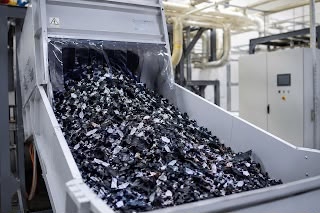
The Certificate Is Not the Specification
Currently, the most common means of quality control across recycled fiber supply chains is chain-of-custody certification. For instance, standards such as the Global Recycled Standard (GRS) confirm that a given material was derived from an approved recycled source and was handled properly along the entire value chain. These certifications fulfill an important role – they prevent greenwashing and support claims about the percentage of recycled content in a product.
What they do not, however, do is verify the chemical, mechanical, or physical properties of the fiber. Certification of a recycled cotton fiber does not dictate anything about its distribution of fiber lengths, its moisture level, its concentration of impurities or its remaining residue from any previous dyes and finishes. Similarly, a recycled polyester fiber certified under GRS will not communicate anything about its IV value, tensile strength or contaminants that could have entered the stream of production at collection, sortation or processing.
For the manufacturer of textiles accepting certified recycled fiber solely on the basis of the certification document, it translates to accepting a production material that is not fully defined. The supplier may well be producing material whose characteristics fall within standard acceptance parameters; if it happens not to, then production failure – not an incoming inspection process – will reveal it. This issue has great relevance for manufacturers of technical textiles.
For example, producers of geotextile fabrics that call out the use of recycled polyester yarns in civil engineering applications are expected by regulation and function in their end use to deliver on specific performance criteria, regardless of the source. A recycled-content statement doesn’t translate to the passing of that product performance test. Rather, the tensile, break elongation andUV stability criteria for those fibers used in the finished geotextile will have to be confirmed at the fiber level, and not merely inferred from the certificate.
Read More: Recycled Fibers: The Vital Data For Quality and Profitability
Where Contamination Enters the Equation
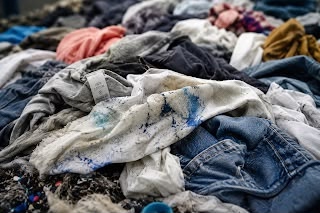
Post-consumer recycled textiles bring potential pathways of contamination that are not typically found in virgin fiber supply chains. Collected apparel can contain residual dyes, optical brighteners, softeners, flame retardants and other chemicals used in manufacturing, plus the effects of everyday use. Mechanical recycling won’t eliminate them.
Chemical recycling may remove them, depending on the method and extent of input cleaning, but it’s an imperfect process. For brands seeking RSL compliance in items destined for sensitive applications (apparel that touches the skin, medical fabrics, food-contact tech fabrics, etc.) it’s not a purely academic issue.
Restricted Substance Lists (RSLs) for finished goods require input materials to conform to strict maximum limits for categories like dyes, phthalates, formaldehyde, and metals. Without effective inbound fiber quality control and purification processes, the inclusion of post-consumer fiber increases the odds of RSL failure. In fact, at least a few brands in Europe have already seen just this – an RSL failure for a finished good that didn’t result from what that brand did in its own production process, but the fiber itself contained contamination. It cost the brand, but the hole is at the fiber verification point.
Building a Validation Framework for Recycled Fiber
Closing this validation gap doesn’t necessarily imply that manufacturers must establish and operate their own in-house analytical laboratories. It’s about shifting from an ‘accept by certificate and go to process’ mindset regarding recycled inputs toward a property-based approach to incoming quality assurance.
The nature of this incoming testing will depend on the specific recycled input and the intended use, but it could include things such as fiber length and moisture analysis plus RSL (restricted substance list) contaminants for recycled cotton, and inherent viscosity or tensile tests for recycled polyester.
The key is to test the properties that directly correlate with process consistency and end-product performance. The ‘other side’ of the equation involves supplier development. Companies need to establish rigorous property specifications and collaborate closely with their recycled fiber suppliers to ensure those specifications are met.
And, when there are issues, manufacturers should share pertinent test data with suppliers to close the loop on continuous improvement. Ultimately, textile circularity requires that recycled fiber becomes a reliable production input rather than simply a claim about end-of-life management. Certification is largely in place, and there is clearly a business case. The missing piece is the validation layer that links fiber content claims to tangible material properties that manufacturers’ processes demand.