






Net textile and apparel fibre imports by the US rose to a second consecutive record in calendar 2018, as consumer demand for clothing increased with the expanding economy. Total fibre product imports exceeded 20.8 billion raw-fibre-equivalent pounds in 2018, compared to 19.7 billion pounds in 2017. Textile and apparel exports reached 3.5 billion pounds.
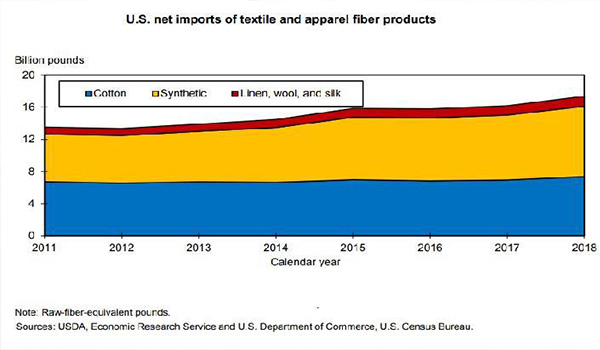
Thus, net textile and apparel fibre imports by the US in 2018 approached nearly 17.4 billion raw-fibre-equivalent pounds, 7 per cent above 2017, the Economic Research Service of the US department of agriculture (USDA) said in its latest ‘Cotton and Wool Outlook’ report.
In 2018, synthetic product net imports increased for the 9th consecutive year, as continued growth in athleisure wear has increased demand for synthetics. For the 5th year in a row, synthetic fibre products accounted for the largest share of total net imports—surpassing cotton in 2014.
Last year, synthetic textile and apparel products contributed about 51 per cent of the total, while cotton products provided 42 per cent, and linen, wool, and silk combined for an additional 7 per cent. Although cotton’s share of total net fibre product imports has steadily declined since 2007, its share equalled 50 per cent as recently as 2011, when synthetics accounted for 44 per cent, the USDA report said.
Meanwhile, the US domestic cotton consumption (mill use plus net textile imports) increased 4 per cent in calendar 2018 as consumer demand for cotton products reached its highest in 8 years. Retail consumption was estimated at nearly 8.9 billion pounds, or 18.4 million bale-equivalents for the year. Although domestic cotton consumption has increased for 2 consecutive years, the 2018 estimate remains more than 18 per cent below the calendar 2006 record of approximately 10.9 billion pounds.
US cotton product imports and exports moved in opposite directions once again in 2018, as demand for synthetic products grew at a faster pace and limited cotton’s growth. Cotton product imports approached 9.0 billion pounds in calendar year 2018, 4 per cent higher than 2017 and the highest since 2010.
At the same time, however, cotton product exports declined 3.5 per cent to 1.6 billion pounds in 2018. Similarly, US cotton mill use in calendar 2018 decreased to 1.5 billion pounds. Consequently, the US per capita estimate of retail cotton consumption rose nearly 1 pound in 2018 to 27 pounds; however, US cotton mill use contributed less than 5 pounds of the total as textile and apparel product manufacturing remains concentrated in low-wage-rate countries, the report said.











