Removing foreign parts from cotton is a challenging task. That’s why our T-SCAN technology features multiple modules that detect contaminations and reliably eject them as part of our blowroom process. After establishing T-SCAN in cotton ring lines, our Indian customers are now enjoying the benefits of our intelligent solutions in rotor applications.
When cotton travels out of fields and into spinning mills, it sometimes carries a few unwelcome passengers. Leaves, stems, stones, plastic or jute particles from transport bags, bits of metal or shreds of paper can find their way into cotton bales. Some of these foreign parts sneak past the first cleaning steps in the blow room.
Colored parts and plastics like polypropylene create particularly big problems for spinners: They can cause yarn breaks during spinning and weaving, take dye in a different way than the raw material and therefore show up on the surface of the final textile product. And if that happens, the yarn might get rejected or returned to the spinner! In ring spinning, sophisticated yarn clearers with an option to detect and cut polypropylene and colored contaminants are the main solution to this problem. However, the usage of such a yarn clearer in rotor spinning is in practice very limited, especially the detection of polypropylene.
The answer? T-SCAN! Our state-of- the-art system ejects foreign parts out of cotton via its comprehensive range of sensor modules for detecting contamination. The TS-T3 and TS-T5 are the latest versions of this market-proven technology. They empower spinners to maximize quality and avoid costly rejections – even when dealing with low-contrast, small or thread-like foreign parts. This technology detects and removes a wide variety of polypropylene types, such as transparent or glossy polypropylene, or polypropylene that reacts to different UV light intensities. Especially in the rotor and recycling segments, these foreign part separators can be a good solution to effectively deal with contaminants.
Proven performance in the rotor and recycling segment
Real-world tests from Trützschler customers, particularly in rotor applications, are confirming the impressive capacity to kick out contaminations, boost quality and avoid rejections with our TS-T5 and TS-T3 systems. Nandam Terry and Nandam Denim are among those pioneering customers. The companies are one of the biggest denim manufacturers based in Ahmedabad, India.
They make 45 tons per day of denim and 10 tons per day of terry towel products. “Since installing TS-T3 and TS-T5 technologies, we have drastically reduced color contaminations with minimum ejection of cotton,” says Ashish Raval, Vice President Spinning. “The appearance of our fabric has improved very much and we are now selling contamination- controlled yarn to high-end brands. Our end users are really happy.”
Thiagarajar Mills Ltd. in Madurai, India, is a vertically integrated group in South India known for quality fine yarns and fabrics. The company runs 25 Trützschler machines to produce 250 tons of yarn per month for denim products. After successfully establishing TS-T5 in ring spinning, the customer continued with our foreign part separator in rotor spinning. “The quality of our yarn, in terms of contamination, is much improved with the TS-T5,” says Muthupalaniappa M, Senior Vice President (Technical). “It is easy to operate and maintain, with improved cleaning for polypropylene. Along with great support from the Trützschler team, we are making excellent progress with the various challenges related to contamination.”
A few customer reviews at a glance:
Further positive feedback recently arrived from Blue Rose Cotspin LLP. This company based in northern India produces 20 tons of yarn per day, mainly for hosiery and weaving customers. “We have not received any complaints about contamination since installing the TS-T3 from Trützschler,” says Ashwani Garg, Managing Director. “The performance is excellent and it’s capable of ejecting all types of contamination while protecting good fibers. The auto-calibration is really valuable for us.”
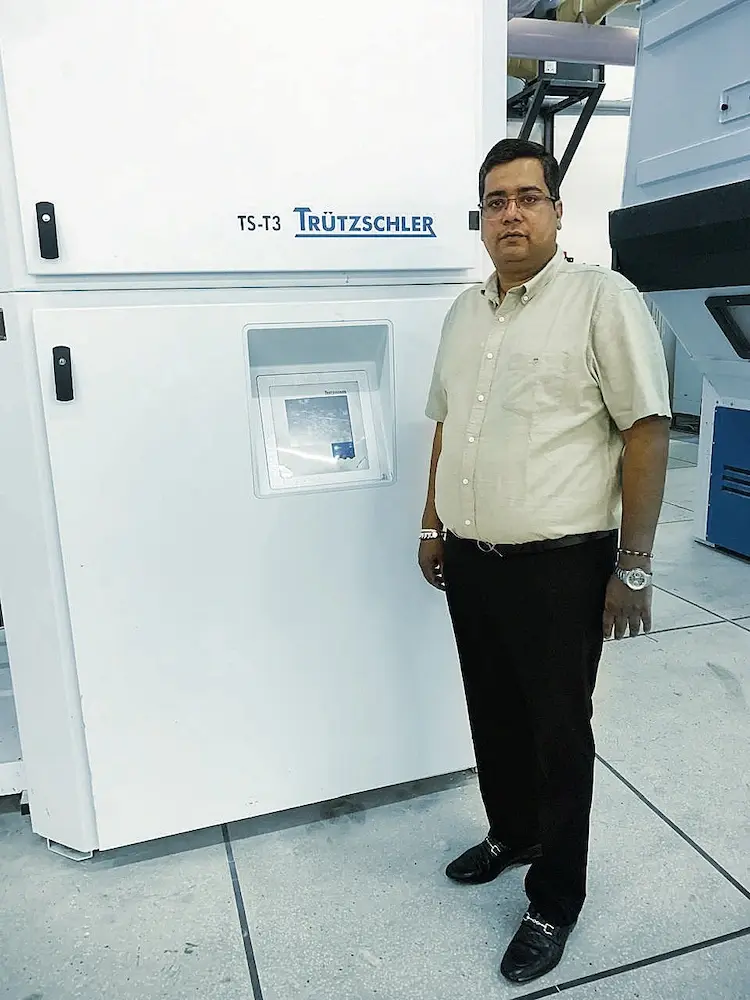
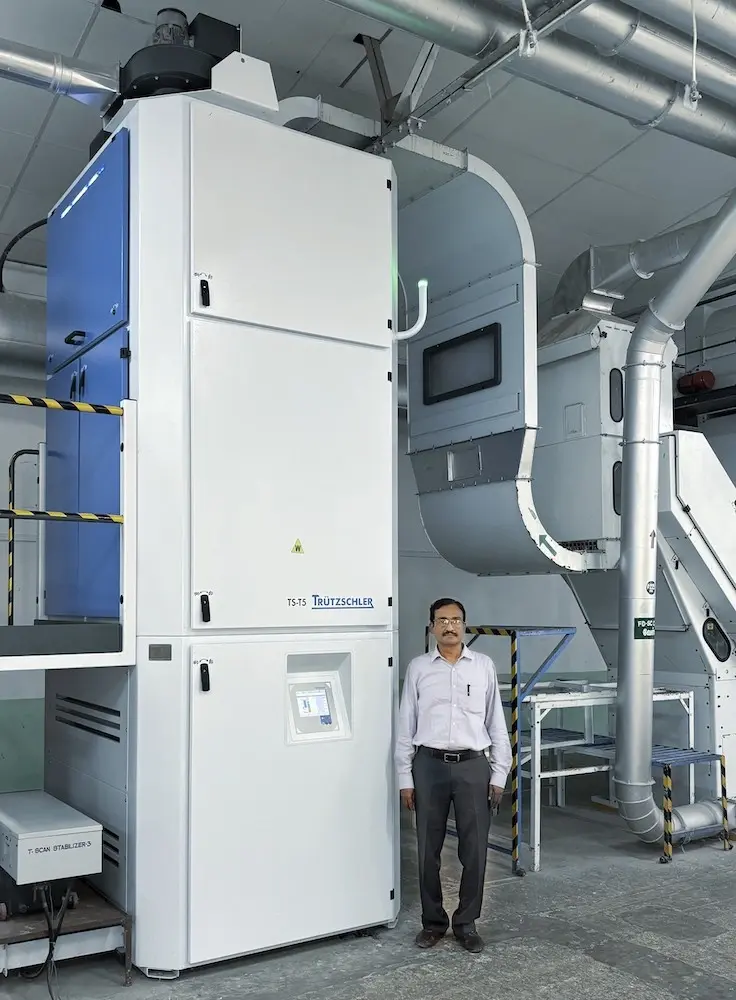
Kamal Kumar, owner of Patiala Gold LLP, is enthusiastic about the user-friendly cleaning and maintenance of the TS-T3: “This reduces downtime to an absolute minimum without any loss of performance. Based in Samana, Punjab, the company operates twelve Trützschler cards with IDF, producing up to 30 tons of rotor yarn per day, mainly for bottomweight and bed sheets. “Compared to other foreign part separators, the production efficiency of our blow room and card lines is significantly higher with the TS-T3,” says Kamal Kumar. Blue Rose Cotspin and Patiala Gold are using the TS-T3 in rotor recycling applications, even for polycotton blends. They have also placed repeat orders for their new units based on the performance of the TS-T3.

Info: Minimal Maintenance, Maximum Effiency
The TS-T5 and TS-T3 achieve maximum foreign part separation with very low levels of good fiber loss. They are energy-efficient solutions that use up to 80 % less compressed air than comparable systems. The TS-T5 and TS-T3 also have minimal requirements for cleaning and maintenance, which customers value highly. Their range of functions and detection modules are unique in the market.