






Efficient technical solutions from KARL MAYER for producing terry goods with ecological benefits
Sustainability and environmental protection are becoming increasingly important in textile production – and this also applies to the production of warp-knitted terry fabrics. These fluffy, absorbent fabrics are absolutely indispensable for the bathroom and home, and are used in huge volumes all over the world. This means that ecological optimisation, carried out along the entire production line, has obvious effects.
As far a fabric production is concerned, KARL MAYER can offer some effective technical solutions for both the warp knitting and warp preparation sectors.
Weaving: sustainability begins with warp preparation
KARL MAYER’s PROSIZE® sizing machine can offer advantages for the environmental footprint of the entire manufacturing process when producing woven terry goods.
This efficient warp preparation machine operates on the basis of a prewetting principle, which involves soaking the yarn with hot water before the size is applied. This permits savings of up to 40% to be made in sizing additives and energy.
This principle is simple yet effective: the water penetrates into the hollow spaces of the fibrous structure and partially fills them once the excess water has been squeezed out. During subsequent sizing, the water in the damp yarn rapidly forms a bond with the size. The textile agent is, therefore, absorbed more rapidly and easily by the warp yarns than with processes that do not involve prewetting. On the other hand, the diluting effect of the water in the yarn structure ensures that most of the size remains on the fibre surface. This reduces the consumption of chemicals.
To carry out this beneficial pretreatment process, the PROSIZE® has been equipped with the HSB-PW size box, i.e. it is available as a prewetting version.
The innovative size box also delivers ecological advantages for the sizing process itself. Instead of the usual immersion and bath application process, the size is applied in three, highly turbulent, homogeneous application zones, with spray bar technology and a subsequent application/squeeze roller system. This well-thought-out processing sequence can reduce the consumption of sizing agent by up to 10%. Reduced size consumption also means less effluent and a lower energy consumption when preparing the chemicals for application to the yarns.
The spray technology also offers advantages in terms of conserving resources, since yarn rejects as a result of long machine stoppages are minimised. With the immersion process, if the machine is stopped, the yarns remain in this position in the size. Over-sized sections, so-called stop marks, are produced, which cause problems with rejects during subsequent sizing and weaving – and this is even more of a disadvantage during frequent and rapid warp changes.
Warp knitting: ecological advantages during production
KARL MAYER can supply the TM 4 TS-EL for producing warp-knitted terry fabrics. This four-bar tricot machine processes staple-fibre yarns and produces high-quality textiles, in which the terry loops are firmly anchored into the ground during the stitch-forming process. The pullout resistance of the loops is much higher than that of comparable woven fabrics. Warp-knitted towels and bathrobes can, therefore, be used for longer, which generates less waste. The longer replacement cycles also reduce the consumption of resources.
Furthermore, warp-knitted terry fabrics have a general technological advantage over woven fabrics in terms of the environmental loads generated during production, i.e. warp knitting does not require a sizing process, which saves on textile chemicals, effluent and energy to the value of roughly 0.20 US dollars/kg – approximately 30% of the production costs (without the yarn) when producing the raw fabric. No sizing also means no desizing, which reduces the environmental loads even further. In practice, water consumption can be reduced by 9 l and energy consumption can be reduced by 0.6 KW per kg of fabric.
Warp knitting also scores points for sustainability during fabric production. The TM 4 TS-EL consumes roughly 87% less energy per kg of fabric produced than airjet weaving machines, which require large amounts of energy to produce the compressed air. This advantage is also enhanced by the high efficiency of this terry warp knitting machine. At a width of 186” and a speed of 800 min−1, the TM 4 TS-EL has a daily production rate of about 1,800 kg of terry fabrics with a weight of 400 g/m2 – 250% more than on an airjet weaving machine.
A specialist in processing cotton
Following a long gap in what was available in the range, the TM 4 TS-EL was premiered at ShanghaiTex 2015 as a new terry warp knitting machine for processing cotton. This new machine is both versatile and highly productive. Thanks to the modern EL pattern drive system, the speed of the TM 4 TS-EL has been increased by about 30% compared to its predecessor with manual transmission. A working width of 186″ has increased output even further.
This efficient machine can produce every type of terry article, especially hand and bath towels, i.e. webs having long repeats, smooth ends to the borders, and cutting edges. The EL system also enables the pattern to be changed quickly and easily.
The machine is equipped with the standard gauge of E 24 for terry goods. Further technical features include the KAMCOS® system, a brushing unit for aligning the pile loops, and a beam frame for large warp beams with long running lengths. Like all KARL MAYER’s products, the TM 4 TS-EL operates at a high level of reliability, precision and user friendliness.
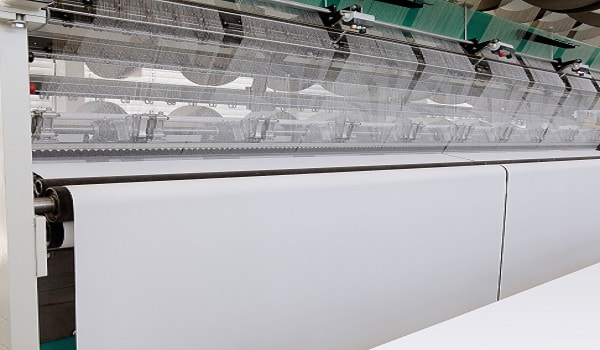
Fig.: The TM 4 TS-EL at work











