How the German textile machinery giant is combining European engineering, Chinese manufacturing capabilities and customer-driven innovation to shape its global strategy.
By Behnam Ghasemi | Editor-in-Chief, Kohan Textile Journal
During the VDMA press conference at ITMA ASIA + CITME 2026 in Shanghai, which I attended, Lutz Wolf, CEO of KARL MAYER, shared some remarkable insights into the company’s global strategy, its innovation priorities and, most importantly, the strategic role of China in its international business.
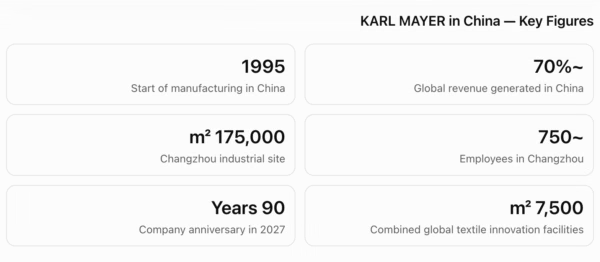
Among all the figures and information presented during the press conference, one number particularly caught my attention: approximately 70% of KARL MAYER’s global revenue is generated in China.
For a German textile machinery manufacturer with nearly 90 years of industrial heritage, this figure speaks volumes about the transformation of the global textile industry and the growing importance of Asia.
It also explains why ITMA ASIA + CITME represents one of the most important international exhibition platforms for KARL MAYER.

China: KARL MAYER’s Most Important Market
While China accounts for 29% of Germany’s total textile machinery exports, its importance to KARL MAYER is considerably greater.
According to Lutz Wolf, China is the company’s most important market, accounting for approximately 70% of its global revenue.
However, what makes KARL MAYER’s relationship with China particularly interesting is that the company does not simply consider the country a destination for selling machinery.
China has become a strategic centre for manufacturing, research and development, textile innovation and customer collaboration.
This approach reflects a broader transformation in the international textile machinery industry, where proximity to customers is becoming increasingly important for maintaining technological leadership and competitiveness.
More Than Three Decades of Investment in China
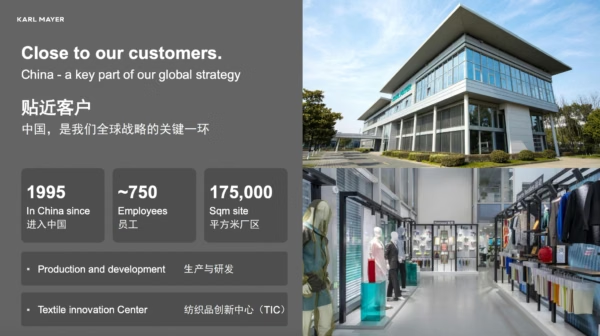
KARL MAYER has been manufacturing in China since 1995. Over the past three decades, the company has significantly expanded its industrial and technological capabilities in the country.
Today, its Changzhou operation represents one of the most important pillars of its global strategy.
The figures presented during the press conference illustrate the scale of this commitment:
- Manufacturing presence in China since 1995.
- Approximately 750 employees in Changzhou.
- A 175,000-square-metre industrial site.
- Local production and technology development capabilities.
- A dedicated Textile Innovation Center.
Another particularly interesting statement from Wolf was that, in 2026, China became the country with the largest number of KARL MAYER employees worldwide for the first time.
This demonstrates how deeply China has become integrated into the company’s global industrial structure.
China Is Not Just a Market — It Is a Source of Innovation
One of the most valuable insights I took away from Wolf’s presentation was his perspective on the relationship between KARL MAYER and its Chinese customers.
Rather than describing China solely as a market that benefits from German engineering, he emphasized that KARL MAYER also learns from its Chinese customers.
The speed of technological development, intense competition and rapidly changing customer requirements in China encourage the company to accelerate its own innovation processes.
What KARL MAYER learns and develops in China can subsequently be applied to other international markets. At the same time, the company brings its global engineering expertise and application knowledge to its Chinese operations.
This two-way exchange of knowledge has become an important element of its competitive strategy.
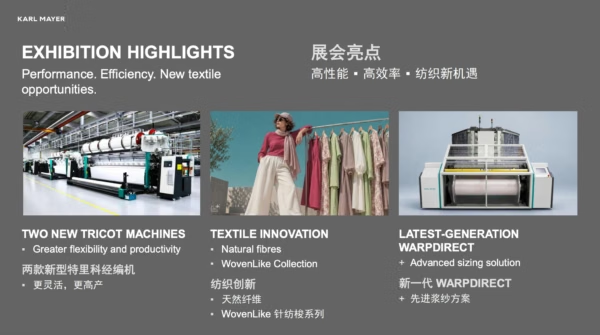
A clear example is the development of the next-generation TM Pro tricot machinery series in Changzhou, combining higher performance with an attractive investment cost.
Moving Beyond Machinery Innovation
During his presentation, Wolf also emphasized that innovation at KARL MAYER extends beyond the development of new machinery.
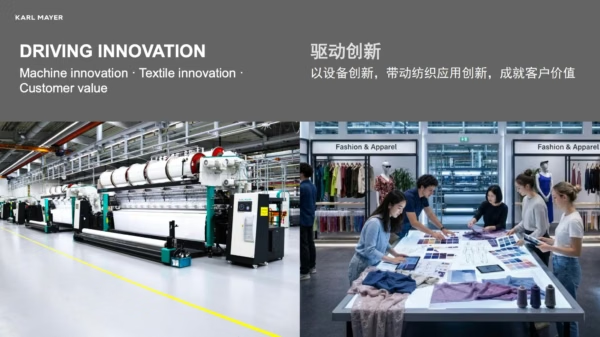
The company’s strategy is built around three interconnected priorities: machine innovation, textile innovation and customer value.
While machinery manufacturers must continuously improve productivity, flexibility and cost efficiency, they must also help textile producers develop new products and access new business opportunities.
Read more: Strong exhibition start for KARL MAYER at ITMA ASIA 2026
KARL MAYER is investing in textile innovation facilities across Germany, Japan and China, with approximately 7,500 square metres of combined space dedicated to textile innovation.
These centres bring together machinery engineers, textile manufacturers and international brands to develop new fabric structures, applications and production solutions.
The company’s work on natural fibres, woven-like knitted fabrics and innovative footwear textiles illustrates this broader approach.
For textile manufacturers, the value of a machine is ultimately determined not only by its technical performance, but also by the commercial opportunities it creates.
Why ITMA ASIA Is So Important for KARL MAYER
Considering the company’s strong dependence on the Chinese market, its substantial presence at ITMA ASIA + CITME 2026 came as little surprise.
KARL MAYER has participated in every edition of the combined ITMA ASIA + CITME exhibition since its launch, demonstrating its long-term commitment to the Asian textile industry.
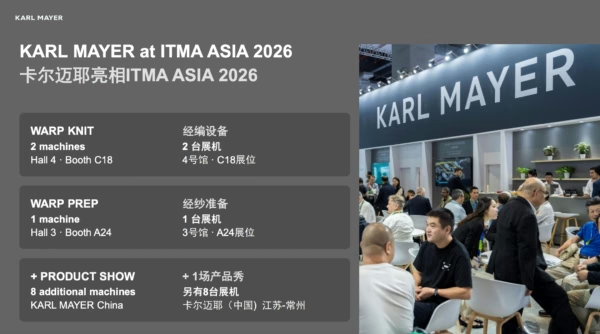
This year, the company presented innovations in its two strategic technology fields, warp knitting and warp preparation, complemented by additional machinery demonstrations at its Changzhou facility.
However, from my perspective, the significance of ITMA ASIA for KARL MAYER goes far beyond machinery demonstrations.
The exhibition provides a platform for understanding emerging customer requirements, strengthening industrial partnerships, exchanging technical knowledge and identifying new opportunities in its largest market.
For a company generating approximately 70% of its global revenue in China, maintaining close contact with Asian textile manufacturers is a strategic necessity.
German Engineering Meets Chinese Industrial Dynamism
The traditional model of European machinery manufacturers developing technology in Europe and exporting it to Asia is gradually evolving.
KARL MAYER represents an interesting example of this transformation.
Its strategy combines German engineering expertise, local Chinese production, regional research and development, global knowledge exchange and direct customer collaboration.
In my view, this approach offers an important lesson for European textile machinery manufacturers operating in an increasingly competitive global market.
Being close to customers today means more than establishing a sales office or providing technical service. It increasingly means developing technologies alongside customers, understanding their commercial challenges and responding quickly to changing market requirements.
As KARL MAYER approaches its 90th anniversary in 2027, its experience in China demonstrates how a long-established European engineering company can adapt its global strategy to the changing geography of textile manufacturing.
China is not simply KARL MAYER’s largest market. It has become one of the driving forces behind the company’s global innovation and future development.