Textiles tell stories. They carry memories, reflect identities and document social changes. A look into their past enables a deeper understanding of the status quo and revives forgotten practices. But how can we learn from the past in order to shape a more sustainable and conscious future? Heimtextil Trends 25/26, curated by Alcova, provides the answer. Through six inspiring interviews, textile branches are given a voice and their stories are brought to life.
In collaboration with the founders of Alcova, Heimtextil is presenting Heimtextil Trends 25/26 under the title ‘Future Continuous’ – offering a visionary perspective on the far-reaching significance of textiles. They show their central role in technological, cultural and ecological developments.
‘Future Continuous’ opens up exciting new perspectives on the future of the textile industry. Alcova has conducted six groundbreaking interviews with international designers, textile researchers and representatives of associations and institutions from their network, who shed light on various aspects of the textile industry. These stories interweave tradition and innovation, craftsmanship and modern technology – and invite us to explore new ways for the textile future.
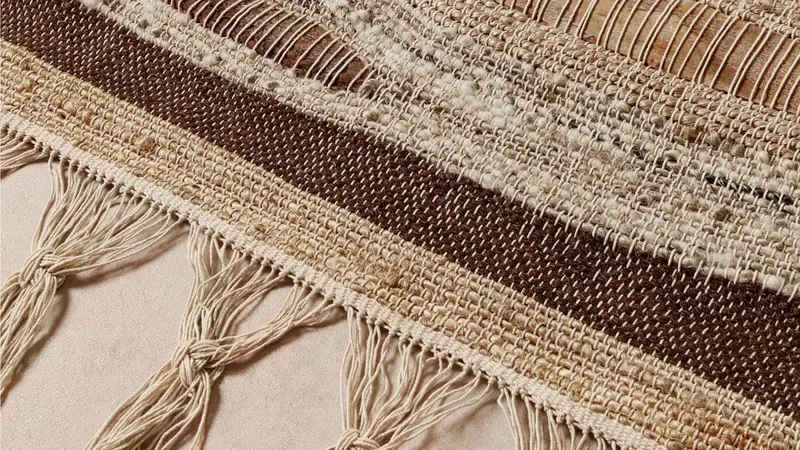
Textiles as a connecting element between past and future
Textiles are much more than just fabrics – they are deeply embedded in history and culture. Even the word ‘text’ comes from the Latin ‘texere’, which means ‘to weave’ and shows that textiles served as a means of expression and communication long before writing. They link narratives, interweave storylines and have been a central component of our technology for thousands of years.
Janis Jefferies, a pioneer of textile research, makes it clear in the interview: Spinning and weaving fibres was the first human technology and thus the basis for architecture and mathematics. Today, textiles are the focus of a new, sustainable way of thinking: away from pure ‘recycling, reducing and reusing’ towards regenerative agriculture and a vocabulary that speaks of ‘restoring, renewing and replenishing’. This development marks a profound shift in the sustainability discourse – towards a holistic approach that sees textiles as the key to a sustainable future.
Renaissance of natural fibres and traditional craftsmanship
In the middle of the fast-paced, digital world, a movement is growing that is leading back to the physical, tangible aspects of life. Textiles play a central role in this: they connect people with their cultural heritage and create a contrast to virtual existence through their tactile quality.
In the current throwaway culture, which favours short-lived, often irreparable products, textiles and craftsmanship stand for authenticity, sustainability and genuine values. They create a moment of mindfulness in a world dominated by screens – and give the feeling of being able to really touch something again.
Ilse Crawford, renowned interior designer and founder of StudioIlse, also emphasises: In an increasingly digital and disembodied world, there is a deep need for physical connection. Natural fibres such as hemp, jute, flax and nettle are making a remarkable comeback. They have been valued for centuries for their durability and comfort.
Christine Ladstätter, Innovation Manager at Salewa, points out another important aspect: In recent decades, there has been a trend towards a greater appreciation of local materials and techniques. Her projects emphasise the growing importance of craftsmanship. The focus is on promoting local agriculture and preserving traditional pastoral landscapes.

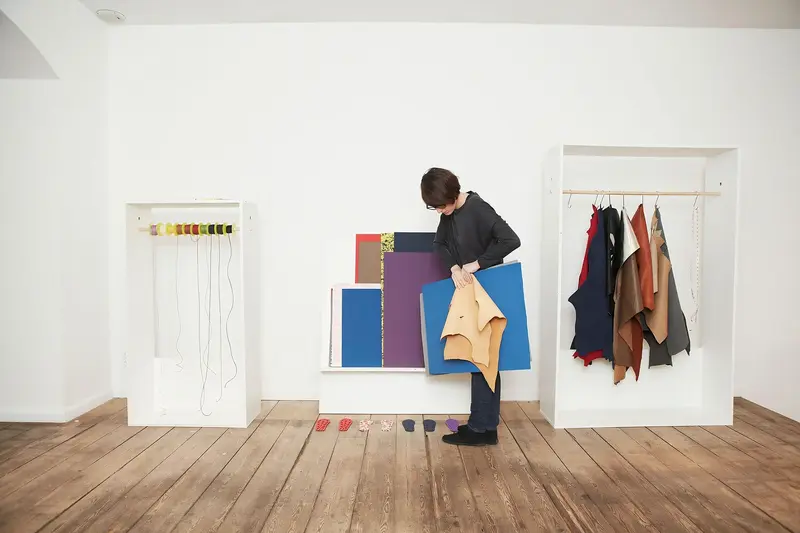
Heimtextil Trends 25/26 Colour palette
Photo: Alcova for Heimtextil
Circularity and transparency as the basis for the future
Fast consumption and a throwaway culture dominate today’s world. But the importance of care and foresight is becoming increasingly apparent – even in the textile industry. The sector is on the brink of change: towards a sustainable, connected and transparent future. Dirk Vantyghem, Director General of Euratex, emphasises that the textile sector in the EU is currently more than ever at the centre of attention – not least thanks to the European Green Deal.
In a time of global uncertainty, the need for durable, functional and sustainable products is growing. Many manufacturers often use terms such as ‘sustainable’ or ‘circular’ arbitrarily. That’s why the European Parliament is campaigning for more traceability in the supply chain – thereby combating greenwashing and enabling consumers to make more informed purchasing decisions. Simone van der Burg and Lucas Evers, both group leaders in the WAAG Future Lab, emphasise the importance of open and co-creative production.
Their approach aims to use local resources such as dyes and fibres from natural sources. The focus here is on the democratisation of production processes: Designers and creatives are given access to open-source tools and resources to experiment freely – without high costs.
Italian designer and lecturer Eugenia Morpurgo calls for a fundamental rethink of agricultural practices in textile production and a move away from petroleum-based materials. She warns against economic models that favour disposable products over long-lasting alternatives. Her project ‘Syntropic Materials’ investigates regenerative agriculture as a sustainable solution for textiles and food. The aim is to improve soil health and biodiversity. Morpurgo emphasises that the true costs – from resource consumption to long-term soil fertility – must be taken into account when assessing sustainability.
Colours that tell stories
From Naturally Uneven Green to End of Petrol and Imperfect Pink – the Heimtextil Trends 25/26 present a visionary colour palette that Alcova has interpreted both visually and linguistically. Inspired by the six interviews, the colours interweave the ideas and concepts that came up in the discussions.
In this way, they tell a vivid story. Natural, unbleached tones meet dynamic, vibrant colours and reflect the tension between tradition and innovation. This contrast represents an active balance that is constantly evolving – characterised by renewal, growth and a forward-looking vision that goes beyond mere sustainability.