






The art of carpet weaving in India was introduced by Sultan Zain-ui-Abadin, who brought some Persian carpet weavers into Kashmir in the fifteenth century to train the local inhabitants.
Indian carpet industry
Jammu & Kashmir, Himachal Pradesh, Punjab, Haryana, Madhya Pradesh, Rajasthan, Gujarat, Kerala, Andhra Pradesh, Telangana, Odisha, and Uttar Pradesh are Major Carpet Producing Centres In India, and cities like Bhadohi, Mirzapur, Varanasi, Agra, Jaipur … are so famous in carpet weaving. As you can see in below picture you can find the art of carpet weaving in many locations and districts of the country.
Since India is a very vast country with different cultures and customs, the wide range of carpet weaves in all provinces and cities causes a wide range of designs and colors, and this is one of the interesting and positive aspects of handwoven carpets.

India is one of the important countries in the global carpet and flooring market. India is currently the largest exporter of handwoven carpets in the world by a large margin and exported US$ 1.39 billion in FY24.
Interestingly, the title of the world’s second exporter of handmade carpets is held by Egypt with 175 million dollars, and the third place is held by Iran with 80 million dollars.
In India, nearly two million people are engaged in carpet weaving, mostly in rural and low-income areas.

India is the unrivaled producer of Indian tufted carpets
Also, India is one of the important countries in tufting carpets and especially hand tufting. In India, due to the cheapness of labor, all activities and industries that require workers are affordable.
Also, hand-woven carpets and even Indian tufting carpets require very little investment, and unlike tufting carpets that are produced with advanced and expensive machines in very high quantities, in hand tufting, the only necessary capital is a metal or wooden frame and a manual tufting machine that can be purchased for a few hundred dollars.

Very low initial capital for equipment and cheap and skilled labor are two very important factors that have almost made India unrivaled in the field of handwoven carpets and hand-tufted carpets in the world. More interestingly, the export of hand-tufted rugs in India is twice as much as the export of handwoven carpets in this country, about 750 million dollars.
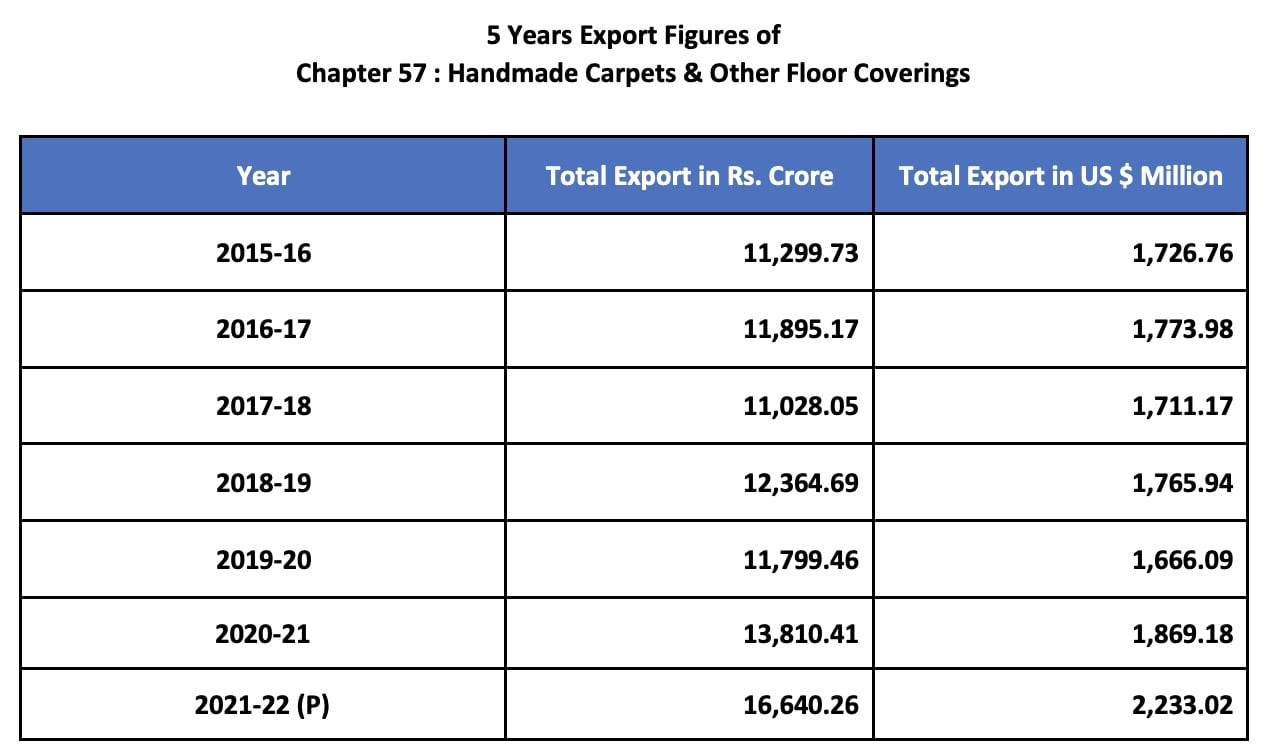
Table: Handmade Carpets and Other Floor Coverings (5 years)
There are many companies in India that have the ability to produce hand-tufted carpets in very large and different sizes. Even Indian companies do a lot of hand-tufted carpets for world-famous hotel projects and commercial centers, especially in Dubai and the Middle East region.
According to the skill level of the weaver, very creative and attractive motifs and designs can be produced in hand-tufted carpets, which are ready for sale much faster than hand-woven carpets.
As mentioned above, India has almost nothing to say in the machine-made carpet industry due to its capital intensiveness, and the export of this type of Indian carpet is very small. In the field of machine-made carpets, Turkey has 30% of the world’s production with exports of nearly 3 billion dollars.
India’s Handmade Carpet Industry: Export Growth and Global Leadership in 2023-24
In FY24, India’s carpet exports reached $1.39 billion, maintaining its position as the world’s largest exporter of handmade carpets. The Indian handmade carpet industry, with origins dating back to the 16th century, is renowned for its eco-friendly, high-quality, and intricately designed products. The sector is highly labor-intensive, employing over 2 million artisans, especially women in rural areas.
India produces a variety of carpets, including Indo-Persian, silk, wool, and hand-tufted, and has several carpet-producing states, such as Jammu & Kashmir, Himachal Pradesh, and Rajasthan. India exports about 85-90% of its carpets, accounting for 40% of the global handmade carpet trade. Major export destinations include the USA, Germany, and the UK, with the USA being the largest importer, receiving over $200 million worth of carpets in 2023-24.
The government supports the sector through initiatives like skill development programs, trade events, and financial subsidies. The India Carpet Expo 2023 attracted 350 overseas buyers, promoting India’s handmade carpets internationally. Exports grew at a CAGR of 7% since 2017, highlighting the sector’s strong potential for continued growth.
Read more: Carpet Industry and Exports
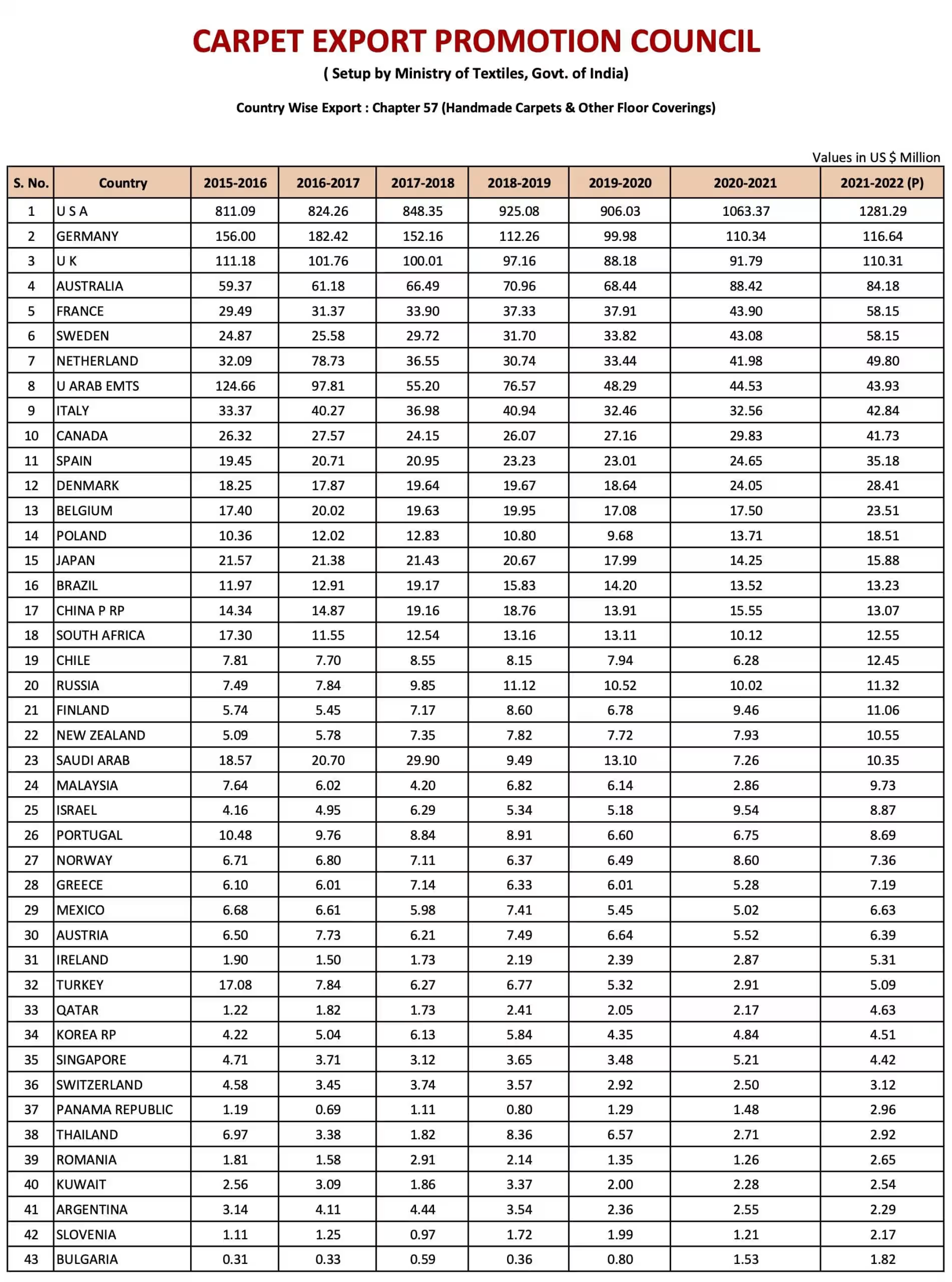
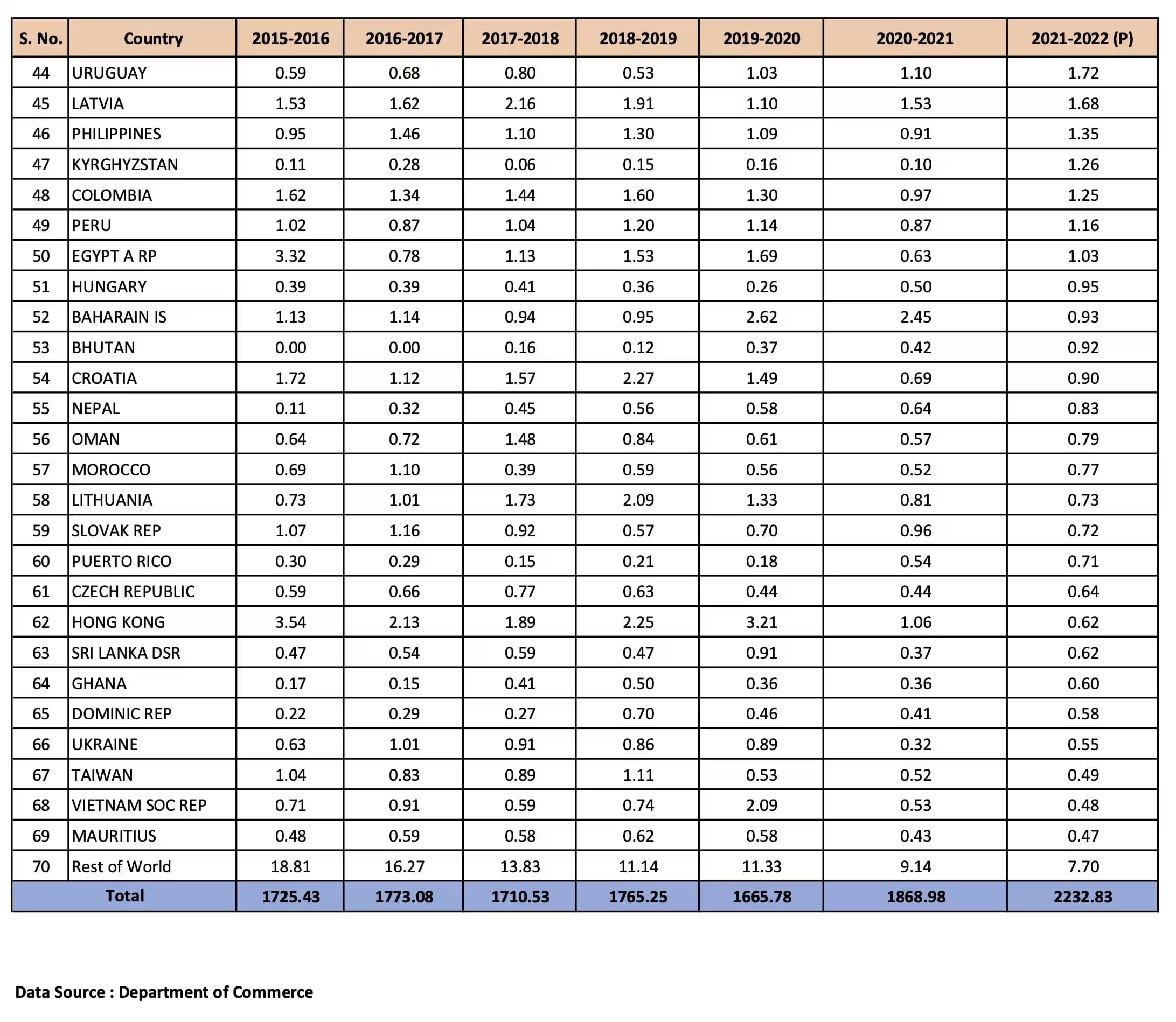
As shown in the table below, the United States of America is the first buyer of handwoven and tufted Indian carpets by a large margin, and more than one billion two hundred million dollars of the total exports of Indian carpets and floor coverings are exported to America. Indians in America are a powerful and influential colony who have been able to establish good sales channels for themselves in America over the years.
KEY MARKETS AND POTENTIAL
India is exporting to more than 70 countries in the world, mainly to the USA, Germany, Canada, the U.K., Australia, South Africa, France, Italy, Brazil, etc., and started exporting to China.
It can be said that the most important competitors of Indians in the American market are Iranian and Turkish businessmen. Especially after the corona pandemic and China’s shorthand from the American market, Turkey has been able to increase its machine carpet market in the United States and export almost as much machine carpet to the American market as India.
The largest export markets for Indian textile flooring and carpet are America with 47%, Europe with 31%, and other countries with 22%.
Source: Indian Handmade Carpet Industry

Iran’s decline in handwoven carpets and the increase in India’s market share
Once upon a time, Iran and Iranian carpets were the leaders of the handwoven carpet sales and export market, but over time and the policies of the governments of Iran and the United States, led to the embargo of Iranian goods, including handwoven carpets, Iranian carpets almost lost their place in the market. And in the meantime, countries like India could fill the void in the Iranian market, especially the large American market, with proper marketing and knowing the market’s taste.
One of the tools that Indians use to enter the market is a strong presence in related American exhibitions such as the Surface exhibition. Also, Indians have an active presence in the demotex exhibition and domestic exhibitions in India.
In March, the Indian Carpet Export Promotion Center held an exhibition with the presence of more than 200 important producers of this country, in which 256 buyers from 56 countries were present.

• Kashmir: Kashmir is famous for its handmade silk carpets. These are very exclusive carpets and give ethnic look. We can say that it is the fort of exclusive handmade oriental carpets. Kashmir is well known due to its craftsmanship in the carpet industry. Handmade silk carpets are hand-knotted carpets that take many months to complete. Weavers make designs that represent the nature of Kashmir as they make
Chinar trees, Birds, etc.
• Uttar Pradesh: As we know Bhadohi, Mirzapur, and Agra are famous places of handmade Indian carpets. These places are known for their unique colors and designs of the carpet. Emperor Akbar established the first carpet weaving center in Agra. Weavers used vegetable dyes to give vibrant colors to the carpet. The specialty of these carpets is their individual designs. The weavers represent stories behind carpet designs, for instance, they included the Taj Mahal, bold motifs, war, etc.
• Jaipur: Jaipur, is the capital of Rajasthan. As we know Rajasthan is the place of kings like Maharana Pratap, Jai Singh, Man Singh, etc. so they used handmade carpets for decorating their palaces. Jaipur, Ajmer, and Jodhpur are famous for their handwoven dhurries.
Rajasthan is only place where you can find the finest material of handmade cotton hurries. These hurries are also known as Jaipur Dhurries.
The pattern of Carpets: Handmade carpets are available in various design patterns. Handmade carpets are divided into two categories. The first one is a traditional design and a modern design. Traditional carpets include Kirman, Kashan, Hamadan, Tree of life, Bokhara, etc. But nowadays handmade carpets are also woven in contemporary designs like abstract, plain, strips, etc. for modern home decor.
Material of carpet: Handmade carpets are woven in wool, pure silk, and cotton material. It can be woven in a combination of wool on cotton, wool on wool, silk on cotton, and silk on silk.
Best Places to buy Indian handmade Carpets: You can buy handmade carpets in Delhi, Jaipur, and Agga. Delhi is the best place to buy a handmade carpet because this is a place where you can easily find a big collection of handmade carpets.
Read more: Top Textile Companies In India That Boost Fabric Market
The Art & Craft Manufacturing Process
Once the dyed yarn is ready, the designers create carpet designs either by hand or on a CAD. These designs are the reference point for the production of all types of carpets. A warped frame is constructed for hand-knotted carpets. Hand-knotted carpets made from silk and wool are the most exquisite in these carpets are skillfully tied by the weaver under strict guidance of the master weaver.
Pre-woven fabric is stretched on a tufting loom to produce Tufted Carpets. Tufted Carpets are relatively easier to produce as the yarn is tufted by a tufting tool at a high frequency. Hand-woven carpets are directly woven on handloom-like fabrics.
Yarns used for all types of carpets are dyed or prefinished natural yarns. Post-weaving, handmade carpets go through the process of latex fixing, backing, washing, sheering, finishing, and inspection before they are ready for export shipments. India offers one of the largest varieties of designs, weaves, structures, and processes for handmade carpets. The range consists of Hand-knotted, hand-tufted, and Hand-woven carpets, Area Rugs, Kilims, and Durries, all of which follow a unique manufacturing process of their own.
About Carpet Export Promotion Council
The Carpet Export Promotion Council (CEPC) was set up by the Ministry of Textiles in the year 1982 under the Companies Act to Support, Protect, Maintain, increase, and promote the export of handmade Carpets and other floor covering from India. There is 2,600 member – exporters registered with this Council under the Import-Export Policy. The main functions and objectives of this Council are to organize participation in trade fairs, exhibitions, and Buyer Seller Meets in India and abroad.












Quite update
I needed floor carpet for business purposes
hello sir,
Kindly contact on email therugcollezione@gmail.com